

Editor’s Brief
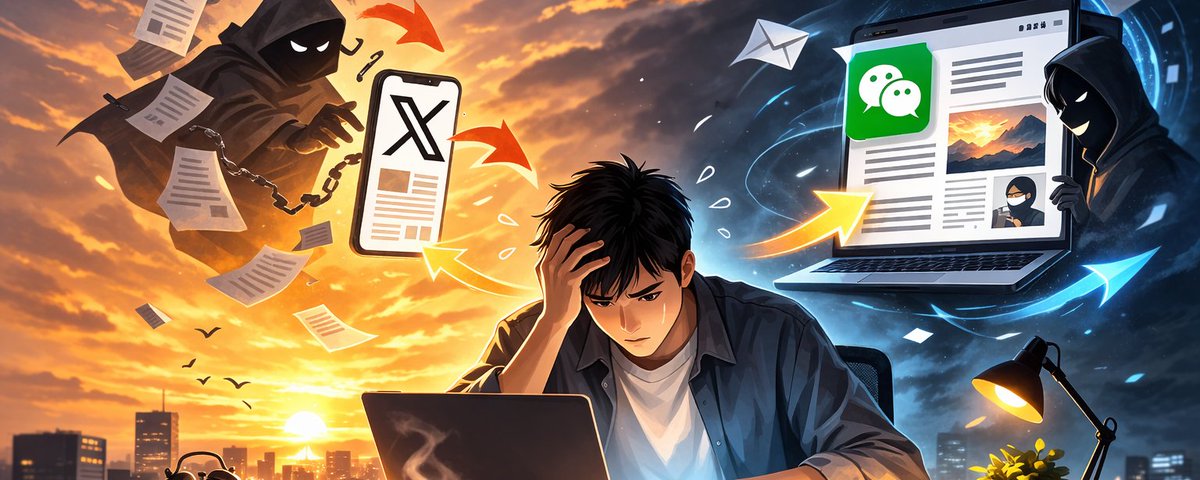
A practical strategy for creators to protect their original X (formerly Twitter) content from being highjacked by "content scrapers" on WeChat Official Accounts. The guide addresses the technical loophole where plagiarists post X content to WeChat first, triggering duplicate content filters against the original author, and offers a "silent publishing" workaround to secure digital ownership.
Key Takeaways
- The Speed Gap:** Plagiarists use automated or rapid manual scraping to move viral X posts to WeChat within an hour, blocking the original author from claiming "Original" status.
- The Support Failure:** Tencent’s automated appeal system frequently fails to recognize X as a source of truth, leaving creators with little recourse through official channels.
- The "Silent Publish" Tactic:** Creators should use WeChat’s "Publish" (发布) feature—which indexes content without notifying followers—immediately after posting on X to "timestamp" their ownership in the WeChat ecosystem.
- Manual Enforcement:** Directly messaging infringing accounts with proof of the original X post is often more effective than formal appeals, as established accounts fear platform penalties.
- Strategic Synchronization:** High-performing X content should be treated as a lead magnet for WeChat, requiring a dual-platform growth mindset rather than treating one as an afterthought.
Introduction
The following content is compiled by NOVSITA in combination with X/social media public content and is for reading and research reference only.
focus
- You spend an hour formatting and optimizing the article on
That moment… - This is my experience, and I sent the article in the morning. How embarrassing is it that something like this happened suddenly? Time is wasted, and more importantly, I have to send articles in the morning, which…
Remark
For parts involving rules, benefits or judgments, please refer to Yang Gaoneng’s original expression and the latest official information.
Editorial comments
This article “X Import: Yang Gaoneng – Guide to Preventing Articles on X from being Moved to Public Accounts” comes from the X social platform and is written by Yang Gaoneng. Judging from the completeness of the content, the density of key information given in the original text is relatively high, especially in the core conclusions and action suggestions, which are highly implementable. You spend an hour formatting and optimizing the article on The feeling at that moment cannot be summed up by the word “uncomfortable”. This is my experience, and I sent the article in the morning. How embarrassing is it that something like this happened suddenly? Time is wasted, and more importantly, the article has to be sent in the morning. This cannot be given up easily. The question is: How should we prevent it? How to stop loss? How do you stop the movers from coming again? yesterday…. For readers, its most direct value is not “knowing a new point of view”, but being able to quickly see the conditions, boundaries and potential costs behind the point of view. If this content is broken down into verifiable judgments, it will at least include the following levels: You spend an hour typesetting and optimizing the article on X on the official account, click send – and the result is: someone posted it before you, and the content, cover, and pictures are exactly the same.
At that moment…; I had such an experience, and I sent the article in the morning. How embarrassing is it that such a thing happened suddenly? Time is wasted, and more importantly, I have to send articles in the morning, which… Among these judgments, the conclusion part is often the easiest to disseminate, but what really determines the practicality is whether the premise assumptions are established, whether the sample is sufficient, and whether the time window matches. We recommend that readers, when quoting this type of information, give priority to checking the data source, release time and whether there are differences in platform environments, to avoid mistaking “scenario-based experience” for “universal rules.” From an industry impact perspective, this type of content usually has a short-term guiding effect on product strategy, operational rhythm, and resource investment, especially in topics such as AI, development tools, growth, and commercialization. From an editorial perspective, we pay more attention to “whether it can withstand subsequent fact testing”: first, whether the results can be reproduced, second, whether the method can be transferred, and third, whether the cost is affordable. The source is x.com, and readers are advised to use it as one of the inputs for decision-making, not the only basis. Finally, I would like to give a practical suggestion: If you are ready to take action based on this, you can first conduct a small-scale verification, and then gradually expand investment based on feedback; if the original article involves revenue, policy, compliance or platform rules, please refer to the latest official announcement and retain the rollback plan. The significance of reprinting is to improve the efficiency of information circulation, but the real value of content is formed in secondary judgment and localization practice. Based on this principle, the editorial comments accompanying this article will continue to emphasize verifiability, boundary awareness, and risk control to help you turn “visible information” into “implementable cognition.”
You spend an hour formatting and optimizing the article on
The feeling at that moment cannot be summed up by the word “uncomfortable”.
This is my experience, and I sent the article in the morning. How embarrassing is it that something like this happened suddenly? Time is wasted, and more importantly, the article has to be sent in the morning. This cannot be given up easily.
The question is: How should we prevent it? How to stop loss? How do you stop the movers from coming again?
Yesterday, I saw a friend’s popular X article in the group. It was moved to the official account by others and I couldn’t send it myself.
So, last night I decided to write this article.
I send articles every morning. After an hour, I optimize the layout of the articles on X on the official account. I click send and it’s over!
Someone sent it before me. I clicked it and saw that it was exactly the same as my X article. The cover image and content image were also the same.
What to do?
I post a public account article every morning.
There is really no emergency solution. I can only appeal. After all, I am the original one and everything is made by me.
As a result, I was extremely disappointed.
Because my appeal failed once, I appealed twice and failed again, and I appealed three times and failed again.
Maybe the movers will be happy to see this, but I’m angry.
Tencent’s customer service did nothing. Later, I saw a friend go to Tencent’s headquarters. He said that there were only a few people in Tencent’s customer service. Alas, I am really convinced.
I have no choice but to follow the other party’s public account and then send a message in the background: You have moved my X content, please delete it as soon as possible. And send a screenshot of X article.
Then, it’s just a hard wait. Usually the other party will delete it on the same day or the next day.
Because no one who writes a public account wants to get into trouble, especially bloggers who have good accounts. I also believe that if you continue to appeal, Tencent will definitely support it and ask the other party to delete the content or even punish the other party. This is also the main reason why movers delete articles.
Later, the article was moved by others, and after I asked “Zhang San” to delete it, the article was moved to the official account by others before my official account sent it. Alas, this is really a trick!
Inadvertently, many articles were moved to the official account. I could only follow many bloggers, contact them in the background, and ask them to delete them. In the end, everyone deleted them.
At that time, I thought, even if they delete it, someone will move it and send it later. What should I do?
So, I came up with a brilliant method.
I send an article to the official account every morning, and sometimes I send two articles on This article is not a mass post, that is, your fans cannot receive reminders of this article. If this article performs well on
A friend said that it is inconvenient to post articles on X on the official account. I don’t think it’s a big problem unless you go too far.
Anyway, my articles can be sent on both platforms without any problems. In order to better suit the platform, slight optimization is enough.
If your article on
Now, I no longer worry about someone transferring my X content to the official account, because the article is also posted on the official account. In addition, I will embed my unique content in the article. If Tencent does not take it seriously, I will use this content to ask Tencent to support me.
If you can write good content on one platform, you can most likely write it on another platform.
I know that many of my friends do poorly on their official accounts. If they don’t do well, they ignore their official accounts.
Don’t do this, you can synchronize the content to the official account.
I saw a friend who didn’t care about the official account before, but after his last article on X exceeded 10 million, he started to switch to the official account on
A truly powerful person must be able to do well on both writing platforms.
My official account has added nearly 50,000 fans in two years, and X has added 14,000 fans in the last two months.
Use content to attract people, write one article every day, write carefully, keep iterating, and keep doing it, don’t give up easily.
I wish you all friends to continue to write good articles!
source
author:Yang Gaoneng
Release time: March 3, 2026 05:29
source:Original post link
Editorial Comment
The "Dark Forest" of the Chinese internet has always been a high-friction environment for creators, but the specific friction point between X and WeChat is particularly galling. Yang Gaoneng’s account of spending an hour formatting a post only to find a scraper beat him to the "Send" button is a universal nightmare for modern writers. It’s not just about the stolen views; it’s the systemic insult of being told by an algorithm that you are the one plagiarizing your own work.
This scenario highlights a massive structural flaw in how platform "originality" filters work. These systems are designed for speed, not justice. They prioritize the first person to upload a string of text to their specific database, effectively creating a "finders-keepers" economy for content arbitrage. If you are a creator who values craft—taking that extra hour to polish a layout or find the right header image—you are effectively penalizing yourself in the race against scrapers who don't care about aesthetics, only the timestamp.
The most valuable takeaway here is the tactical use of the "Publish" (发布) versus "Broadcast" (群发) distinction on WeChat. For the uninitiated, "Broadcasting" is the traditional way to reach your followers—it sends a notification and counts toward your daily limit. "Publishing," however, is a newer, quieter action. It puts the content on the server and makes it searchable, but it doesn't "ping" your audience. By "Publishing" a draft immediately after an X post goes live, a creator effectively plants a flag in the WeChat ecosystem. It creates a digital paper trail that predates the scrapers. If the post later catches fire on X, the creator can then "Broadcast" that already-published link to their followers, safe in the knowledge that they own the "Original" tag.
There is also a sobering lesson here about the reality of platform support. The author’s frustration with Tencent’s "non-existent" customer service is a sentiment shared by millions. In an era of hyper-automation, the human element of platform governance has been hollowed out. When the "Report" button fails, you are left with "trench warfare"—manually messaging accounts, sending screenshots of your X analytics, and hoping the person on the other end has enough to lose that they’ll delete the post out of fear rather than ethics.
For senior editors and strategists, the broader takeaway is about the "liquidity" of content. In 2024 and beyond, you cannot afford to let your intellectual property sit on a single island. If your content has value, someone will find a way to port it to a different platform to capture the local attention. The only defense is a proactive offense: simultaneous distribution.
Yang’s success—gaining 50,000 WeChat followers in two years alongside a burgeoning X presence—proves that the "cross-pollination" strategy works. It’s no longer enough to be a "writer"; you have to be a distribution manager. You have to understand the plumbing of these platforms—the buttons, the filters, and the loopholes—just as well as you understand the prose. The goal is to move from a state of "hoping they don't steal it" to a state of "making it impossible for them to claim it." It’s a cynical way to look at creativity, perhaps, but in a digital landscape where speed is the only currency the algorithms respect, it’s the only way to survive.