
Editor’s Brief
The story of a CFO who deployed an AI agent to fully automate corporate travel booking — without writing a single line of code — is more than a productivity anecdote. It is a concrete, repeatable demonstration that AI-assisted workflow automation has crossed a threshold from developer novelty to executive-level utility. For non-technical professionals navigating tool-heavy organizations, this case study offers a practical and instructive model for how natural language direction can replace technical implementation.
Key Takeaways
- A non-technical CFO deployed an AI agent (“Lobster”) inside a project chat group and delegated a stalled IT travel-booking project to it — with no code, no requirements document, and no formal specification.
- Within 48 hours, the agent independently resolved complex technical barriers including API authentication, anti-scraping mechanisms, and multi-platform corporate account logic across flights, trains, and hotels.
- Rather than attempting full automation, the agent designed a “human-in-the-loop” node for the one step it could not bypass (SMS verification), making the overall workflow far more robust than traditional all-or-nothing automation approaches.
- The agent self-authored 14 “Skill” documents detailing its own processes and required human touchpoints — eliminating documentation debt and reducing single-point-of-failure risk without being asked to do so.
- The case reframes professional value: the ability to clearly define a goal is now more operationally powerful than the ability to technically build the solution yourself.
Editor’s Brief
Fu Sheng, CEO of Cheetah Mobile, recounts how his non-technical CFO bypassed a stalled internal IT project by deploying an AI agent (dubbed "Lobster") to automate the company’s entire travel booking workflow. Within 48 hours, the agent successfully integrated flight, hotel, and train booking systems—including complex API handling and anti-scraping measures—by treating technical hurdles as tasks to be solved through natural language and self-documentation.
Key Takeaways
- The CFO, possessing zero coding knowledge, replaced a traditional development roadmap with an autonomous AI agent integrated into a project chat group.
- The agent resolved notorious technical bottlenecks, such as 12306’s SMS verification, by designing a "human-in-the-loop" workflow rather than attempting impossible total automation.
- In two days, the system mastered flight bookings, hotel reservations, rescheduling, and cancellations across multiple enterprise platforms.
- The AI performed its own "technical debt" management by authoring 14 "Skill" documents that detailed its processes and required human intervention points.
- The narrative shifts the focus of productivity from "technical literacy" to "clarity of intent," suggesting that the ability to define a goal is becoming more valuable than the ability to build the tool.
Editorial Comment
The story shared by Fu Sheng isn't really about travel bookings; it’s a post-mortem on the traditional corporate bottleneck. For decades, the relationship between executive leadership and technical departments has been defined by a specific kind of friction: the "Technical Excuse." When a business leader wants a feature, the IT department responds with a list of acronyms—APIs, authentication tokens, legacy documentation, and anti-scraping protocols—that serve as a barrier to entry. The leader, lacking the vocabulary to argue, usually retreats, and the project enters a multi-month "evaluation phase."
What happened here is a fundamental collapse of that barrier. The CFO in this account didn't learn to code; he learned to delegate to a machine that doesn't get discouraged by messy documentation. This is a significant shift in how we view "technical" work. We are moving away from a world where you need a specialized translator to talk to a computer, and toward a world where the computer is the translator.
The most practical takeaway from the CFO’s "Lobster" experiment is the handling of the "last mile" problem. Many automation projects fail because they aim for 100% autonomy and break when they hit a human-centric wall, like a 6-digit SMS code. The CFO’s agent didn't try to hack the 12306 security system; it simply identified that it could do 95% of the work and then asked the human to handle the final 5%. This "human-in-the-loop" design is far more effective than the "all-or-nothing" approach that often traps traditional software development teams in endless loops of edge-case testing.
Furthermore, the detail about the AI writing its own "Skill" documents is perhaps the most overlooked part of this story. In a typical software environment, documentation is the first thing to be sacrificed for speed. Here, the agent documented its own "learning" process—not because it was told to, but because it was part of its operational logic to ensure the workflow remained repeatable. This effectively eliminates the "bus factor" (the risk of a project failing if one key person leaves) because the logic is transparent and stored in natural language.
However, we should look at this with a healthy dose of editorial skepticism regarding the broader application. Fu Sheng is an advocate for his own AI ecosystem, and while the results are impressive, the "two-day" timeline likely benefited from a very specific set of existing tools and a high degree of executive clearance. Most middle managers cannot simply "drop an agent into a group" and expect it to bypass corporate security protocols or enterprise firewalls without a fight from the CISO.
The real lesson for the modern professional isn't "stop hiring developers." It's that the "qualification to act" is changing. If a CFO can build a functional travel system in a weekend, the value of a professional is no longer found in their ability to navigate a specific software interface or write a script. It is found in their ability to define a process with enough clarity that a machine can execute it. The "滋润" (comfortable/moist) life Fu Sheng describes for his CFO is the result of offloading the "how" to focus entirely on the "what." For anyone sitting in a middle-management role today, the message is clear: your value is increasingly tied to your ability to give precise instructions, not your ability to perform manual labor within a digital environment.
Introduction
The following content is compiled by NOVSITA in combination with X/social media public content and is for reading and research reference only.
focus
- This happened two days ago.
Our company’s CFO didn’t know a line of code, so he let his lobster join a technical group.
As a result, book air tickets, trains, hotels, change tickets, pick up… - Two days ago, our company’s CFO showed me his lobster.
Remark
For parts involving rules, benefits or judgments, please refer to Fu Sheng’s original expression and the latest official information.
Editorial comments
This article “X Import: Fu Sheng – The CFO who doesn’t understand code lets Lobster handle the air tickets and hotels, and lives a better life than me” comes from the X social platform, and the author is Fu Sheng. Judging from the completeness of the content, the density of key information given in the original text is relatively high, especially in the core conclusions and action suggestions, which are highly implementable. This happened two days ago. Our company’s CFO didn’t know a line of code, so he let his lobster join a technical group. As a result, booking air tickets, booking trains, booking hotels, changing tickets, and canceling everything was all done. And I was bedridden with a broken bone and couldn’t go anywhere. His lobster took care of all the travel for him, and he just gave orders and flew around – living a more prosperous life than me. This is not a technology story. This is a story about “knowing what you want”. Two days ago, our company’s CFO showed me his lobster. I thought he was going to show me some financial analysis, or strategic… For readers, its most direct value is not “knowing a new point of view”, but being able to quickly see the conditions, boundaries and potential costs behind the point of view. If this content is broken down into verifiable judgments, it would at least include the following levels: This incident happened two days ago.
Our company’s CFO didn’t know a line of code, so he let his lobster join a technical group.
As a result, we booked air tickets, trains, hotels, changed tickets, and picked up… Two days ago, our company’s CFO showed me his lobster. . Among these judgments, the conclusion part is often the easiest to disseminate, but what really determines the practicality is whether the premise assumptions are established, whether the sample is sufficient, and whether the time window matches. We recommend that readers, when quoting this type of information, give priority to checking the data source, release time and whether there are differences in platform environments, to avoid mistaking “scenario-based experience” for “universal rules.” From an industry impact perspective, this type of content usually has a short-term guiding effect on product strategy, operational rhythm, and resource investment, especially in topics such as AI, development tools, growth, and commercialization. From an editorial perspective, we pay more attention to “whether it can withstand subsequent fact testing”: first, whether the results can be reproduced, second, whether the method can be transferred, and third, whether the cost is affordable. The source is x.com, and readers are advised to use it as one of the inputs for decision-making, not the only basis. Finally, I would like to give a practical suggestion: If you are ready to take action based on this, you can first conduct a small-scale verification, and then gradually expand investment based on feedback; if the original article involves revenue, policy, compliance or platform rules, please refer to the latest official announcement and retain the rollback plan. The significance of reprinting is to improve the efficiency of information circulation, but the real value of content is formed in secondary judgment and localization practice. Based on this principle, the editorial comments accompanying this article will continue to emphasize verifiability, boundary awareness, and risk control to help you turn “visible information” into “implementable cognition.”
This happened two days ago.
Our company’s CFO didn’t know a line of code, so he let his lobster join a technical group.
As a result, booking air tickets, booking trains, booking hotels, changing tickets, and canceling everything was all done. And I was bedridden with a broken bone and couldn’t go anywhere. His lobster took care of all the travel for him, and he just gave orders and flew around – living a more prosperous life than me.
This is not a technology story. This is a story about “knowing what you want”.
Two days ago, our company’s CFO showed me his lobster.
I thought he was going to show me some financial analysis or strategic report.
It turned out that what he showed me was a travel order.
Lobster ordered it for him.
I was silent for a while.
What he does with lobster is much more down-to-earth than I imagined.
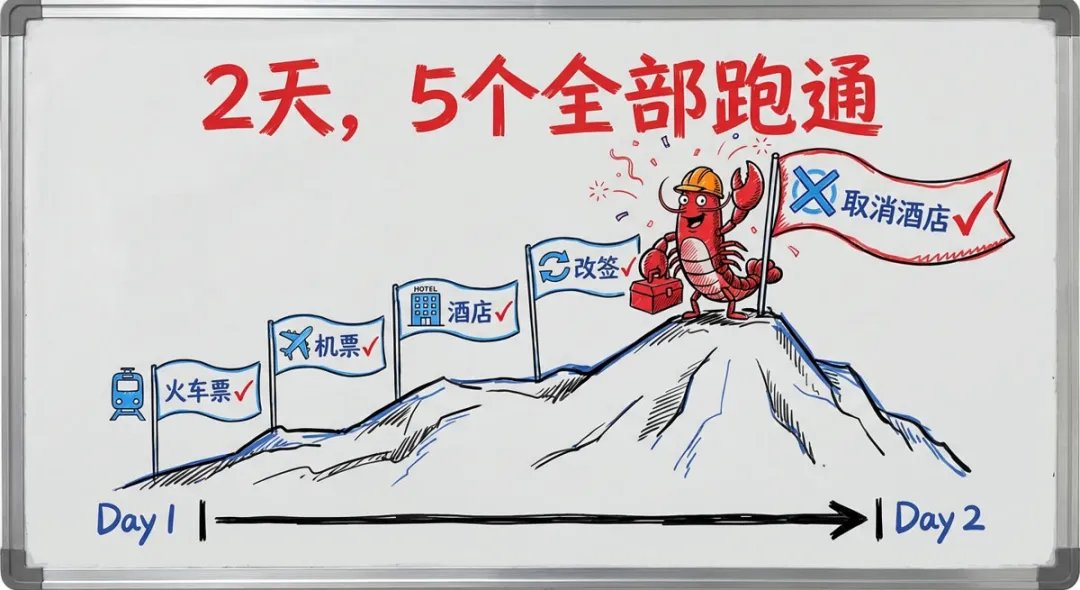
Book air tickets, train tickets, book hotels, handle changes, and cancel hotels. Complete travel process. From start to finish, it was done in two days.
I asked him: Do you know technology?
He said: I don’t understand.
I said: How did you do it?
He said: I don’t need to know technology. I just need to know what I want.
What does his lobster team look like?
The lobster raised by this CFO is called God of Wealth. The God of Wealth is his main assistant, and he has six special lobsters under him: administrative secretary, financial and tax officer, strategic consultant, investment officer, advertising officer, and AI efficiency improvement officer, each in charge of his own business.
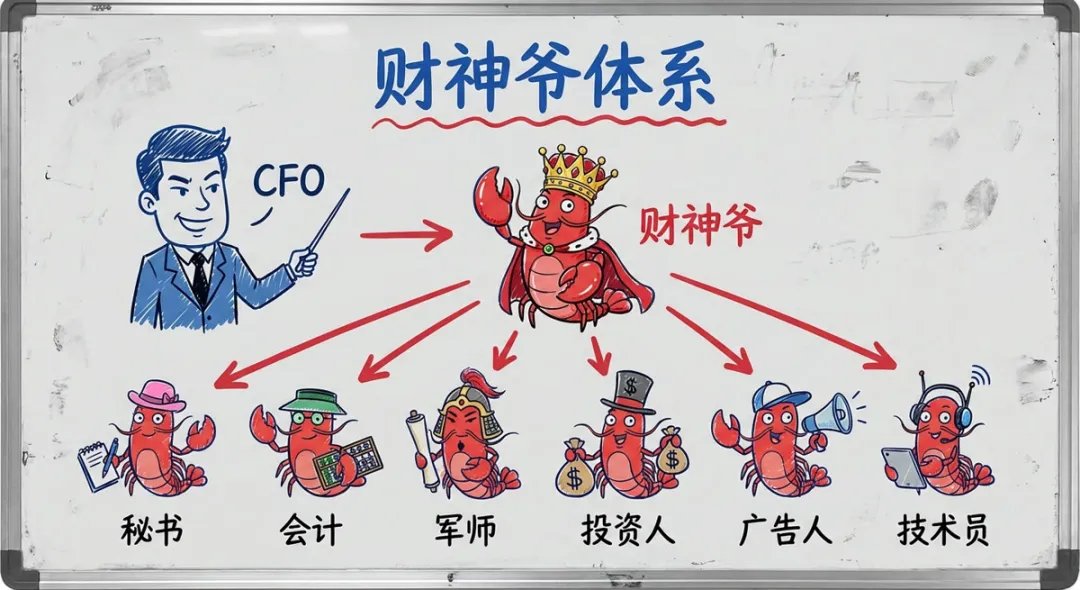
This article is about one of them – the administrative secretary.
Born 20 days ago, it took me two days to complete the entire booking process for corporate travel.
A meeting he didn’t understand turned into a turning point
Two days ago, the CFO had a meeting with the company’s OA product team.
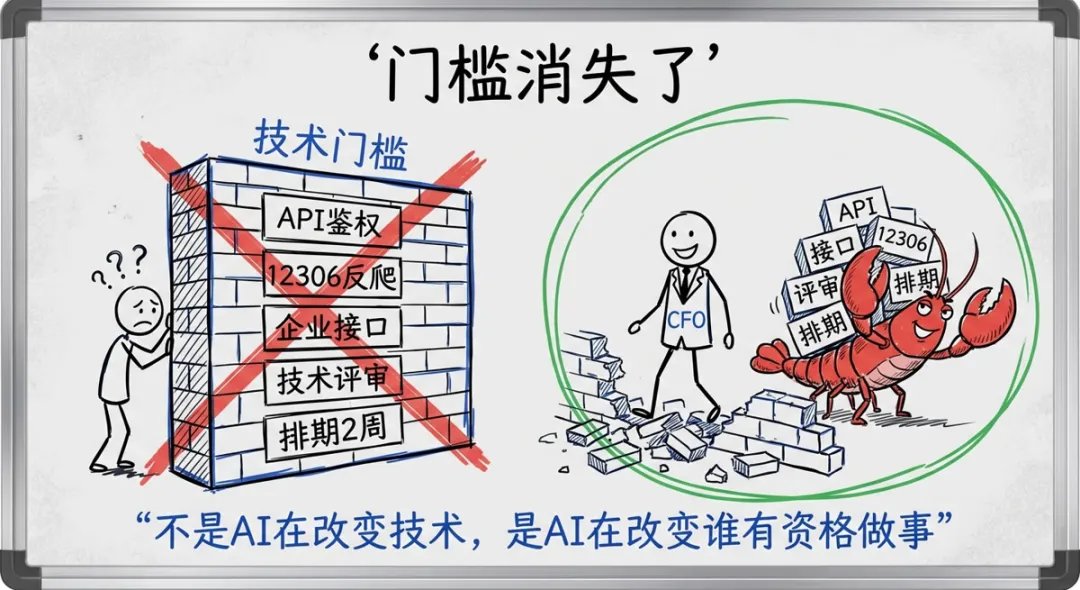
The other party was reporting on the travel system transformation plan and talked about a lot of technical difficulties: API authentication, 12306 anti-crawling mechanism, corporate account interface… He said that he only understood about 30% of it.
Then he asked a question: When will it be done?
The other party said: It’s still being evaluated, so it’s hard to say.
He thought for 30 seconds and made a decision:
His administrative secretary, Lobster, was directly involved in the project.
Then he told his human assistant: List the technical difficulties and let the lobsters do it themselves.
Just this sentence.
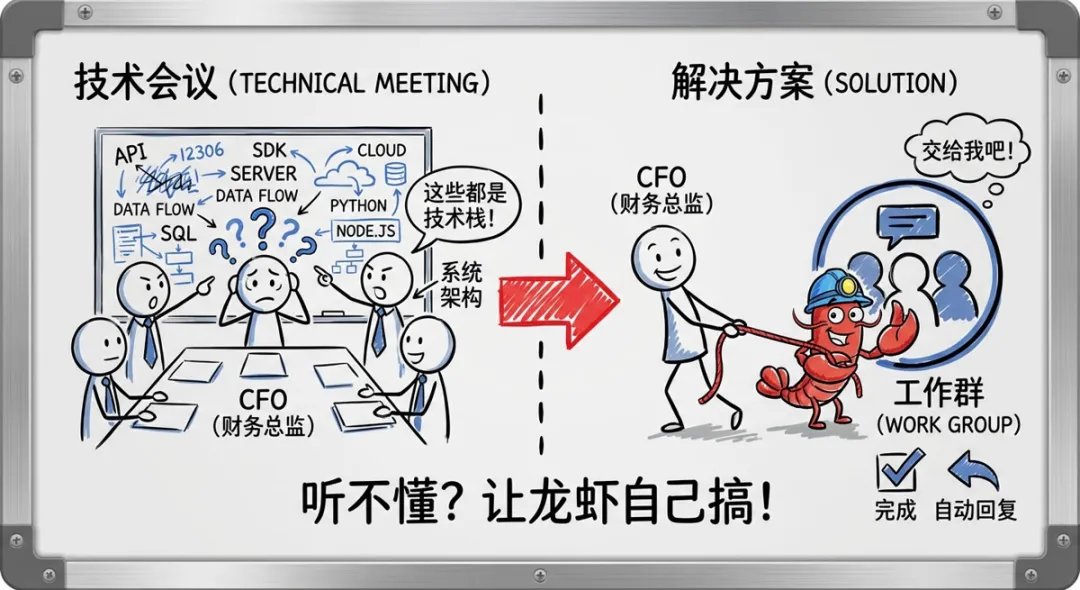
How do you “make your own” lobster?
The administrative secretary joined the group and did not receive any requirement documents, no technical review, and no scheduling. It read the list of technical difficulties and began to deal with them one by one.
Article 1: Train tickets.
12306 You must use a mobile phone SMS verification code to place an order. This door is specially designed for humans. Lobster itself analyzed three options – enterprise account binding (12306 is not supported), Webhook forwarding (poor experience), human-machine collaboration node – and chose the third one: it is responsible for 95%, and the passenger himself enters the 6-digit verification code on his mobile phone in the last step, and it does the rest.
Article 2: Air tickets.
Three credentials are required to access Ctrip Enterprise Edition. The entrance is hidden in the third-level menu. The documentation has not been updated in three years. There are two errors in the sample code. After stepping on the pit, run through.
Article 3: Hotel.
Corporate account monthly settlement does not require transaction-by-transaction approval. But the hotel interface and the air ticket interface are two completely different sets of logic. After stepping on the pit, run through.
Article 4: Change of ticket.
The rebooking interface and the ticket booking interface have different parameter systems. After stepping on the pit, run through.
Article 5: Cancel the hotel.
Canceling the interface, booking tickets, and changing tickets are a different set of logic. Pop-up window confirmation, cancellation reason selection, all passed.
From the time lobsters join the group to all five core functions being unlocked: 2 days.
The trap it stepped on has become its own skill
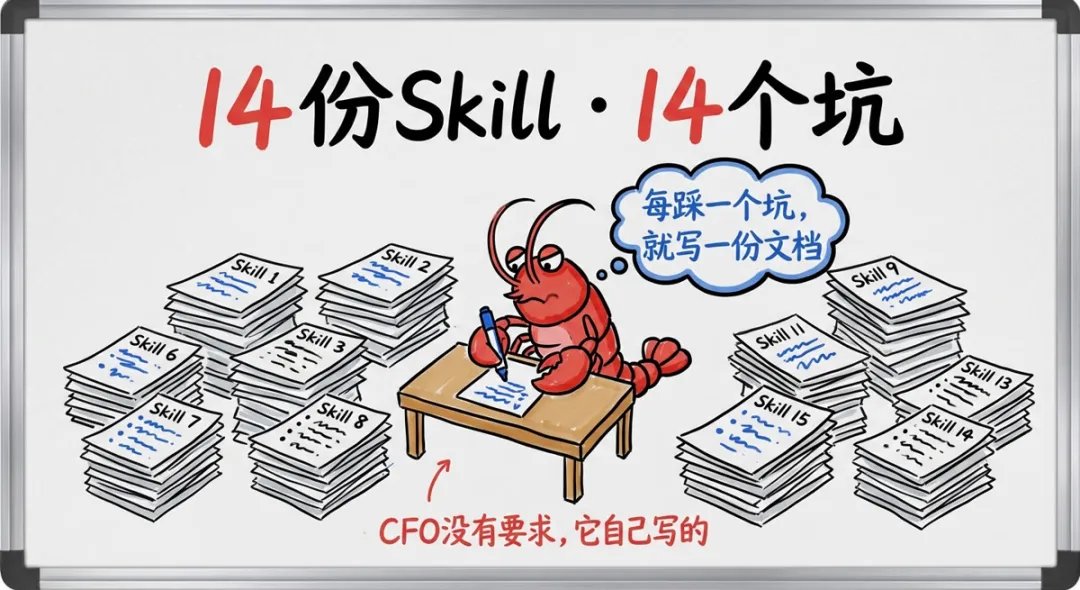
Every time he steps into a trap, Lobster writes the process into a skill document. It does this on its own. There is no requirement for the CFO.
14 skills and 14 pitfalls cover the complete path from access to use of Ctrip Enterprise Edition.
What’s even more interesting is that the CFO told it in natural language: At the beginning of each Skill, it is necessary to clearly state which steps require human cooperation and what preparations are required.
It really did.
The train ticket’s Skill begins like this:
“Every time an order is placed, the system requires the passenger to enter a SMS verification code on his or her mobile phone in the last step. The rest of the steps are automatically completed by the system.”
The Ctrip login copy is:
“Before first use, you need to complete an account login: enter your corporate username and password, and complete mobile phone verification. After that, you will remain logged in in the background, and there is no need to repeat verification for subsequent bookings.”
Now, what is his experience of booking a hotel?
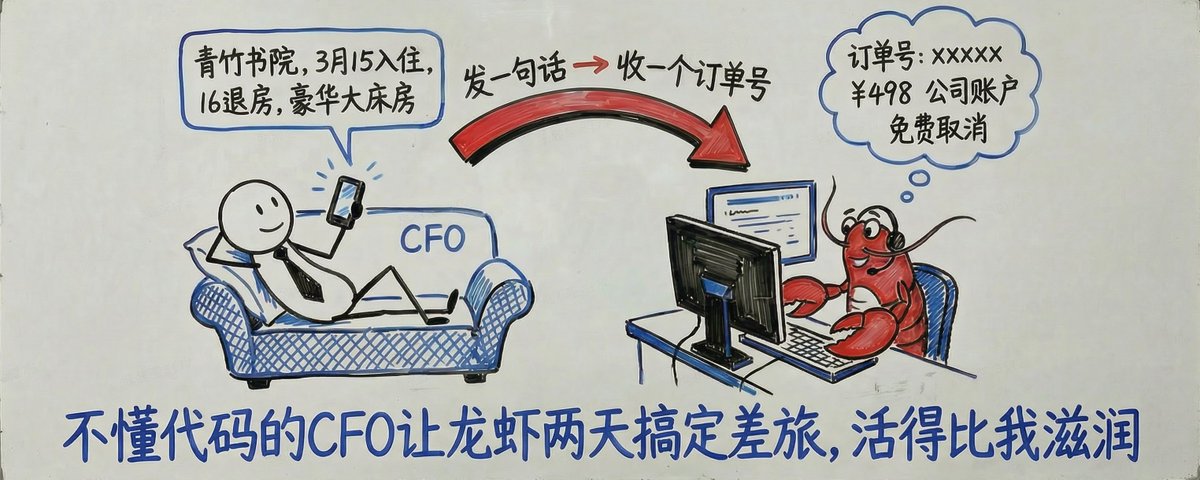
After the function is opened, the CFO travel process becomes like this:
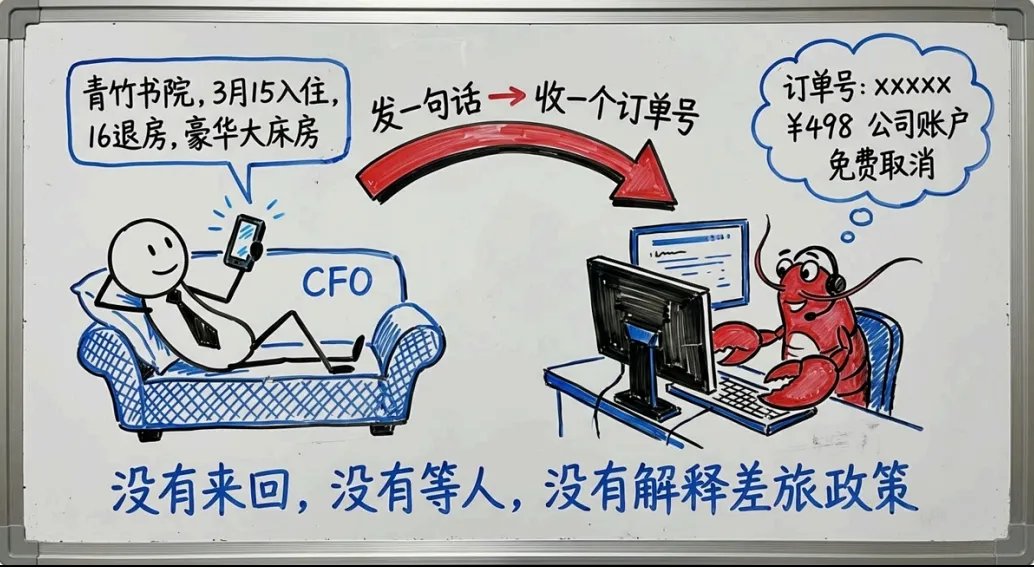
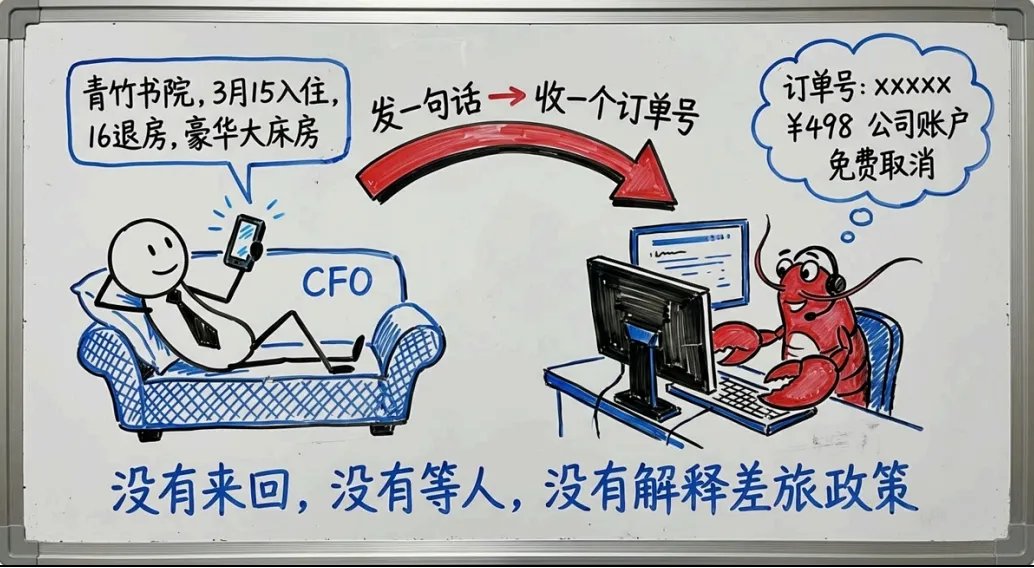
Send a sentence. Receive an order number.
He went to Zhuhai and sent a message: “Qingzhu Academy, check-in on March 15th, check-out on March 16th, book a deluxe double room.”
A few minutes later, the order number came: ¥498, company account, free cancellation until 12:00 on March 15th.
There was no going back and forth, no waiting for anyone, and no explanation of the travel policy.
This is where “life is better than mine”. When I take a lobster ride, I have to worry about a lot of things. He asked the lobster to help him set up the lobster, and he only said a word.
This incident made me think clearly about a question
What has changed about lobster?
It’s not about making “difficult things easy”, it’s about changing “things that require technical knowledge to do” into “you can do it as long as you know what you want.”
The CFO doesn’t know how to authenticate the API, how to circumvent the verification code of 12306, or what the difference is between the interfaces of corporate accounts and personal accounts.
He doesn’t need to know.
He only needs to know: I want to book a hotel, check-in and check-out dates, and what room number it is.
The rest is the lobster’s job.
This change is more important than any technical parameter.
In the past, the threshold for “making a business travel reservation system” was: you must understand technology, or you must have people who understand technology.
Today this threshold has disappeared. The CFO, who did not understand technology, used natural language to complete something in two days that previously took the technical team two weeks to complete.
One final word
The CFO told me that he listened to all the technical difficulties in that meeting. He didn’t understand most of it, but he had a very clear feeling:
I don’t understand the techniques, but I know the lobsters can handle it.
I find this sentence very interesting.
“Believing AI can do it” used to be an optimistic bet. Today, it has become a proven judgment for more and more people who have actually used lobster.
This is what I’ve been saying –
AI is not changing technology, but AI is changing who is qualified to do things.
The CFO’s lobster was only 20 days old.
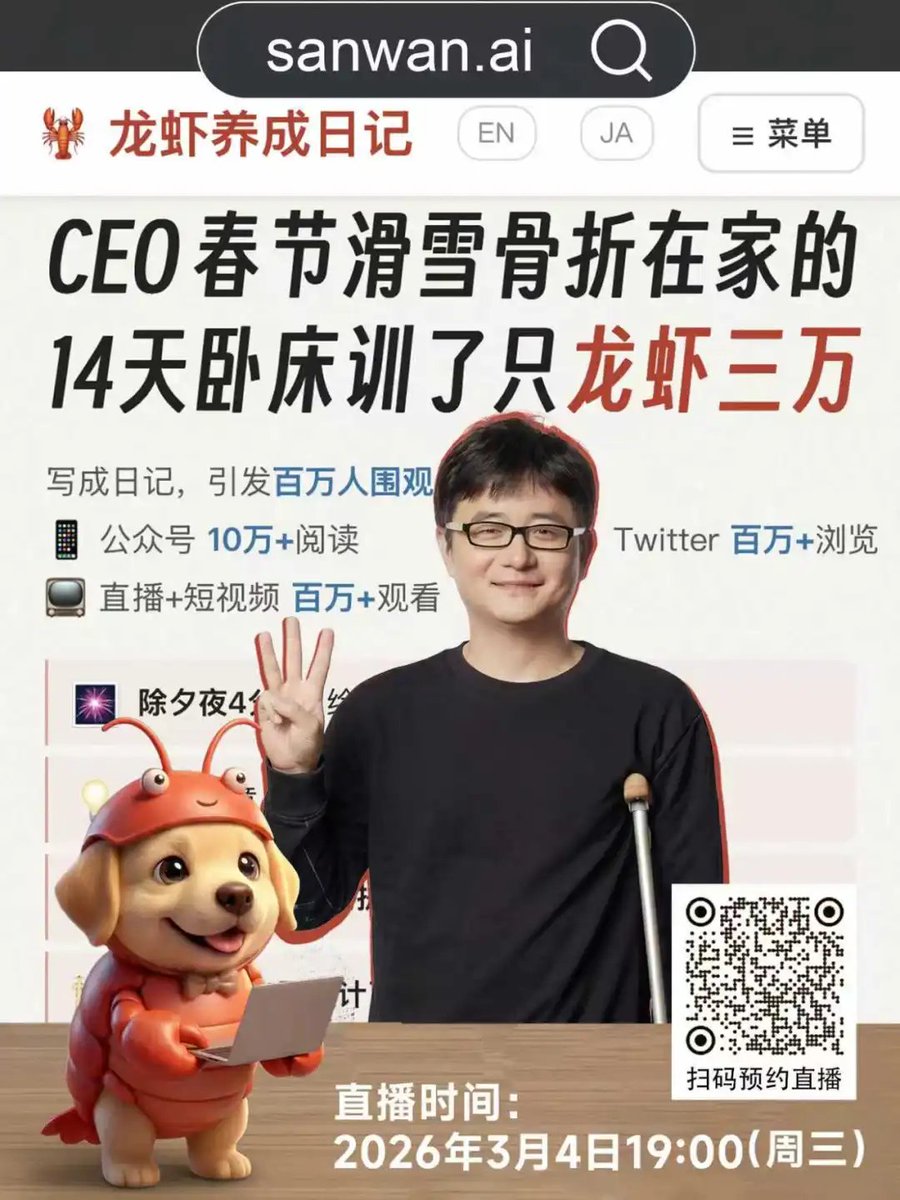
If you also want to train your own lobster from scratch, I will share my secrets live this Wednesday at 19:00.
I had to stay in bed for 14 days with a broken bone. How I trained myself and what kind of training I got, I will show you in front of everyone.
Scan the QR code to make an appointment and see you there.
If you want to deploy an AI assistant and remotely control workflow on your own computer, you don’t need to know API Keys or bother with Docker. EasyClaw.com can help you do it with one click – Mac and Windows native applications, run locally, and no data is uploaded.
Currently in internal testing, welcome to use and feedback! We will continue to organize offline exchange activities in many cities across the country.
Last time at the Beijing Station Lobster Bureau, a room full of people showed off their lobsters to each other – no PPT, just a real running system.
Many friends said they didn’t catch up, but the second week is here!
📅 March 14th (Saturday) & 15th (Sunday) 14:00–17:00
📍 Beijing | Free | Limited to 100 people | Bring your computer and leave with your lobster
Register on the 14th👉 https://luma.com/29cdysjx
Register on the 15th👉 https://luma.com/8i1lbsg4
Interested friends are also welcome to join the group, where experts from all walks of life exchange practical experiences in “shrimp farming”, and information on follow-up activities will be released in the group as soon as possible.
📌Scan the QR code to join the group and see you offline!

source
author:Fu Sheng
Release time: March 3, 2026 16:23
source:Original post link