
Introduction
The following content is compiled by VIPSTAR in combination with X/social media public content and is for reading and research reference only.
focus
- I have been in Barcelona on business for the past two days.
- I finally persisted in keeping a diary for several days.
Remark
For parts involving rules, benefits or judgments, please refer to the original expression and latest official information of Digital Life Kazik.
I have been in Barcelona on business for the past two days.
I finally persisted in keeping a diary for several days.
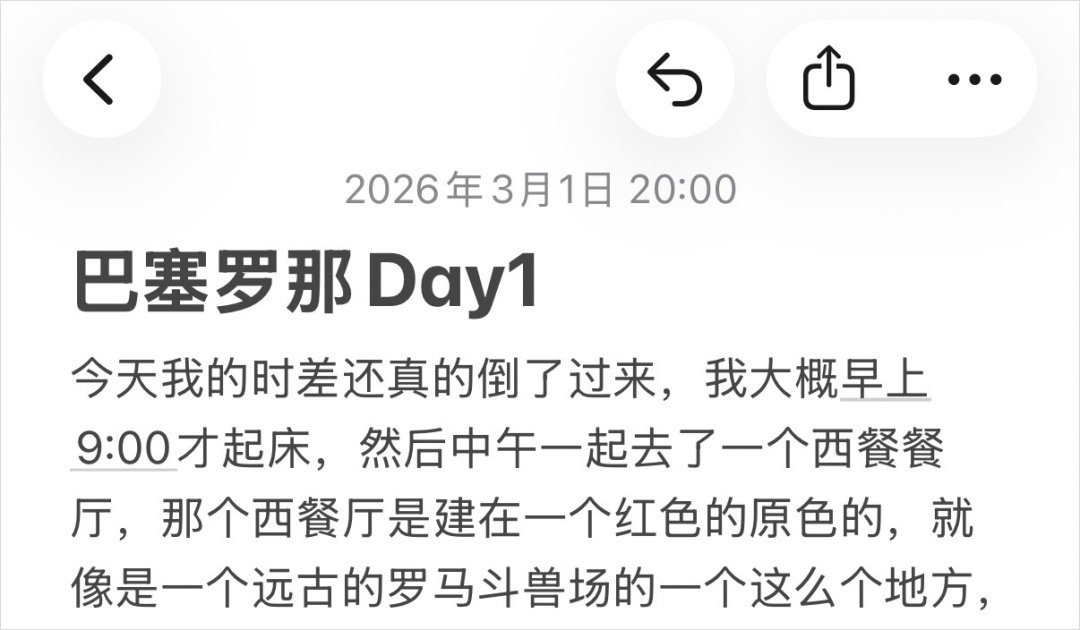
I have always had the idea of starting a diary before, and I have written some intermittently, but I have not persisted. But now, what really made me start to rethink my diary are two people.
One is Ma Boyong.
On December 28, 2024, he decided to start writing a diary again.
For someone like him who writes stories until they take off, he can actually say that my brain is the best hard drive. However, he chose to keep a diary honestly. The reason is also very simple, because memory is unreliable and time is too dense.
The other is Luo Zhenyu.
He started recording a video diary every day on the sixth day of the Lunar New Year, facing the camera as if chatting with friends, expressing his daily thoughts and emotions and keeping them in his files. At that moment, you will realize directly that there are some things that if you don’t leave them on the spot, you won’t be able to get them back in two days.

One of them has been telling stories for half his life, and the other has been making content for half his life. Although they already have strong improvisational expression skills, they are both seriously making up for this lesson and the lesson of recording.
I want to make a point.
In the AI era, diary is the true anchor of your existence in this world.
I actually thought about it carefully these past two days, and I found that in the past three years, I have experienced too many things, met too many people, and had too many ideas, but very few of them have really been left behind.
I looked through my chat history, my circle of friends, and my memos, but I could find very few fragments.
Most of the days passed like this, flowing away like water without leaving even a water stain.
Do you think I’m busy? It was so busy that I took off. Do you think I am producing content every day? Yes, official accounts are being written, videos are being shot, live broadcasts are being done, and companies are opening up. I output a lot of stuff, but to be honest, those are for others to see, and they are content that I think is valuable to others.
What about my own?
The things I have experienced myself, those nights when I was still in tears at six in the morning, those moments when I was sitting alone in a car in a daze after arguing with others until my face turned red, those moments when I was suddenly hit by a message from a reader, and I burst into tears but held back. These things, it seems, are nowhere to be found now.
It’s not that they are unimportant, but I think they are too routine and not worth remembering.
But now I think it’s wrong.
It is precisely those things that you think are too everyday, which are the evidence that you have truly lived in this life.
Yesterday afternoon I came out of the hotel from the Glory press conference and walked on the streets of Barcelona. On Sunday, all the shops on the street were closed, because Spain is closed on Sundays. Even the shops are closed on Sundays. The streets were very quiet. Occasionally, people walked their dogs, and some people sat on the benches on the roadside to bask in the sun. Next door is the Camp Nou stadium, Barcelona’s home stadium, but it is being renovated.
Then several birds flew overhead.
I told my friend: Damn, this big bird is pretty good-looking.
My friend said: That’s not a big bird, it’s a seagull. We’re not very far from the sea.
At that moment, I suddenly felt a long-lost sense of tranquility.
A sense of tranquility away from AI and hustle and bustle.
That kind of feeling cannot be given to me by any photo, any text, or any AI-generated content.
I didn’t choose that seagull to fly by at that moment. I didn’t plan what I wanted to feel at that moment, but that thing hit me at that moment.
At that moment, I felt that I needed to record what I saw and felt today, and record my life this day.
My recording method is based on Ma Boyong’s, which is very simple.
Just follow the style of “Yuemantang Diary”:
Every detail must be written down, jade and scraps of gold accumulated, a few examples a day, one thing at a time, what books I read, who I met, and what I encountered were all recorded directly on a daily basis. The most important thing is to record things, followed by discussion.
In human terms, write more facts, record them one by one, and only record facts and insights.
So, how exactly do you get started?
I know that at this point, some people may start to think that I understand all the principles you said, but I am just lazy. It is too troublesome to write a diary every day. What should I do if I can’t persist?
To be honest, I’m worried that I won’t be able to hold on.
So in the past two days, I have studied a plan that has a very low threshold for me, and it can also exercise my expressive skills. It is a combination of Ma Boyong and Luo Zhenyu. I feel good at the moment and the cost is extremely low. I would like to share it with everyone.
The core principle is just one:
Speak, don’t write.
When many people hear the words “keeping a diary”, the picture that comes to their mind is of sitting at a desk, opening a notebook or document, and typing word by word. This picture itself brings huge psychological pressure.
Don’t do this.
When you have something you want to remember, you take out your phone, open Notes, switch to voice input, and start talking.
You don’t need to use any so-called AI products, and you don’t need to make some messy and complicated notes. Just use your mobile phone memo.
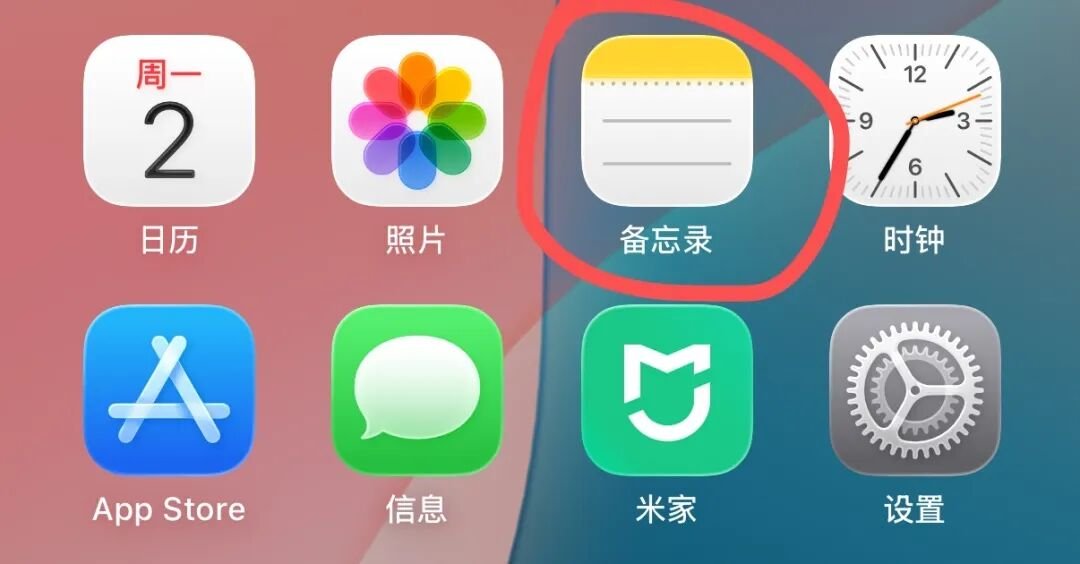
Being able to persist is the most important thing.
Open the memo, just like you send a voice message to a friend. Say what comes to mind. “What did you do today? Who did you meet? There’s something that annoys me…” That’s it. After two or three minutes of speaking, the voice was automatically converted into text.
The voice input method I use now is the beanbao input method, and the voice recognition is the most accurate so far.
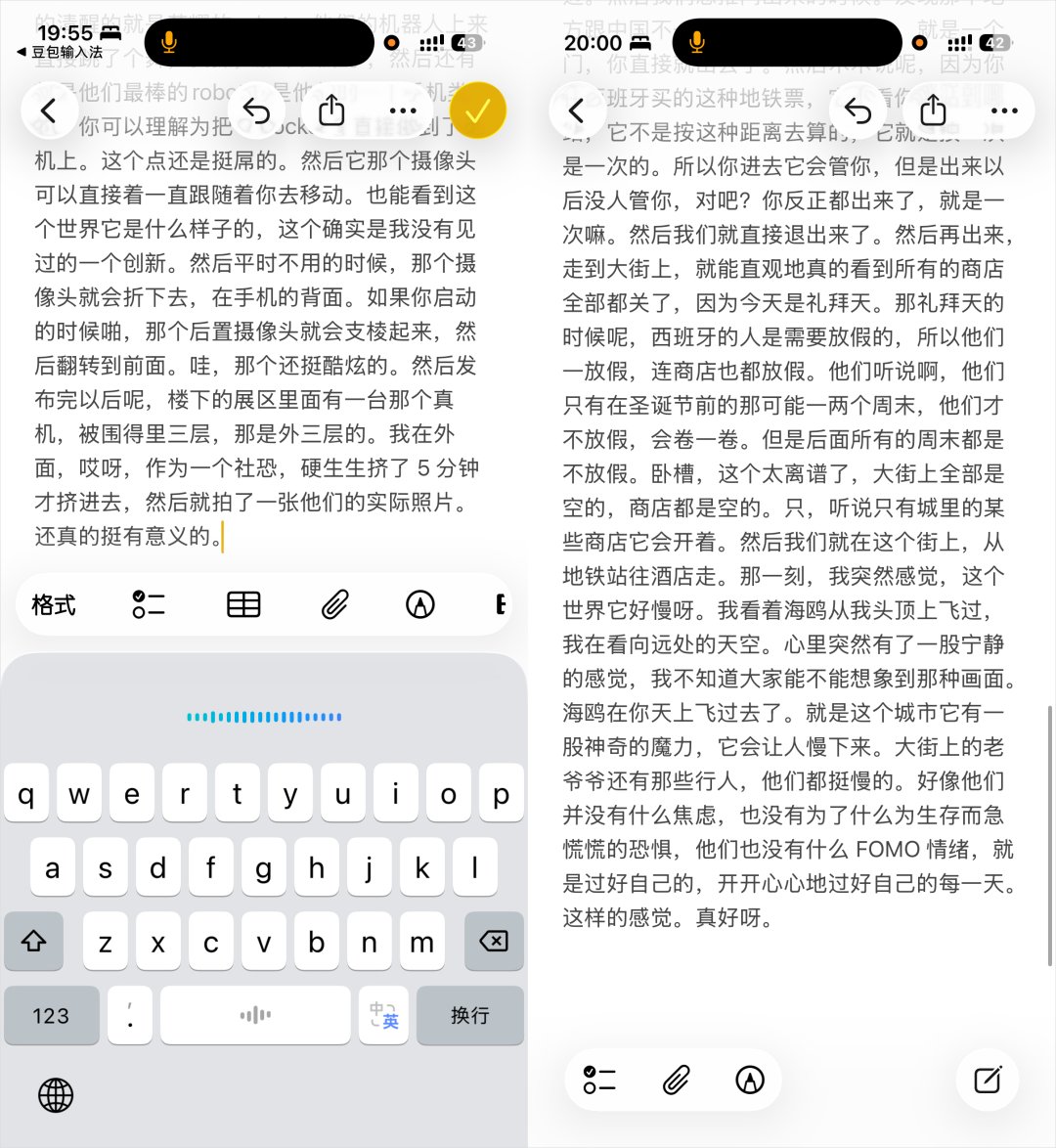
This is not an advertisement, but this is indeed one of the few voice input methods that can accurately recognize words such as Pocket 3, FOMO, and Gemini.
You must speak, don’t write.
There is a fundamental difference between dictation and typing in the matter of diary.
I type a lot, so one thing I know very well is that when you actually type, you are not just recording your thoughts, you are also editing your thoughts.
You typed a sentence and you feel it doesn’t make sense, delete it and rewrite it.
You want to express a feeling, but after typing it you feel it’s too pretentious, so change it to a more restrained version. For example, you originally wanted to write “That bad pen really pissed me off today”, but halfway through typing, you felt that it was too emotional, so you changed it to “There was some friction when communicating with XX today.”
When typing, there is an editor working in real time in your brain, which will help you polish, trim, beautify, and restrain.
This editor is useful when you write a public account or write a lot of external content, but when you write a diary, it is your worst enemy.
And when you hold down the voice button and start speaking, you don’t have time to edit, the words have already been spoken. You can’t delete them and start over like typing. You can only speak forward.
Moreover, speaking is much faster than typing, which can greatly reduce your time. At the same time, it can also exercise your language expression skills. Many of us are actually not good at speaking.
My current habit is that if it is convenient during the day, I will open the memo anytime and anywhere to record the facts and feelings at the moment. When I am lying in bed and getting ready to go to bed at night, I will open the memo, press and hold the voice button, make up for what I did not remember today, and then say a few words casually, and I will finish it in three to five minutes at most.
And sometimes, you will find a very interesting phenomenon. It’s just that you thought you had nothing to say today, but once you started talking, you couldn’t stop talking.
When it comes to diaries, I actually think the biggest enemy is the sense of ritual. Once you add a sense of ritual to it, I think its death is not far away.
Of course, many people will also ask whether I should use those AI polishing methods to optimize my diary.
My recommendation is, don’t.
The value of a diary does not lie in the quality of the writing, but in the authenticity of the writing.
Your records that are not fluent, have grammatical errors, are inconsistent, and even contain typos are your truest state. They are like recordings, recordings that will not be modified. If you play them back decades later, you can still hear the heartbeat at that time.
But if you let AI help you beautify it, it is no longer a recording, it is a cover. The key is accurate and the timbre is good, but it is no longer your voice.
Of course, I think it’s OK to just eliminate the pure oral habit of um um ah ah ah.
There is another correct use of AI that I think is particularly good, which is review.
You can throw your diary for this week or month to Claude and let it do a monthly review for you. It will help you discover some patterns that you are not aware of. For example, you are at your lowest mood every Wednesday. For example, you become anxious when a certain project is mentioned. For example, you have actually done a lot of things this month but always feel that you have done nothing.
This usage is very good, because the role of AI here is not to help you polish the content, but to help you read and summarize, and to help you find clues from those messy records.
But the premise is that the original material must be your own.
If even the original materials are written by AI, then AI doing the review for you will be like AI reading what it wrote itself, and you will not be involved in the whole chain at all.
Finally, I still want to say something.
The significance of keeping a diary in the AI era.
In the AI era, diary may not just be a matter of good habits.
It’s becoming a necessity, and one that’s more costly the later you realize it.
Luo Zhenyu mentioned a sentence in his video diary, which was written by the writer Liu Heng.
“After artificial intelligence can replace almost all human expression, the only thing that will survive is the unique expression of individual human beings about their lives.”
I have been working on AI content for three years, and I probably know better than most people what AI can do.
I have used AI to write strategic plans, do data analysis, create video scripts, and build automated processes. Even various SOPs within the company are built based on various skills.
AI is too strong, how strong is it? It’s so powerful that sometimes I can’t even tell which part of a paragraph I wrote is what I really want to say, and which part is driven by the AI’s thoughts.
This feeling was subtle at first, and then became more and more obvious.
Once I was talking to Claude about an angle for selecting a topic. I thought the angle it gave was very good. It was indeed something I had never thought of before, so I used it. The data in the final article was indeed pretty good, and everyone praised it.
But, if you think about it carefully later, how much “I” is there in that article?
In other words, what do “I” and “you” refer to? Why do you think you are “you”?
After thinking about it for a while, the answer is actually very simple.
Because you remember.
You remember your name, your experiences, your preferences, the people you loved, the mistakes you made. These memories are strung together to form a coherent story, and this story is “you”.
But now, when AI can help you write articles, help you think of opinions, help you make decisions, and help you analyze emotions, what really belongs to “you”?
Did you come up with your opinions yourself, or was AI sorted out for you? Is your writing style your own, or was it polished by AI for you? Is your aesthetic cultivated by yourself, or is it fed by an algorithm?
When you think about it, these questions become increasingly difficult to answer.
What’s your opinion? AI can output more comprehensively than you can.
your knowledge? AI crushes you.
Your ability to express yourself? AI can imitate your style and get more and more like it.
Your aesthetic? AI can analyze your preferences and then feed you what you like. As a result, many people’s aesthetics are now being shaped by information cocoons and algorithms.
So in this era where everything can be generated, what do you have left as a person?
People will get lost.
Therefore, I feel that we need to find an anchor in this real world, and the best way to anchor this is to keep a diary.
The unrecorded life is, in a sense, the life that never happened.
A thousand years ago, there was a palace maid in Japan named Seishonagon who wrote a book called “Pillow”.
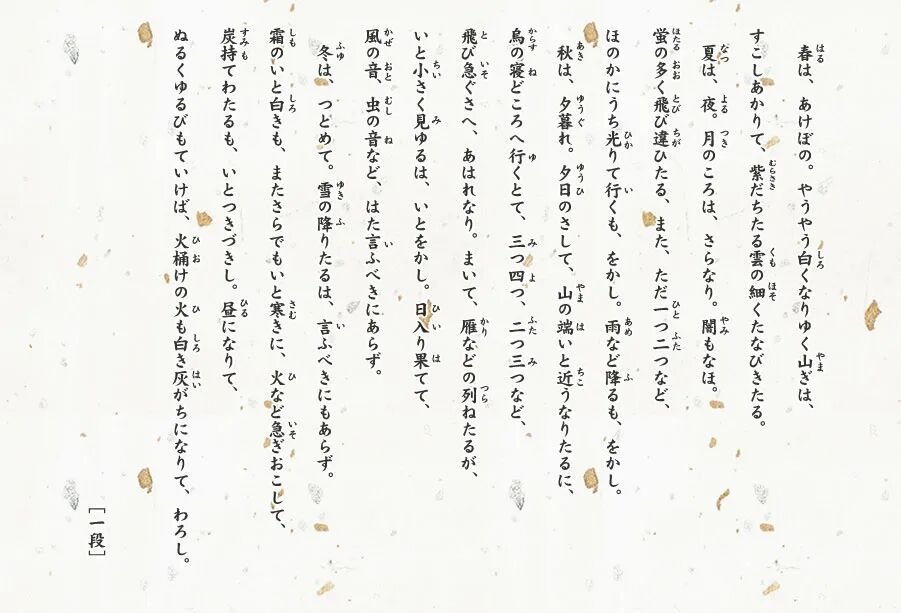
By today’s standards, it is just a diary. It was full of trivial things, such as “summer nights are the best”, “what are the annoying things”, and “the color of the clothes this person is wearing today is really nice”.
That’s all.
A thousand years later, the diary has become one of the greatest works of Japanese literature. Through those trivial words, you can clearly see a real person who lived a thousand years ago.
What she likes, what she hates, what makes her feel beautiful, what makes her irritated.
The human self is never a fixed entity, but a story that is constantly being told.
The reason why you feel “I am me” is not because your body has not changed, but because you can string together the self of yesterday, the self of ten years ago, and the self of today into a coherent narrative.
Human memory is actually extremely unreliable, as evidenced by too much evidence and research.
The diary provides an anchor. It is the testimony you left at that moment and will not drift with subsequent memory reconstruction.
Moreover, the human brain, like large models, actually has something very interesting called compression algorithm.
Henri Bergson, a French philosopher, won the Nobel Prize for Literature in 1927. He was a very interesting person.
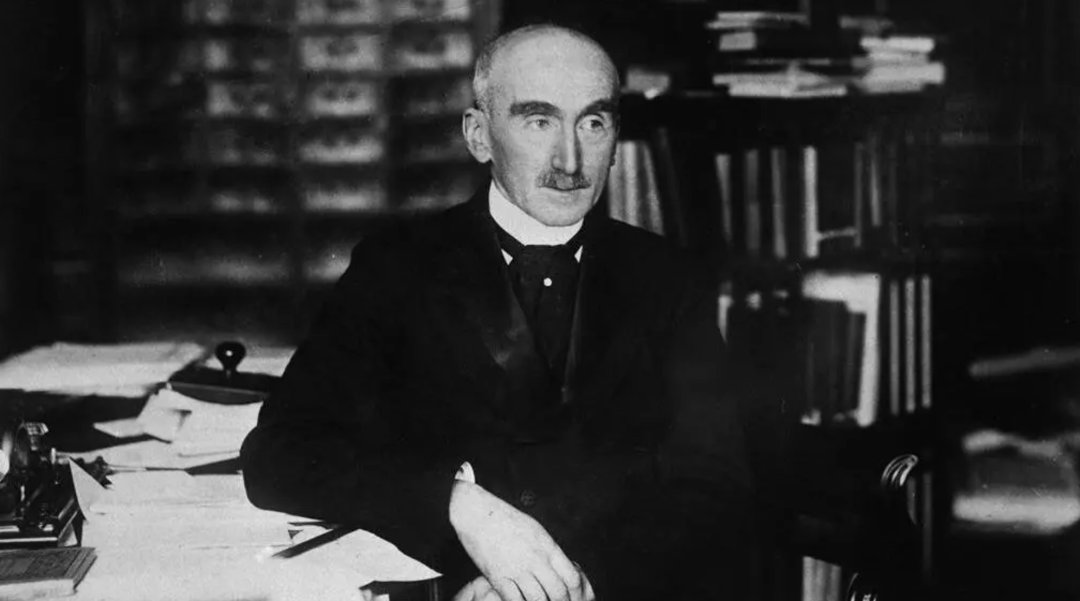
He distinguished two kinds of time, one is called clock time (temps), which passes evenly, at the same speed, and without distinction; the other is duration (durée), which is the subjective time with differences in concentration that we really live in.
As we grow older, we are trapped by inertia, and our days become more and more homogeneous, and our brains start to compress, compressing repetitive days into one line, and discarding weekends that are nothing special. So after a year passed, I looked back and saw that it was empty. Another year had just passed.
When we were young, we will always be remembered, because at that time, we were still young and full of curiosity about the world.
I think a diary can resist this compression very well. When you record every day, you will be forced to pay attention to the difference between today and yesterday, and be forced to find out the unique texture of this day from the homogeneous assembly line.
And these recorded real experiences and insights can help you, in this AI era, find your most authentic anchor as a human being.
So start journaling today.
Tell me what you ate today, who you met, what things touched you, and what thoughts came to your mind.
Tell it to yourself.
Tell it to you ten years from now.
Tell this to a world that will soon be filled with AI.
On this day in 2026, a real person once stood here. He had some trivial worries, some indescribable touches, and some confusions that he might not understand until his death.
But he lived.
And he remembers.
source
author:Digital life kazik
Release time: March 2, 2026 12:00
source:Original post link
Editorial comments
This article “X Import: Digital Life Khazik – In the AI Era, why do I highly recommend you start keeping a diary?” 》from X social platform, written by Digital Life Kazik. Judging from the completeness of the content, the density of key information given in the original text is relatively high, especially in the core conclusions and action suggestions, which are highly implementable. I have been in Barcelona on business for the past two days. I finally persisted in keeping a diary for several days. I have always had the idea of starting a diary before, and I have written some intermittently, but I have not persisted. But now, what really made me start to rethink my diary are two people. One is Ma Boyong. On December 28, 2024, he decided to start writing a diary again. For someone like him who writes stories until they take off, he can actually say that my brain is the best hard drive. However, he chose to keep a diary honestly. The reason is very simple, because… For readers, its most direct value is not “knowing a new point of view”, but being able to quickly see the conditions, boundaries and potential costs behind the point of view. If this content is broken down into verifiable judgments, it would at least include the following levels: I have been on a business trip in Barcelona these two days. ; I finally persisted in keeping a diary for several days. . Among these judgments, the conclusion part is often the easiest to disseminate, but what really determines the practicality is whether the premise assumptions are established, whether the sample is sufficient, and whether the time window matches. We recommend that readers, when quoting this type of information, give priority to checking the data source, release time and whether there are differences in platform environments, to avoid mistaking “scenario-based experience” for “universal rules.” From an industry impact perspective, this type of content usually has a short-term guiding effect on product strategy, operational rhythm, and resource investment, especially in topics such as AI, development tools, growth, and commercialization. From an editorial perspective, we pay more attention to “whether it can withstand subsequent fact testing”: first, whether the results can be reproduced, second, whether the method can be transferred, and third, whether the cost is affordable. The source is x.com, and readers are advised to use it as one of the inputs for decision-making, not the only basis. Finally, I would like to give a practical suggestion: If you are ready to take action based on this, you can first conduct a small-scale verification, and then gradually expand investment based on feedback; if the original article involves revenue, policy, compliance or platform rules, please refer to the latest official announcement and retain the rollback plan. The significance of reprinting is to improve the efficiency of information circulation, but the real value of content is formed in secondary judgment and localization practice. Based on this principle, the editorial comments accompanying this article will continue to emphasize verifiability, boundary awareness, and risk control to help you turn “visible information” into “implementable cognition.”