
Editor’s Brief
MiroFish, a multi-agent simulation engine developed by a university senior in just ten days, has secured a 30 million RMB investment from Shanda. The project signals a shift from AI as a historical data retriever to a 'predictive engine' capable of simulating complex social evolutions through thousands of independent digital personas.
Key Takeaways
- Evolution to Agent 3.0: MiroFish moves beyond task-oriented bots to a 'digital society' where emergent behavior creates new information rather than just reciting training data.
- High-Fidelity Sandboxing: The platform allows users to upload 'seed information' to generate parallel worlds for testing market reactions, PR crises, or policy impacts.
- The 'Vibe Coding' Workflow: The project demonstrates the power of 'super individuals' using AI-assisted design and modular development to bypass traditional engineering bottlenecks.
- Strategic Decision-Making Shift: The tool aims to replace intuition and static data analysis with high-fidelity simulations, offering a low-cost space for trial and error.
Introduction
Seeing MiroFish’s demo, the most intuitive feeling is that AI has finally crawled out of the “dusty archives” and begun to attempt to deduce unknown possibilities. It is no longer a simple Q&A tool; instead, by building a digital society containing thousands of agents with independent personalities, it allows information to “emerge” through interaction. This prediction engine based on multi-agent evolution may be attempting to break the limitation where AI can only repeat historical experiences, bringing decision-making logic into a new dimension
Editor’s Comment
Recently, the buzz around MiroFish on social media has given many people the illusion that a “prophet is right beside us.” A senior student managed to produce a demo in just ten days using what he calls “Vibe Coding,” and it has already attracted a whopping 30 million‑dollar investment. The story sounds like a hero’s epic from the golden age of Silicon Valley, but even the most sober observers can’t help but smell a hint of bubble.
At its core, MiroFish is really selling the idea of “democratizing sociological experiments.” In the past, decision‑making was either a gut‑feel exercise or a dive into dusty archives of historical data. MiroFish’s Agent 3.0 model essentially commercializes Stanford’s “virtual town” logic: instead of merely replaying history, it lets a cast of digitally embodied characters—each with distinct personalities and memories—interact freely in a sandbox. This leap from “data retrieval” to “evolutionary simulation” truly hits the pain point of AI’s evolution. If it can indeed derive a logically consistent ending from the first 80 chapters of Dream of the Red Chamber, then, in theory, it could simulate the market reaction to a brand‑PR crisis or a product launch with equal plausibility.
However, as an editor, I must remain cautious about the claims of a 30 million‑dollar investment and the promise of “predicting the future.” Under the current AI architecture, an agent’s behavior is still largely constrained by the probabilistic distribution of the underlying large model. The so‑called “independent personality” and “long‑term memory” still face a huge technical gap when it comes to long‑form text handling and logical consistency. What MiroFish is currently demonstrating looks more like…
It is a highly imaginative “possibility generator,” not a precise “forecasting device.” It can tell you what might happen in the future, but it cannot guarantee which of those possibilities will actually occur. The lack of certainty means it is better suited as a tool for creative brainstorming than as the sole basis for serious decision‑making.
On an industry level, the greatest insight from MiroFish lies not in the predictions themselves but in the rise of the “super‑individual.” The author’s Vibe Coding workflow—closing the loop from Figma sketches to AI‑assisted code generation—reveals a harsh yet fascinating truth: the barrier to development is eroding, while the barrier to definition is rising. When a senior college student can challenge the market share of traditional consulting firms and research agencies in just ten days, the industry’s focus has shifted from “how to build” to “how to set the rules.” This kind of “sandbox simulation” decision support may soon become a corporate standard, and could even spawn a new class of professionals dedicated to writing “simulation scripts.”
For ordinary readers, I would advise not to mythologize this “predictive power.”
Last night
We need to translate. Let’s produce English:
“Imagine this: If Xibei used MiroFish for PR guidance, Jia Guolong might not have announced the large-scale closure of Xibei.
If Smartisan Mobile used MiroFish to predict market reactions, Luo Yonghao might not be doing podcasts now.
I believe one of MiroFish’s greatest innovations is that it will inevitably change decision-making patterns in the future world, from personal daily decisions to national policies—who wouldn’t want to use a sandbox for simulated assisted judgment?
Thought 2: The Ultimate Evolution of Agents: From Answering the Past to Simulating the Future
AI Agent 1.0: Lone soldier. You give the agent a problem to solve, and the agent thinks independently, calls tools, and completes the task.
AI Agent 2.0: Agent Teams. Compared to the 1.0 era, agents have learned division of labor and collaboration, and can complete tasks more efficiently.”
We should keep tags? Might keep and
tags. Let’s produce final.想象一下:
If Xibei had used MiroFish for PR guidance, Jia Guolong might not have announced the large‑scale closure of Xibei.
If Smartisan Mobile had used MiroFish to predict market reactions, Luo Yonghao might not be doing podcasts now.
I believe one of MiroFish’s greatest innovations is that it will inevitably change decision‑making patterns in the future world—from personal daily choices to national policies. Who wouldn’t want to use a sandbox for simulated, assisted judgment?
Thought 2: The Ultimate Evolution of Agents—From Answering the Past to Simulating the Future
AI Agent 1.0: Lone soldier. You give the agent a problem to solve, and the agent thinks independently, calls tools, and completes the task.
AI Agent 2.0: Agent Teams. Compared to the 1.0 era, agents have learned division of labor and collaboration, enabling them to complete tasks more efficiently.
It should be noted that in the Agent 1.0 and Agent 2.0 eras there was a common limitation: models were trapped by historical data. They are like students who repeatedly solve past exam papers—perhaps they become faster and more accurate, but their problem‑solving strategies always derive from historical experience. When confronted with truly unprecedented challenges that lack any historical precedent, this approach reaches its limits.
Agent 3.0: represented by MiroFish, collective intelligence is a “digital society” composed of tens of thousands
MiroFish extracts characters such as Jia Baoyu and Lin Daiyu from the first 80 chapters of Dream of the Red Chamber to create a group of agents with distinct personalities. These agents freely interact in a digital world according to their own traits, unfolding endings that are entirely new and not found in any historical data.
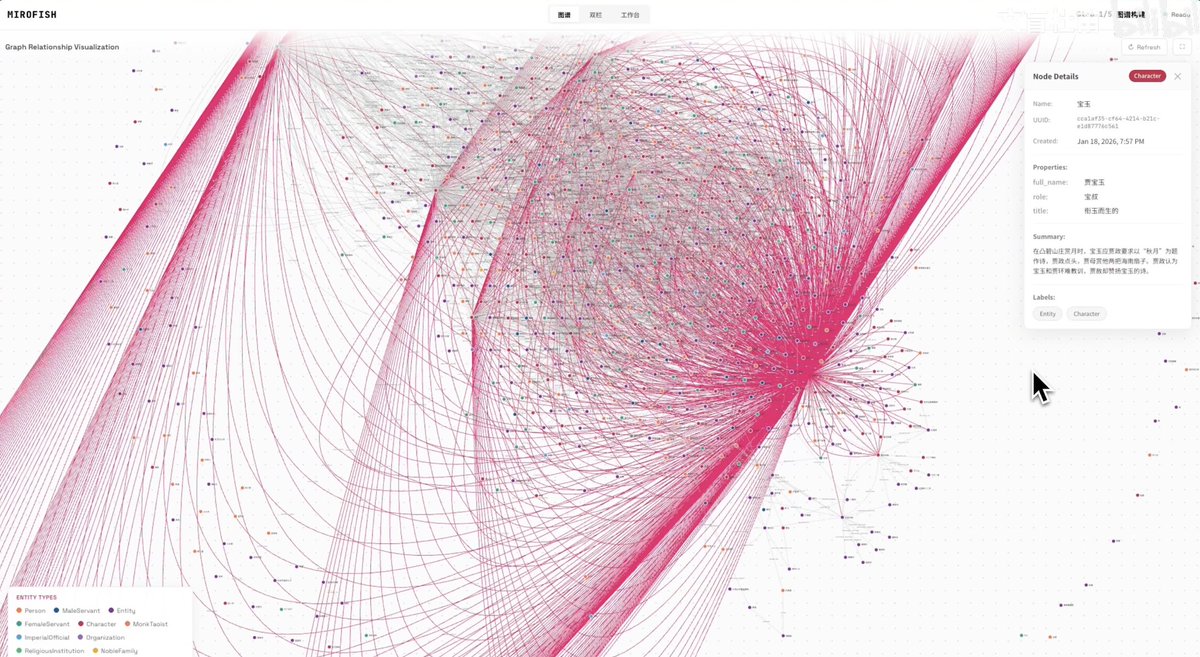
For the specific prediction results, we recommend that everyone watch the demo video released by the author. After watching, you’ll be as stunned as I am. (Link at the end.)
Thought 3: The Era of Super Individuals Has Arrived
The author of MiroFish is a senior student. The project was built in just ten days of “vibe coding” and has already attracted a 30‑million investment from Shengda.
His current vibe‑coding workflow is:
- Figma design sketch
- Quickly clone a front‑end demo with Google AI Studio
- Integrate the page into the project documentation, then break the tasks into modules and hand them over to an AI IDE for batch development.
Meanwhile, he also shared some practical tips in the article, such as using multiple agents to parallelize a task, and more. (This summary is drawn from the author’s Xiaohongshu post.)
After reading the entire piece, my biggest takeaway is that the era of the “super‑individual” has arrived. The market is frantically hunting for people who can turn AI into real productivity, and such success stories are popping up one after another. In this age, what truly sets someone apart is a daring creative spirit, a distinctive aesthetic, and a rich imagination. After all, AI makes everything possible.
Finally, I’ll borrow a line from the founder of Mirofish:
“Vibe coding—building products and open‑source—offers a practical, replicable path, and it’s still not crowded.”
The AI era is here! How you play this game is up to you.
Article reference link:
Official website: https://666ghj.github.io/mirofish-demo/
GitHub link: https://github.com/666ghj/MiroFish
Author’s statement: https://mp.weixin.qq.com/s/UyYV
Source
Author: Sac
Published: March 9, 2026 15:33
Source: Original post link
Editorial Comment
The tech world has a recurring habit of mistaking a clever demo for a crystal ball. When MiroFish—a project built in ten days by a senior student—secured a 30 million RMB investment from Shanda, the industry's collective eyebrow shot up. On the surface, it looks like another peak-hype cycle event. But if we strip away the 'prophetic' marketing, MiroFish reveals a significant pivot in how we conceptualize artificial intelligence: the transition from the 'Library' model to the 'Laboratory' model.
For the past two years, we have treated Large Language Models (LLMs) as hyper-efficient librarians. You ask a question, and they fetch a probabilistic synthesis of the past. MiroFish, and the 'Agent 3.0' philosophy it champions, attempts to break this loop. By creating a 'digital society' populated by thousands of agents with distinct personalities and long-term memories, it isn't looking for an answer in the archives. Instead, it is running a simulation to see what emerges. The demo involving 'Dream of the Red Chamber'—where the AI attempts to logically conclude the story based on the first 80 chapters—is a perfect litmus test. It isn't trying to guess what the original author wrote; it’s trying to see what those specific characters, given their traits, would do next in a vacuum. This is 'social emergence' as a service.
From a business perspective, the implications for risk management are profound. Traditional consulting is slow and prone to the 'expert bias' of a few individuals. Data analysis is backward-looking. A high-fidelity sandbox like MiroFish offers a third way: the 'pre-mortem.' Imagine a brand facing a PR disaster. Instead of guessing how the public will react, you populate a simulation with 5,000 agents representing different demographic archetypes and leak the news to them. You don't look for a 'correct' prediction, but for the 'probability distribution' of chaos. It’s a tool for narrowing the range of uncertainty, not for eliminating it.
However, we must maintain a healthy skepticism. MiroFish is currently built on the 'vibe coding' ethos—a workflow that prioritizes rapid prototyping and AI-assisted generation over deep architectural robustness. While impressive, these simulations are still tethered to the underlying LLM’s probability distributions. If the base model has a bias toward optimism or a specific cultural logic, the 'digital society' will mirror that bias at scale. There is a real danger of 'hallucination compounding,' where one agent’s error triggers a cascade of illogical social interactions, leading to a simulation that is internally consistent but externally delusional. We are not yet at the stage where a 10-day build can replace a decade of sociological research.
Perhaps the most enduring legacy of MiroFish won't be the software itself, but the 'Super Individual' narrative it validates. The creator’s workflow—moving from Figma sketches to Google AI Studio and then to AI-driven IDEs—is a blueprint for the next generation of founders. The barrier to entry for building complex systems is collapsing, while the premium on 'defining the rules' is skyrocketing. In this new era, the most valuable skill isn't knowing how to code the simulation, but knowing which variables to seed into it. MiroFish is a reminder that while AI might not be able to tell us exactly what the future holds, it is getting much better at helping us rehearse for it.