

Editor’s Brief
The rapid rise of the open-source project OpenClaw has birthed a chaotic "grey market" for installation services. Prices for a simple setup range from 30 RMB to a staggering 16,000 RMB, driven by a combination of technical illiteracy, corporate anxiety, and a lack of basic security awareness. This phenomenon highlights a massive disconnect between the cutting edge of AI development and the practical reality of end-user adoption.
Key Takeaways
- Extreme Price Fragmentation:** Installation services for OpenClaw are being sold on platforms like Xianyu and Taobao with wild price swings, from "budget" 30 RMB remote sessions to 16,000 RMB corporate "consultancy" packages.
- The Rise of "Li-Gui" Stores:** Unofficial vendors are masquerading as "DeepSeek Official" stores to sell OpenClaw deployments, capitalizing on brand recognition to exploit uninformed users.
- Critical Security Risks:** OpenClaw requires high-level system permissions. Many users are inadvertently creating "zombie drones" by leaving default ports open to the public internet without authentication, exposing their entire systems to bad actors.
- The "Blind Leading the Blind":** A field test revealed that many professional installers are former tech-adjacent workers who don't actually use the tools they install; they are simply arbitrageurs of technical friction.
- The FOMO Tax:** Much like the early days of electrification, users are rushing to install AI tools out of a fear of being left behind, often without a clear plan for how to integrate them into their actual workflows.
Introduction
The following content has been compiled by NOVVISTA using publicly available information from X / social media, and is intended solely for reading and research purposes.
Key Points
- Regarding recent developments with OpenClaw, aside from what I mentioned yesterday about the GitHub top ranking.
- There is also another very magical development.
Note
For any sections involving rules, earnings, or judgments, please refer to the original statements by Digital Life Kazzik and the latest official information.
When I read the comment that “Kazak” had exposed OpenClaw’s installation fee—an astronomical 16,000 yuan—I didn’t feel shocked at first. Instead, I felt a kind of absurd “oh, it’s just like that” realization. This isn’t a new phenomenon in the Chinese tech internet; from the mining‑software and flash‑sale bots of the past to last year’s DeepSeek all‑in‑one device, the pattern is almost identical.
OpenClaw is an open‑source tool at its core, meant to let users tap AI capabilities more smoothly. But when it collides with a huge information gap and anxious, ordinary users, it ceases to be code and becomes an expensive ticket to the “AI era.”
The information Kazak provided is highly credible. As a long‑time AI‑tracking blogger, he posted screenshots from Xianyu (闲鱼) and Taobao, showing a chaotic price range from a few dozen yuan to several thousand—exactly what you’d expect from the gray market of AI services today. Especially those shops that use the “DeepSeek Official” avatar or even the store name; such blatant counterfeit activity underscores both the lag in market regulation and users’ lack of discernment.
The 16,000‑yuan case may sound outrageous, but if it involves enterprise‑level bulk deployment, intranet environment tuning, and so‑called “employee training,” it can appear “reasonable” within the logic of business procurement. After all, many bosses would rather spend money on peace of mind than let their staff waste three days figuring out how to use GitHub.
What this situation reveals about the industry is quite painful. On one hand, AI technology is indeed exploding, and projects like OpenClaw that reach the top of GitHub demonstrate the vitality of the developer community. On the other hand, the “last mile” of technology deployment remains a chasm. For the vast majority of users who don’t even know what a Python environment is, open‑source code is as incomprehensible as a holy book. That huge gap between the “technological high ground” and the “cognitive basin” directly breeds a new class of professionals—“second‑hand dealers.” They don’t produce technology; they simply ferry it, profiting from those who want to hop on the bandwagon but can’t find a way in.
Recently, aside from the GitHub “top‑chart” story I mentioned yesterday, there’s another truly surreal development.
It’s the paid, on‑site installation service for OpenClaw.
The fee varies, but it’s usually a few hundred dollars.
Even more outrageous prices have surfaced—just the other day I saw one in a group chat.
OpenClaw installation: 16,000 USD…
Image 1
They claim it’s guaranteed, no lie, and a 3,000 USD deposit has already been received.
Image 2
I was completely overwhelmed by the numbers. Of course, a price like that can’t come from a single individual. I suspect it’s most likely a bulk installation for a company, plus some training, which would justify the cost.
Because installing an OpenClaw…
w, giving 10k6—I still think it’s a
Figure 5
Image from the main text
“Hmm, the official DeepSeek store sells OpenClaw deployment, with a basic installation fee of 388. It feels like this shop is run by Liang Wenfeng’s second uncle…”
“I don’t know why, but these shops always use DeepSeek’s avatar—perhaps because it’s what most users recognize.”
“That whale represents cutting‑edge AI technology.”
“The differences among these services are mainly in what’s included beyond the installation. Some also offer integration with Feishu and DingTalk, and install certain skills. There isn’t much else. The pricier options bundle a so‑called VIP technical‑guidance package for the future.”
“Most of these are remote installations.”
“On‑site installations in the same city cost a bit more, usually around 500.”
Figure 6
Image from the main text
This point deserves a closer look. I’m not disparaging these businesses—where there’s demand, there’s a market, and that’s perfectly normal.
As for some WeChat micro‑entrepreneurs, the price they quote is exactly what I’d like to criticize.
It
Claw’s service.
Honestly, for 5,000 yuan you get only the installation—no other services at all. It’s incredible…
 a couple of days ago and, out of curiosity, posted on Xiaohongshu. He didn’t expect it to attract so many people—he’s been getting work every day for the past two days, averaging several orders a day.
He found it amazing that there really is a demand for this service.
We asked him about the typical profile of people who need on‑site installations.
He replied, “If you’re asking about the industry, it’s mainly film and media, finance, and internet. Friends from those fields ask me to help with installations. Most of them are individuals, but they’re all working and want to use this wave of OpenClaw to streamline their business processes.”
We then asked, “Do you know what the process looks like? Or what they do with it once it’s installed?”
He said that because he’s just starting out, he doesn’t have enough samples. He couldn’t give specifics, but he mentioned a friend who runs an e‑commerce business and uses it to analyze sales data.
When we followed up on his own usage, he was very candid:
“Honestly, I don’t use it much. I don’t have a strong need for it.”
“The most I do is have it push me AI news updates on a schedule.”
He was indeed very honest.
When I read those comments, I immediately thought of a line from the sitcom Love Apartment:
“The teachers who give you career guidance might never have had a job themselves.”
Figure 17
The guy who installs OpenClaw for you probably doesn’t use OpenClaw much himself…
But if you think about it, that’s actually a pretty normal thing.
After all, knowing how to install it doesn’t really mean you have to know how to use OpenClaw.
It’s a truly magical phenomenon.
So when you see this, you’ll realize that the whole thing actually has almost no learning curve. Just do a little research, learn a bit, and you’ll have it up and running in no time.
Seriously, if you can figure out the installation on your own, go for it. There are tons of tutorials online. If you’re stuck, just check my tweets for installation guides—everything’s there.
I’m stressing this because, besides saving you money, there’s another thing that the vast majority of people haven’t even noticed or cared about: security.
I wrote a paragraph in yesterday’s OpenClaw summit article that a lot of people crossed out.
ntent/uploads/2026/03/HCiVUf8awAcg7xC.png” alt=”” loading=”lazy” />
类OpenClaw这样的产品,为啥很多大厂不做,比如字节、比如OpenAI、比如Claude、比如Google,难道真的因为有技术壁垒吗?
有个屁的技术壁垒,都是开源的、且vibe coding的项目,大家去Github上搜搜有多少复刻的就知道了。
大厂不做的一个很大的原因,是怂,是不敢。
因为小龙虾,是直接拿了你系统的最高权限,几乎可以代替你干任何事情,而且自己还能联网,安全做的也是一坨屎,你放在一个新的mac mini上跑还好,你要是放在一个你自己的电脑上,一旦装了一些奇怪的插件或者Skills偷你个API Key,或者把端口开到公网又没鉴权,你知道这是多大的安全隐患吗。
就像这个网站,上面全部是因为各种原因,被泄露出来的小龙虾。
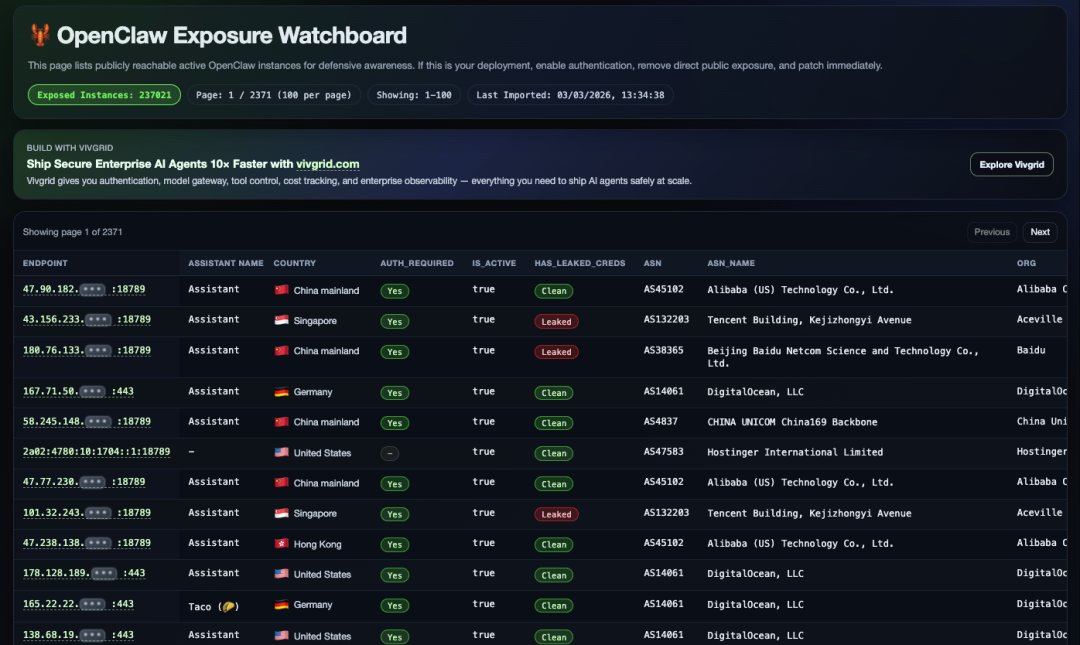 All of them are just default ports.
Everything leaks cleanly, and it even comes with
There is a kind of fear.
It’s the fear of being left behind by the times—a fear I feel myself.
I’m terrified that new tools will keep emerging one after another, and that I’ll be forever chasing but never catching up.
I dread the day I wake up to find that all the experience and skills I’ve accumulated over a decade suddenly become worthless.
This fear is deeply personal. It never appears in a feel‑good article, nor in a senior executive’s year‑end recap, yet it is there, lurking in every quiet, late night.
So when a new tool is released, a lot of people rush to install it. They may not yet know what it can do, but if you don’t install it, you’re already behind. And if you’re behind, you’re finished.
And then many of those stories end the same way: you buy a Kindle, download a hundred books, and never open one again. You get a gym membership, go twice, and it turns into a monthly expense. You enroll in an online course, pile up a bunch of paid‑content products, and then you’re stuck at the very first lesson.
It’s unnecessary, really.
In the 1880s, electricity began to spread across the United States. Many factory owners spent a fortune buying generators and electric motors to install in their plants. But after installation, many found that production efficiency hadn’t improved significantly.
They had simply replaced steam engines with electric motors, while the factory layout, workflow, and management practices remained unchanged.
Real efficiency gains came two or three decades later. The next generation of factory managers realized that electricity was not just a new source of power—it should redefine the entire production process.
Thus the factories shifted from a vertical layout to a horizontal layout, from a central …
Movement has shifted to a distributed‑driven model, turning rigid production lines into flexible ones.
Those who truly reap the electricity dividend are the early wave of people who first understood what electricity
Everyone now has the ability to develop solutions to their own business pain points.
Even HR, following some of our bizarre requests, hand‑crafted an AI pre‑screening tool to score resumes.
Figure 20
Figure 21
Of course, I’m not saying I don’t recommend OpenClaw—it’s a solid product. Even though some engineering aspects are a bit absurd and its token consumption is extremely high, many of our colleagues still use it. In the next couple of days we might publish an interesting tutorial on OpenClaw.
What I want to say is that this era is evolving too rapidly.
Everyone has fears; among the people I’ve met, the higher the status, the more fearful they become.
Curiosity and…
Fear may be the two sides of the same coin.
Curiosity drives us toward the unknown, while fear keeps us from staying in one place. Together, these forces form the entire engine of human civilization.
But do not surrender your right to think because of fear.
Nor should you give up your own safety.
Spend a little more time researching it yourself.
This process may be the AI era.
It is more important than learning to use a tool.
Source
Author: Digital Life Kazzik
Published: March 4, 2026, 11:33 AM
Source: Original post link
Editorial Comment
The report from "Digital Life Kazik" regarding the OpenClaw installation craze is a perfect microcosm of the current AI gold rush. When an open-source tool hits the top of GitHub, the tech world sees a breakthrough in automation. However, the broader market sees something else entirely: a terrifying barrier to entry that they are willing to pay almost any price to bypass. Seeing installation fees hit 16,000 RMB for what is essentially a Python environment setup isn't just a sign of a bubble; it’s a "tax on ignorance" that reflects the deep-seated anxiety of the modern workforce.
The most jarring part of this story isn't the price gouging, but the "magical moment" where the author hires an installer for 499 RMB. The installer, a former operations guy, admits he doesn't even use OpenClaw. He’s simply an arms dealer who doesn't know how to shoot. This is the reality of the "last mile" in technology. We have these incredibly powerful, agentic AI systems, yet the average professional is still stymied by a command-line interface. This gap is being filled by a new class of "digital porters" who move code from GitHub to a user's desktop for a fee, often with zero regard for the long-term stability or security of the system they are building.
Speaking of security, the author hits on a point that most users are blissfully ignoring: the "meat chicken" (zombie drone) problem. OpenClaw, by its nature, needs to "see" and "act" on your system. Granting that kind of permission to a script installed by a stranger from Taobao is the digital equivalent of giving a random passerby the keys to your house and your filing cabinet. The fact that thousands of these instances are currently sitting on the public internet with default ports open is a ticking time bomb. It’s a reminder that while AI might be "smart," the implementation of it remains dangerously amateurish.
There is a historical parallel here that we shouldn't ignore. In the 1880s, when electricity first arrived in factories, owners simply swapped steam engines for electric motors. They didn't change their floor plans or their workflows, and as a result, productivity didn't budge for decades. Real change only happened when a new generation of managers realized that electricity allowed for a total redesign of the factory. We are currently in that 1880s phase with AI. People are desperate to "install" AI, thinking the tool itself is the solution. They are hoarding tools like unread Kindle books, hoping that the mere presence of the software will somehow shield them from obsolescence.
The hard truth for any professional right now is that you cannot outsource your way into the AI era. Paying 500 RMB—or 16,000 RMB—to have someone else click "install" for you doesn't make you an AI-native professional; it just makes you a customer. The real value isn't in owning the tool, but in the grueling, often frustrating process of learning how to configure it, break it, and fix it yourself. That process is where the actual "evolution" happens.
If you’re terrified of being left behind, the solution isn't to buy a "VIP installation package." It’s to sit down, open a terminal, and face the friction. In an era where everyone is looking for a shortcut, the only real competitive advantage is the willingness to do the legwork that everyone else is trying to pay their way out of. Security, efficiency, and true mastery can't be bought on Xianyu.