
Editor’s Brief
Most guides to OpenClaw stop at installation. This one starts where the real work begins. Written by Achuan for the X platform, it maps the journey from “it just sits there collecting dust” to deploying a personalised autonomous agent that compounds in usefulness the longer you run it. The guide is structured around four concrete moves: persistent identity initialisation, a curated skill stack, cross-tool workflow combinations, and — remarkably for a free guide — viable monetisation paths. What makes it worth a careful read is the underlying thesis: OpenClaw advanced features beyond chatting are not reserved for developers. They are available to anyone willing to invest one minute of setup and adopt a consistent maintenance habit. If you have installed OpenClaw and are unsure what to do next, start with Move One and work forward sequentially.
Key Takeaways
- Identity initialisation is the highest-leverage first step. Sending a structured personal context block — job role, schedule, communication preferences — transforms OpenClaw from a generic chatbot into a configured assistant that retains context across all future sessions. One minute of input prevents weeks of repetitive re-explanation.
- Skills and plugins are categorically different things. Skills expand what the agent can actually do (web search, file handling, browser automation). Plugins change the interface. Beginners who conflate them waste time on cosmetic changes while leaving core capabilities untapped.
- Three skill sources cover all needs: ClawHub, GitHub, and the Chinese-market Aquatic Market (openclawmp.cc). ClawHub offers one-click installs with official security scans. GitHub provides 200-plus open-source repositories with greater specialisation. The Aquatic Market covers China-specific integrations like Feishu and WeChat that overseas platforms do not address.
- The Capability Evolver and Self-Improving Agent skills form a self-optimising foundation. The first adapts OpenClaw’s communication style to the user’s habits over time. The second conducts post-task reviews so the agent does not repeat the same errors. Together they are the mechanism that makes the system more valuable the longer it runs.
- Golden workflow combinations multiply capability exponentially. OpenClaw paired with Claude Code covers the full development loop. Paired with n8n it handles any cross-application automation without manual drag-and-drop configuration. Paired with Obsidian it auto-populates a second brain from every conversation.
- Agent Browser (GUI automation) is the single skill that most changes what is possible. Once OpenClaw can operate a browser at the visual level — clicking buttons, filling forms, reading screen content — the scope of tasks it can complete shifts from text generation to genuine digital labour.
- Four monetisation paths are already active in the community. Custom skill development, technical setup services, educational content, and Agent-as-a-Service operations for small businesses are all viable. Each path is accessible without deep coding knowledge, relying instead on process literacy and workflow design ability.
Editor’s Brief
A practical roadmap for transitioning from basic chatbot interactions to utilizing OpenClaw as a functional autonomous agent. The guide focuses on persistent memory setup, modular skill installation, and cross-platform automation to turn a "static" installation into a customized digital assistant.
Key Takeaways
- Identity Initialization:** The "Identity Entry" step uses OpenClaw’s persistent memory to store user-specific context (habits, job roles, preferences), preventing the "amnesia" common in standard LLM sessions.
- Skill-Based Architecture:** Distinguishes between "Skills" (functional capabilities like web searching or file handling) and "Plugins" (UI enhancements), emphasizing that utility comes from expanding the agent's toolkit via ClawHub or GitHub.
- Essential Toolkit:** Recommends specific modules like "Capability Evolver" for self-optimization and "Agent Browser" for GUI-level automation, moving beyond text-only responses.
- Workflow Integration:** Details "Golden Combos" such as pairing OpenClaw with n8n for automation, Claude Code for development, or Telegram/Lark for mobile accessibility.
- Monetization Paths:** Identifies four emerging business models: custom skill development, technical setup services, educational content, and "Agent-as-a-Service" operations for small businesses.
Editorial Comment
The honeymoon phase of new software usually lasts about forty-eight hours. You see a viral post on social media, you struggle through a terminal-based installation, and for one glorious evening, you feel like you’re living in the future. Then Monday hits. You realize your shiny new tool doesn't actually know who you are, what you do for a living, or how to help with your actual workload. It becomes just another tab you eventually close. This guide to OpenClaw—or "the lobster," as the community calls it—addresses that specific "Day 2" stagnation.
The core issue with most modern software is that we treat it like a vending machine: you put in a prompt, and you get a result. If you want a different result, you start over. OpenClaw is built on a different premise: persistent state. The author’s first recommendation—the "Identity Entry"—is arguably the most important, yet most frequently skipped, step in personal computing today. By explicitly defining your professional context and personal quirks, you aren't just "chatting"; you are configuring a local database that informs every future interaction. It turns the software from a stranger into a digital intern that actually remembers how you like your spreadsheets formatted.
What makes this specific ecosystem interesting is the modularity of "Skills." For years, we’ve been stuck with monolithic applications. If you wanted a feature, you had to wait for the developer to ship an update. The "Aquatic Market" (OpenClawMP) and ClawHub represent a shift toward a "Lego-style" utility. If you need your agent to read a specific type of financial report or interact with a niche project management tool like Lark, you don't wait for a patch; you install a skill. This is where the "professional farmer" metaphor comes in. You aren't just a user; you are an architect of your own workflow.
However, we should be realistic about the friction involved. While the guide claims "no code" is required, the reality of managing an autonomous agent often involves troubleshooting API keys, managing local environments, and understanding the logic of how different tools talk to one another. The "Golden Combos" mentioned—like pairing the agent with n8n—are incredibly powerful, but they require a level of digital literacy that goes beyond simple copy-pasting. The real value here isn't the software itself, but the "automation mindset" it forces the user to adopt. You have to learn how to break your job down into small, repeatable tasks that a machine can handle.
From an industry perspective, this guide signals a move away from "General Intelligence" toward "Applied Utility." People are tired of talking to boxes that give them poetic descriptions of the moon; they want tools that can check the weather, summarize a PDF, and then send a Slack message to their boss without being asked twice. The monetization paths mentioned at the end of the text—specifically "Agent Operations"—suggest a new service economy. Just as we once hired people to build websites or manage social media, we are entering an era where businesses will hire "Agent Architects" to build and maintain these digital workforces.
Ultimately, the success of a tool like OpenClaw depends on the user's willingness to "train" it. It is not a turnkey solution. It is a raw material. If you treat it like a search engine, it will disappoint you. If you treat it like a piece of clay that needs to be molded through persistent memory and specific skill sets, it becomes the most valuable piece of software on your hard drive. The "lobster" is only as smart as the person holding the tweezers.
Introduction
The following content is compiled by NOVSITA in combination with X/social media public content and is for reading and research reference only.
focus
- Follow the trend and install OpenClaw, which is popular all over the Internet, but after less than a day of enjoying it, it just sits there and collects dust?
- After pretending, I opened it and looked confused: Other people’s lobsters can help with work 24 hours a day, but your lobster doesn’t know anything about it, and can’t even remember your name? I just pretended to have a bunch of Internet celebrity skills, or I didn’t know how to use them…
Remark
For parts involving rules, benefits or judgments, please refer to the original expression and latest official information of Achuan | AI thinking.
Editorial comments
This article “X Import: Achuan | AI thinking – Can you only chat after installing OpenClaw? The only thing you need to be a professional farmer is this beginner’s guide” from the X social platform, written by Achuan | AI thinking. Judging from the completeness of the content, the density of key information given in the original text is relatively high, especially in the core conclusions and action suggestions, which are highly implementable. Follow the trend and install OpenClaw, which is popular all over the Internet, but after less than a day of enjoying it, it just sits there and collects dust? After pretending, I opened it and looked confused: Other people’s lobsters can help with work 24 hours a day, but your lobster doesn’t know anything about it, and can’t even remember your name? You blindly installed a bunch of Internet celebrity skills, but you either don’t know how to use them, or you can’t use them. A good open source artifact, but you just used it as an advanced chat box? There are many comments under the last popular article, all of which are newbies who have just installed OpenClaw and are stuck in Novice Village and don’t know where to go. I’ve been stuck in this trap for almost a month…. For readers, its most direct value is not “knowing a new point of view”, but being able to quickly see the conditions, boundaries and potential costs behind the point of view. If you break this content down into verifiable judgments, it would at least include the following aspects: Follow the trend and install OpenClaw, which is popular all over the Internet, only to let it gather dust after less than a day of being cool? ; After pretending, he opened it and looked confused: Other people’s lobsters can help work 24 hours a day, but your lobster doesn’t know anything about it, and can’t even remember your name? I blindly pretended to have a bunch of internet celebrity skills, or I didn’t know how to use them…. Among these judgments, the conclusion part is often the easiest to disseminate, but what really determines the practicality is whether the premise assumptions are established, whether the sample is sufficient, and whether the time window matches. We recommend that readers, when quoting this type of information, give priority to checking the data source, release time and whether there are differences in platform environments, to avoid mistaking “scenario-based experience” for “universal rules.” From an industry impact perspective, this type of content usually has a short-term guiding effect on product strategy, operational rhythm, and resource investment, especially in topics such as AI, development tools, growth, and commercialization. From an editorial perspective, we pay more attention to “whether it can withstand subsequent fact testing”: first, whether the results can be reproduced, second, whether the method can be transferred, and third, whether the cost is affordable. The source is x.com, and readers are advised to use it as one of the inputs for decision-making, not the only basis. Finally, I would like to give a practical suggestion: If you are ready to take action based on this, you can first conduct a small-scale verification, and then gradually expand investment based on feedback; if the original article involves revenue, policy, compliance or platform rules, please refer to the latest official announcement and retain the rollback plan. The significance of reprinting is to improve the efficiency of information circulation, but the real value of content is formed in secondary judgment and localization practice. Based on this principle, the editorial comments accompanying this article will continue to emphasize verifiability, boundary awareness, and risk control to help you turn “visible information” into “implementable cognition.”
Follow the trend and install OpenClaw, which is popular all over the Internet, but after less than a day of enjoying it, it just sits there and collects dust?
After pretending, I opened it and looked confused: Other people’s lobsters can help with work 24 hours a day, but your lobster doesn’t know anything about it, and can’t even remember your name? You blindly installed a bunch of Internet celebrity skills, but you either don’t know how to use them, or you can’t use them. A good open source artifact, but you just used it as an advanced chat box?
There are many comments under the last popular article, all of which are newbies who have just installed OpenClaw and are stuck in Novice Village and don’t know where to go. I’ve been stuck in this trap for almost a month.
From a pure novice who doesn’t even understand skill, to an exclusive wage earner who plays lobsters as he is on call.
Today, I will share with you this complete guide to raising 🦞 from entry level to advanced level.
It is all practical information that has been tested by myself and is effective. You don’t need to understand complicated codes in the whole process. You can just copy and paste it. If you follow this, your lobster will understand you better and be able to fight better the more you use it!
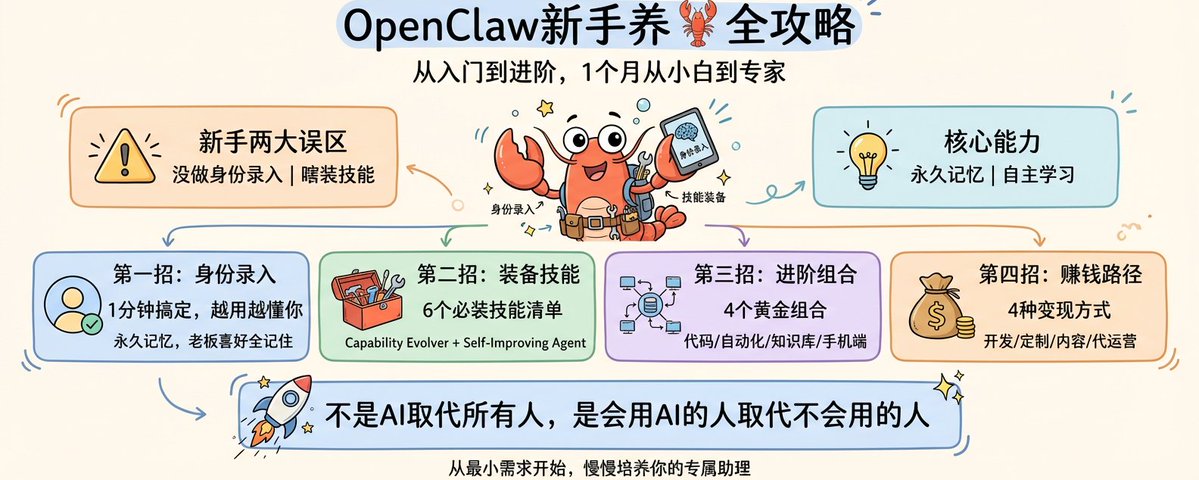
The first step: first do the “identity entry” for the lobster, it can be done in 1 minute
This is the step most easily overlooked by novices, and it is also the most critical step in determining whether your lobster is an “artificial retard” or a “dedicated assistant”.
After installing OpenClaw, many people come up and ask, “What can you do?” or “Write something for me.” But you haven’t even told it who you are, what you want to do, or what your preferences are. How can it give you the answer you want? The most outstanding core capability of OpenClaw is permanent memory.
To put it bluntly, this step is to give your lobster “pre-job training” so that it knows who it works with, what the boss’s preferences, habits, and work rhythm are, so that it can accurately follow your ideas in future work.
Novices can directly copy and modify it, and it can be done in 1 minute. Just send the following information to Lobster, and be sure to add a sentence at the end: Please remember the above content forever, this is my basic personal information.
My name is XX, I am XX years old, I do XX work in XX city, and I am mainly responsible for XX content. I usually don’t like too formal a way of speaking, so you can be more casual when communicating with me. I go to work at XX o’clock every day and usually go to bed at XX o’clock. I am currently in XX / have XX habits, please remind me of relevant content.
Just a few words, no need to write a short composition, no need to be very formal. You can also add information at any time. Tell it today that you like fitness, and tomorrow tell it that you are learning French. It will remember these contents one by one, and the more you use it, the better it will understand you.
The second move: Equip your lobster, a list of skills that novices must equip
Let me first explain it to newcomers. There are two words that 90% of people confuse: skill and plug-in.
A skill is a skill that a lobster can learn – such as helping you search the web, send emails, organize documents, and control the browser. Each skill is a job that it can directly do for you.
Plug-ins are just to add peripherals to the lobster – such as adding a voice input box and changing the skin. They are the icing on the cake and novices don’t need to touch them first. Practice your lobster skills first, and then do all the bells and whistles.
Where can I install skills? 3 channels, all of which can be used directly by novices
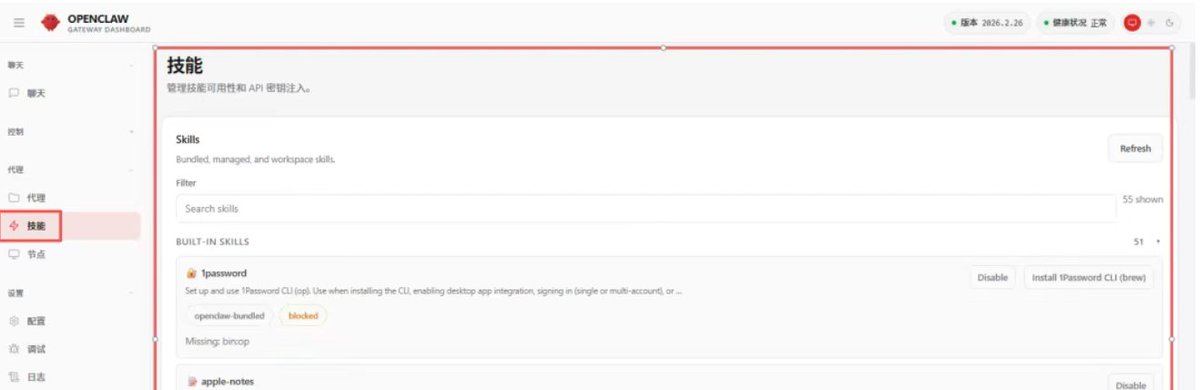
Channel 1: ClawHub official market (novices rush with eyes closed)
Official website:https://clawhub.ai
The official son, you can directly enter OpenClaw, install it with one click, and have official security scans, so you don’t have to worry about stepping on pitfalls, and there is zero threshold for operation. The installation command is super simple
Channel 2: GitHub open source community (if you like to mess around, go directly)
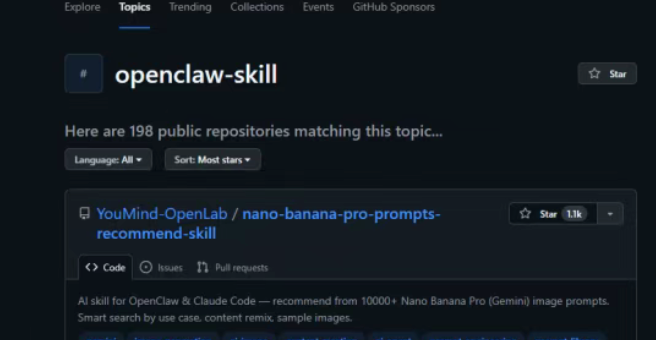
address:https://github.com/topics/openclaw-skill
Here are all the skills created by the big developers voluntarily, with more complete functions and more subdivisions. Currently, there are 200+ open source warehouses. I particularly recommend a treasure warehouse for lazy people: awesome-openclaw-skills. From the official 13,000+ skills, the boss has screened out all junk, duplication, and malicious ones, and sorted out 5,400+ high-quality skills. Just browse here to find skills.
Channel 3: Fishery market (a treasure exclusively for Chinese users)
address:https://openclawmp.cc
The most popular lobster community in the Chinese circle is all based on technologies that are used by Chinese people, such as Feishu, WeChat, Bilibili, and Chinese financial report analysis. They are much more down-to-earth than overseas platforms.
A list of must-have skills for beginners, 6 carefully selected ones, all of which are useful
I’m not going to make you guys a bunch of fancy stuff, just pick something that you can use for beginners and you can feel the effect immediately, it doesn’t take up resources, and it’s risk-free, and you won’t be able to use it if there are too many.
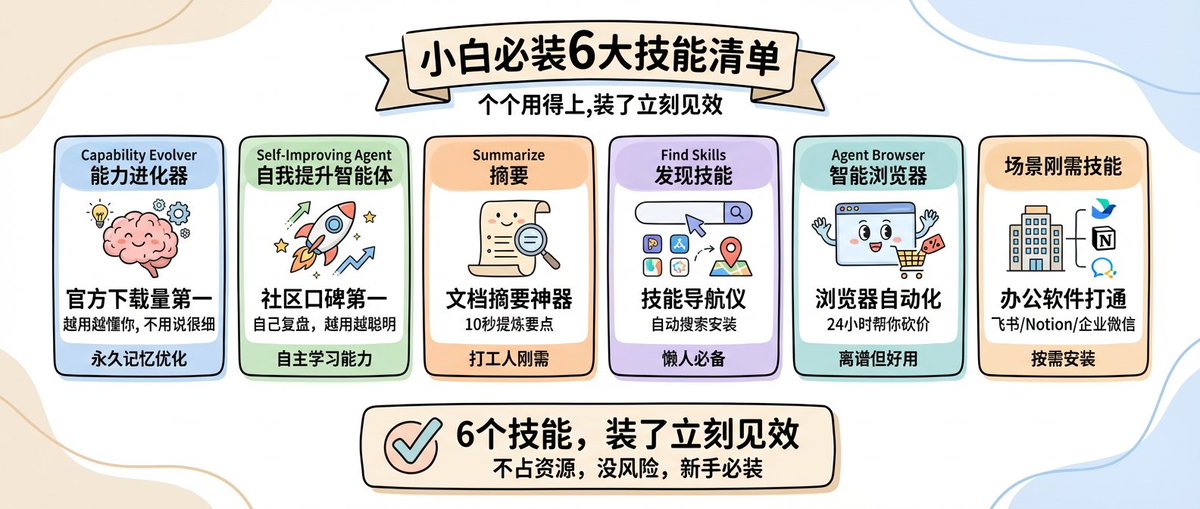
Capability Evolver – No. 1 in downloads on the official market, with 35,000+ people installed. It does not do specific work for you, but makes your lobster more comfortable the more you use it. It will analyze your usage habits and automatically help Lobster optimize your reply methods and work logic. As you use it, you will find that Lobster understands your thoughts more and more, without you having to speak in detail every time.
Self-Improving Agent – the most popular skill in the community, and a golden partner with the one above. The above one is about optimizing the cooperation with you, and this one is about letting the lobster grow on its own. Every time it completes a task, it will review it by itself to see where it went wrong and where it can be optimized. Write it down so that you won’t make the same mistake again next time. The more you use it, the smarter it becomes.
Summarize (Document Summary) – There is no such thing as an artifact that is immediately effective when installed by a novice. Whether it’s a contract, report, meeting minutes, paper, or web page, PDF, audio and video, you throw it to it, and the core points can be extracted in 10 seconds. You don’t have to chew through dozens or hundreds of pages of content yourself. It’s just what workers need.
Find Skills – A must-have skills navigator for lazy people. After installing it, you don’t have to go to various markets to search for skills. You can just say “find me a skill that can do XX” and it’s done.
Agent Browser (browser automation) – Put hands and eyes on a lobster. After installing it, Lobster can operate the browser like a human
Skills that are needed in scenarios (installed on demand) – Workers use Feishu / Notion / Enterprise WeChat to directly search for skills with corresponding names and open office software with one click; developers can directly install GitHub Skill to help you change code, review PRs, and manage issues; those who want to install daily reminders can install Weather, which can automatically check the weather and send you reminders without using an API key.
I would like to add a question that novices often ask: What should I do if Lobster cannot recognize the skills I wrote? 90% of the time, the description of your skills is too vague. Novices can also install Skill-Creator directly and let Lobster help you write skills automatically with zero code.
The third trick: Advanced golden combination, 4 ways to make the lobster work for you 24 hours a day
Many people have installed a bunch of skills, but they still find it difficult to use lobster. Why? Because if you let one person do all the work, he will definitely not be able to do it well. The core of advancement is to let OpenClaw be your “general manager”, understand your ideas, break down the tasks, and then assign professional tools to do the work, directly doubling your capabilities.
We have compiled for you 4 combinations that are the most popular in the community and can be used by beginners. Just follow them.
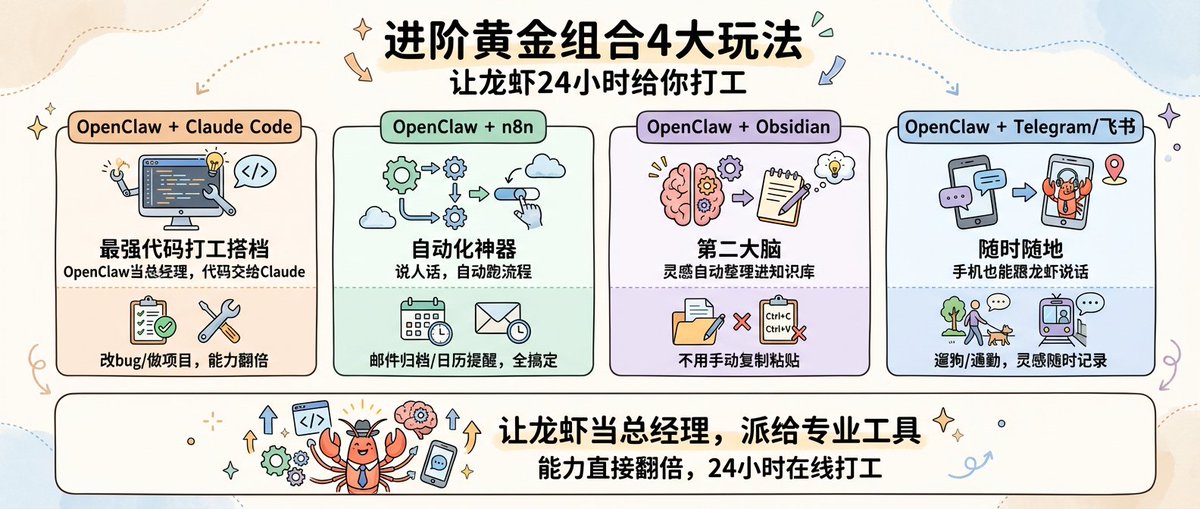
OpenClaw + Claude Code = The strongest code working partner
There is no one that is the most popular group on the Internet right now. Let me explain the division of labor clearly to you: Claude Code specializes in writing code, fixing bugs, and working on projects. It has full capabilities, but it cannot remember your preferences and does not know your project background. It has to say it again every time you use it. OpenClaw can just make up for this pitfall. It remembers all your needs, project history, and work habits.
OpenClaw + n8n = Automation artifact, let it do all the repetitive work
n8n is an open source automation tool that can connect all your software. However, if you use it alone, you have to drag and drop the configuration yourself, which has a high threshold. After combining with OpenClaw, you only need to speak human words, and it can automatically run the process for you.
OpenClaw + Obsidian / Knowledge Base = Your Exclusive Second Brain
A must-read for knowledge workers and creators. Obsidian is a tool used by many people to take notes and build a knowledge base. After it is connected with OpenClaw, all the inspirations, ideas, and useful information you have chatting with Lobster will be automatically organized into the knowledge base for you, and it can also be associated with your previous notes, eliminating the need for you to manually copy and paste.
OpenClaw + Telegram / Feishu = Lobster follows you anytime, anywhere
This combination directly changes the way you use lobster. In the past, you could only sit in front of the computer and use Lobster. After you open Telegram or Feishu, you can use your mobile phone to talk to it anytime, anywhere, send text, voice, and pictures, and it can handle it all, and the results will be returned directly to your chat box.
The fourth trick: 4 real and implementable 🦞 monetization paths
Many people ask me, if I understand how to play lobster, can I make money from it? Of course you can. Some people are already making money from this. From things that novices can do to those with technical content, we have sorted them out for you.
Develop skills – the most direct way. You develop corresponding skills for certain segmented needs, such as cross-border e-commerce operations, self-media multi-platform publishing, and Feishu automation for small and medium-sized enterprises.
Technical services – Many bosses, businesses, and self-media want to have their own AI assistants, but they don’t know how to install, match, or process them. You can turn your experience into services and help customers build exclusive lobster workflows and customize industry solutions.
Content Creation – If you are good at explaining complex things clearly, you can directly turn your lobster farming experience, pitfall guides, and gameplay tips into tutorials, columns, and communities, and monetize your knowledge by paying for it.
Agent operation – Nowadays, many brands and businesses want to build their own AI Agent, but they cannot implement it or operate it. You can use Lobster as the core to help them build and operate a dedicated AI assistant to get through to a customer, and there will be no worries about subsequent repurchases and referrals.
Finally, I would like to say something that touches my heart
Many people think that OpenClaw is difficult and requires understanding code and technical skills, but it is not at all.
Installing OpenClaw is only the first step. It is not a tool that you can install once and for all, but a workman that you need to slowly run in and cultivate. There is no need to make complex gameplay at the beginning, start with the smallest requirements and let it run first.
Let it remind you about the weather today, let it help you organize meeting minutes tomorrow, and let it help you handle emails the day after tomorrow. Slowly, you will find that it understands you better and better, and you become more and more able to use it.
Don’t be afraid that you are a novice or that your needs are stupid. All experienced people start from the step of “let the lobster run first”.
You don’t have to do all the above four tricks. Just by mastering the first two tricks, your lobster will be better than 90% of novices. It is effective in personal testing!
(Oh, by the way, if you haven’t found a stable and scientific way to surf the Internet 🪜, or you don’t have a safe overseas static residential IP, you can find a guide that is also suitable for novices on my homepage~)
What fun automation have you implemented with Lobster? Let’s chat in the comment area and I’ll help you see if you can optimize it~
source
author:Achuan | AI thinking
Release time: March 3, 2026 09:23
source:Original post link
NovVista Editorial Comment
The proliferation of AI agent frameworks in early 2026 has produced a familiar problem: an enormous gap between the promise demonstrated in demo videos and the practical reality experienced by the majority of users who install these tools. OpenClaw is no exception. The framework is technically capable. The issue is almost never the software — it is the absence of a structured onboarding process and an explicit mental model for what the tool is supposed to do after day one. This guide from Achuan addresses that gap directly, and it does so in a way that is worth examining beyond the surface-level “tips and tricks” framing.
The concept of OpenClaw advanced features beyond chatting is the thread running through every move in the guide. The author is arguing, without quite stating it explicitly, that the way most people use OpenClaw — type a question, read the answer, close the window — is a fundamental misuse of the architecture. Persistent memory, modular skills, and cross-platform integrations are not add-ons for power users. They are the designed use case. A user who has never set up identity initialisation is, in practical terms, restarting from zero every session. The compounding value that makes an AI agent genuinely useful over time never has the opportunity to accumulate. Framing this as a “most overlooked step” is generous. It is more accurately described as the step without which the tool does not meaningfully function as advertised.
The skill architecture section deserves more attention than a casual read might give it. The distinction between “Lego-style utility” and monolithic applications has real strategic implications. The traditional software model requires you to wait for a vendor to ship the feature you need. The ClawHub and GitHub ecosystem enables a different dynamic: if a skill does not exist for your specific workflow, someone in the community will likely build it, or you can commission its construction. This is not a minor convenience — it changes the calculus around software adoption. The question shifts from “does this product support my use case” to “can I configure a skill set that supports my use case.” That is a fundamentally different relationship between a user and a tool.
One area where the guide is honest about friction in a way that practical guides often are not: the “no code required” claim deserves qualification. The individual steps — identity entry, skill installation, workflow pairing — are genuinely accessible to non-technical users at the surface level. But the integrations described in the Golden Combos section (particularly the n8n pairing) involve understanding how data flows between systems, how to manage authentication between services, and how to debug when a pipeline does not behave as expected. The barrier is not code syntax. It is systems thinking. Users who have that mental model will find these combinations as straightforward as described. Users who are still building that mental model will encounter friction that the guide under-prepares them for. We would recommend treating the Golden Combos as a second-phase goal rather than an immediate next step after skill installation.
The monetisation section is where this piece most clearly signals its broader cultural context. The emergence of “Agent Architects” — individuals who build and maintain AI agent workflows for businesses that lack the literacy to do it themselves — is a genuine labour market development in the making. The analogy to early web developers or social media managers is not hyperbolic. There is a window, likely measured in one to two years, during which configuring AI agents is a specialist skill commanding a premium. That window will close as the tooling matures and configuration becomes more abstracted. The readers who act on the “Agent Operations” path in the near term are positioning themselves ahead of that commoditisation curve.
For NovVista readers approaching OpenClaw for the first time or returning to a tool they set aside: the investment this guide asks for is genuinely small. Identity initialisation takes one minute. A core skill stack of three to four items takes perhaps twenty minutes to configure. The compounding effects described — an agent that understands your preferences without being reminded, that reviews its own errors, that can operate browser interfaces autonomously — become visible within a week of consistent use. The tool is not magic. It is a system that rewards the small upfront investment of actually setting it up.