

Editor’s Brief
Anthropic has launched "AI Fluency," a comprehensive literacy course that moves away from tactical "prompt engineering" in favor of a strategic "4D Framework." By categorizing AI interaction into Delegation, Description, Discernment, and Diligence, the course reframes AI collaboration as a management discipline rather than a technical workaround. It emphasizes that the most effective AI users are those who apply domain expertise to audit and direct the machine, rather than those who simply memorize specific command strings.
Key Takeaways
- Three Interaction Modes:** The framework identifies Automation (fixed tasks), Augmentation (collaborative thinking), and Agency (independent execution) as the primary ways to leverage AI.
- Delegation:** Focuses on the "problem awareness" phase—identifying which parts of a workflow should remain human-centric and which are ripe for machine assistance.
- Description:** Moves beyond simple instructions to include context, examples, constraints, and "chain-of-thought" reasoning to improve output quality.
- Discernment:** Requires the user to act as an auditor, evaluating not just the final result but the logic and reasoning path the AI used to get there.
- Diligence:** Addresses the ethical and professional responsibilities of the user, including data privacy, transparency, and final accountability for the output.
Introduction
The following content has been compiled by VIPSTAR from publicly available information on X/social media and is intended solely for reading and research reference.
Key point
- Anthropic has recently launched a comprehensive AI literacy program called AI Fluency. Rather than teaching you how to craft prompts, it focuses on showing you how to…
- Many people begin learning AI from a tactical standpoint—tweaking parameters, selecting models, and crafting prompts. Those skills are useful, but they quickly become obsolete. An…
Remarks
For any sections that involve rules, benefits, or judgments, please refer to Jason Zhu’s original wording and the most recent official information.
Edit comment
Recently, the AI community has never been short of “prompt libraries” or “step‑by‑step tutorials.” The truth is, most of those resources have a very short shelf life. When a new version of a large model rolls out, the prompt tricks you spent yesterday mastering may already be obsolete. That’s why, when I saw Anthropic’s new course called **AI Fluency**, my first reaction was that the people who build these models are finally getting serious. Instead of teaching you to stack adjectives, they propose a 4‑D framework that aims to turn AI collaboration from a kind of mysticism into a repeatable management discipline.
The core idea of the course is crystal clear: AI collaboration is not about programming; it’s about management. Anthropic breaks capability down into **Authorization, Description, Discernment, and Responsibility**—effectively moving humans from the role of “typist” to that of “project lead.” What I find most compelling is how they elevate **Discernment** to a top priority. A common mistake people make with AI is to copy and paste any output that looks plausible. Anthropic reminds us to audit the AI’s reasoning path, just like an auditor would, checking for circular arguments or fabricated details. This “process discernment” is far more important than merely looking at the end result, and it’s the key that separates casual users from power users.
From a credibility standpoint, this framework is packed with value. As the parent company of Claude, Anthropic has always been perceived as both academic and pragmatic. They know better than anyone where large‑model hallucinations lie, so what they teach isn’t about making you believe AI is all‑powerful; it’s about enabling you to use it effectively while being aware of its flaws. That’s far more reliable than the anxiety‑driven self‑media that touts “AI will replace humans.”
The course could have a profound industry impact, essentially signaling the end of the temporary profession of “prompt engineer.” When AI literacy is reframed as a generic management skill, it becomes a basic competency—like typing or searching. In the future, employers may no longer care whether you can write complex prompts; they’ll care whether you possess a sense of **Authorization** and **Discernment**. That means if you’re already an expert in a domain (law, tax, programming, etc.), this framework can exponentially boost your effectiveness. If you’re a business novice, relying solely on prompt tricks will quickly make you obsolete.
The advice for readers is simple: stop hoarding thousands of prompts—that’s just wasting disk space. Instead, try to bring Anthropic’s 4‑D framework into your work tomorrow. Treat AI as a smart but occasionally dishonest intern, and start thinking…
Anthropic has recently launched a comprehensive AI‑literacy program called **AI Fluency**. Rather than teaching you how to write prompts, it teaches you how to “think” about AI and how to “use” AI. The course introduces a 4‑D framework that covers the entire human‑AI collaboration pipeline.
Many people begin learning AI from a tactical angle—tweaking parameters, picking models, crafting prompts. Those skills are useful, but they quickly become outdated. Anthropic has taken a completely different path, focusing on core capabilities and foundational understanding. The course is designed to give you a long‑term AI collaboration framework that stays valuable no matter how models evolve or tools change.
Three Ways to Collaborate with AI
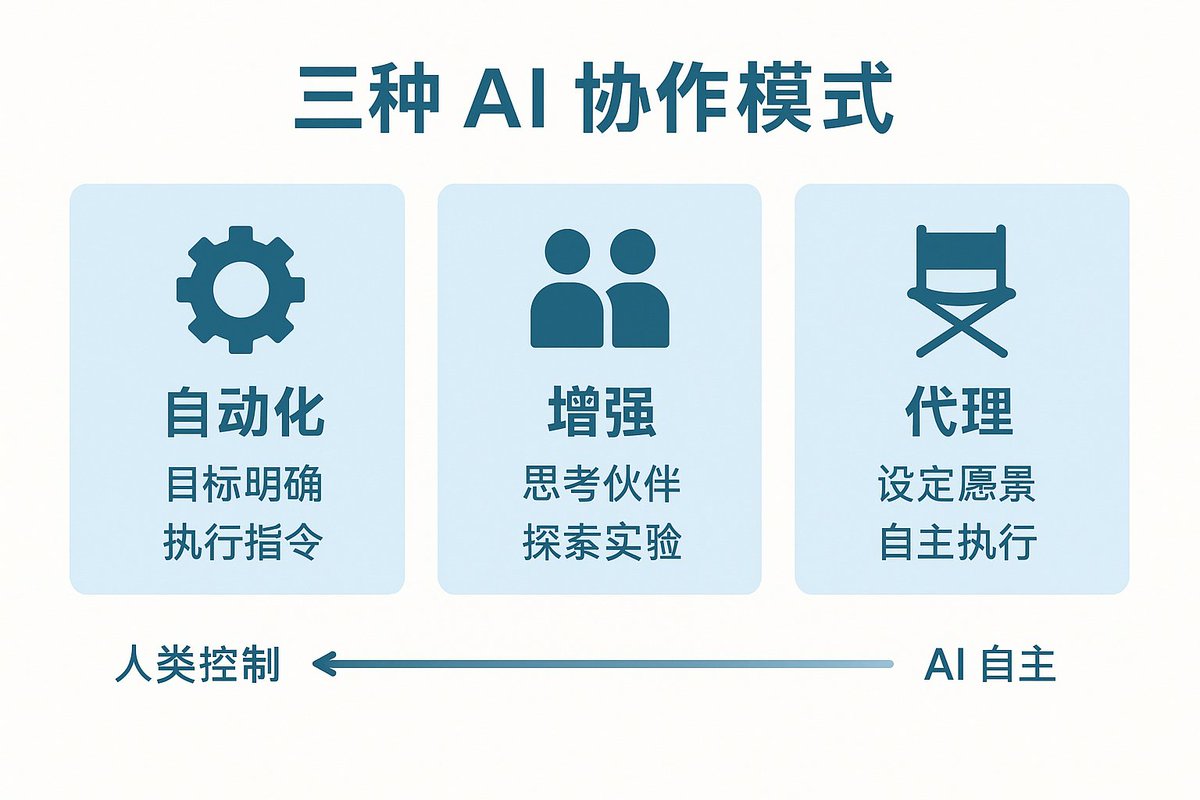
The course first distinguishes three ways of interacting with AI, each suited to different scenarios, and even within a single project they can be mixed.
Automation mode is ideal for tasks with clear objectives. If you know the desired outcome, just give the AI the instructions—it’s like having an assistant run a fixed process.
The augmented mode offers a more valuable way to collaborate. AI serves as your thinking partner—not making decisions for you, but helping you do better. This approach shines most when solutions are unclear and exploration and experimentation are needed.
The proxy pattern lets AI work independently. You’re no longer the screenwriter drafting the script; you’re the director setting the vision. The key is to build the AI’s knowledge and behavioral models, then let it execute on its own.
Enhancement and agent patterns often yield the most creative and effective solutions, because they fully leverage AI’s unique capabilities.
4D Framework: Four Core Capabilities
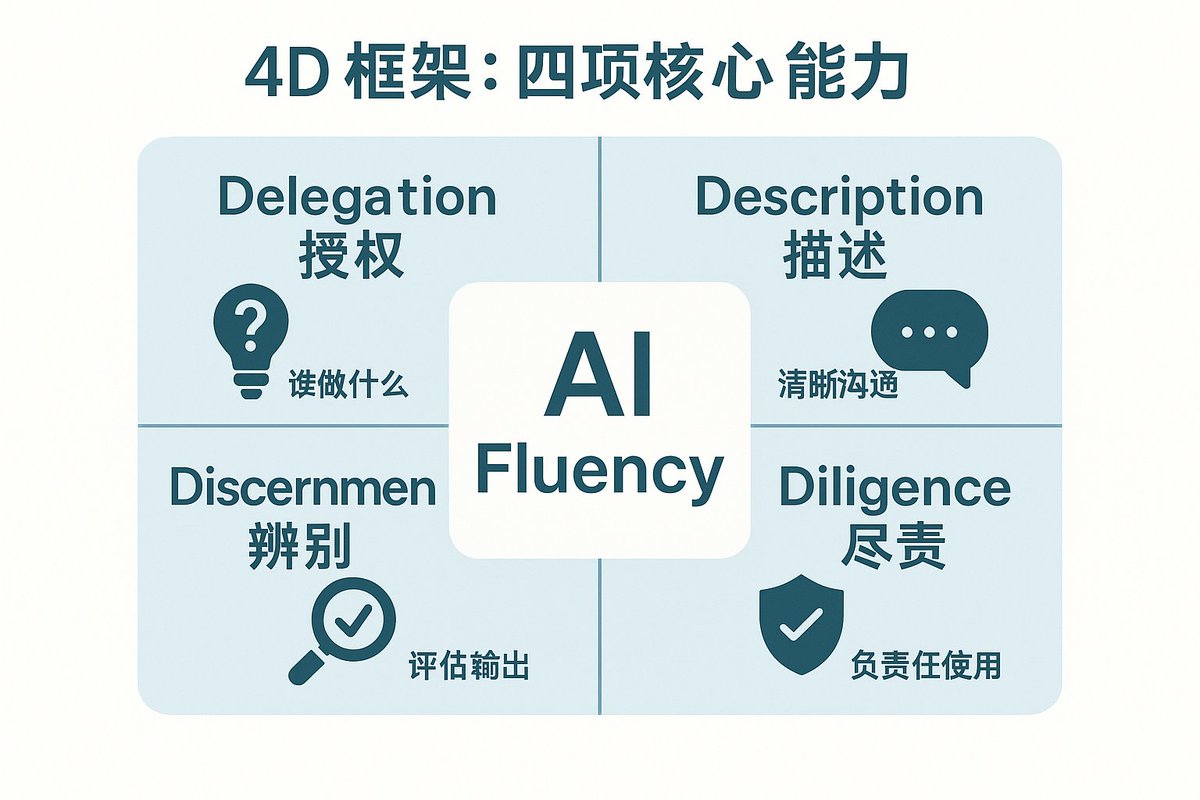
This is the framework of the entire course. The 4 D’s—Delegation, Description, Discernment, and Diligence—together form a comprehensive AI collaboration competency system.
Delegation (Authorization): Deciding who does what
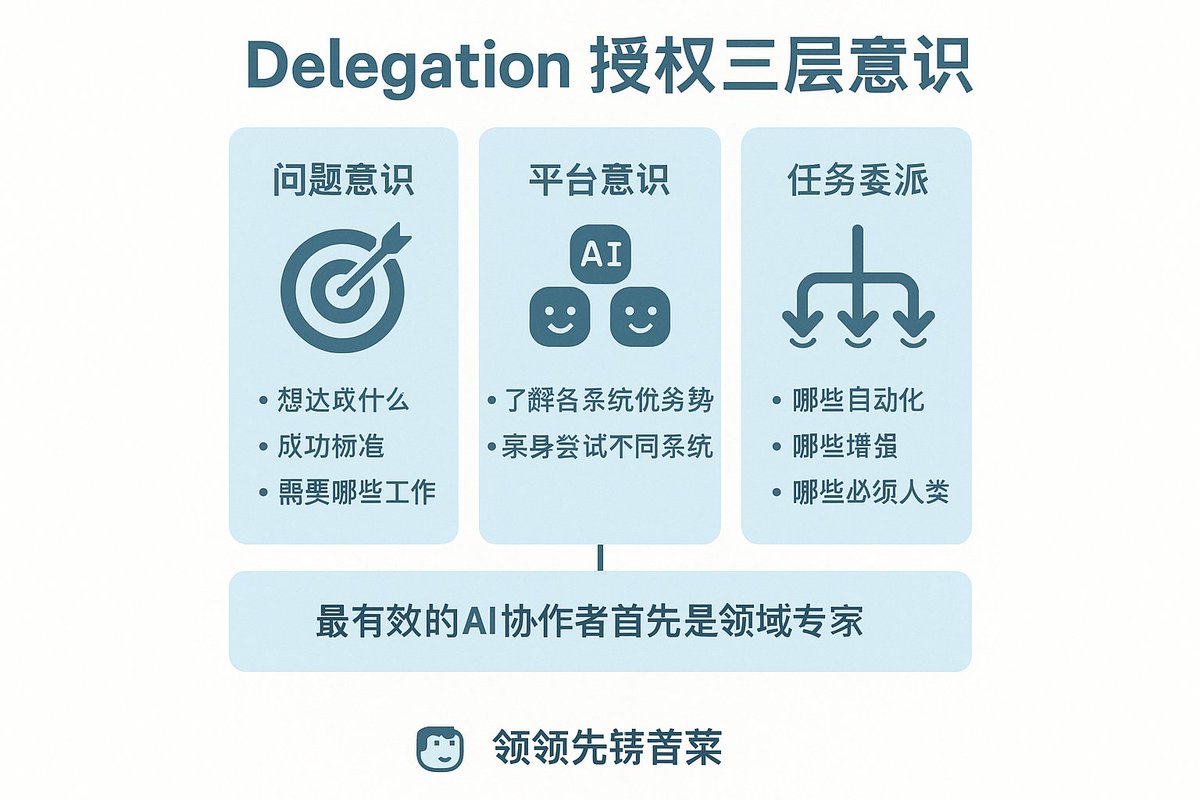
Authorization is the starting point of all collaboration. The core question is: which tasks should you handle, and which should be delegated to AI?
Effective authorization requires awareness at three levels.
Problem awareness is the foundation. Before introducing AI, take the time to clarify a few key questions: What do you want to achieve? What does success look like? What kinds of work will be required?
Platform awareness is about understanding the tools at hand. AI systems differ dramatically in their capabilities: some excel at speed, others at depth. The best way to gauge them is to try out different systems yourself.
Task delegation is truly an art. Think carefully about which steps are suitable for automation, which areas would benefit more from enhancement, and which critical judgments must be made by humans.
The course stresses that the most effective AI collaborators are first experts in their own fields, and only then are AI enablers.
Six Practical Tips and Tricks
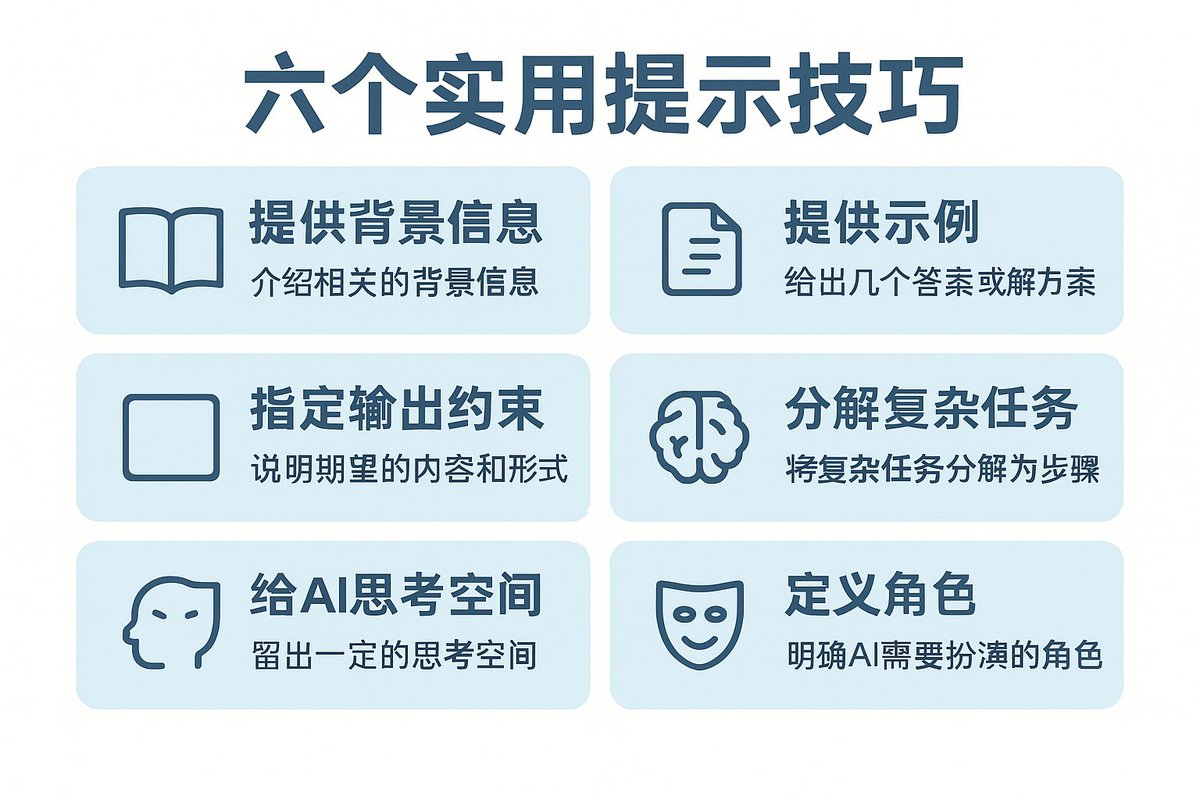
First, provide background information. Don’t just state what you want—also explain why you want it, who you are, and how you’ll use it.
Second, provide examples. Show the AI the sample output you expect, so it can mimic the style and format.
Third, specify output constraints. Turn the vague “Help me design a website” into concrete, detailed requirements.
Fourth, break down complex tasks into clear steps. Outline the workflow you expect, so the AI follows the intended path.
The fifth point is to give AI space to think. Let it analyze first before answering, rather than just spitting out results immediately.
Step 6: Define the role. Tell the AI the persona and perspective it should adopt when responding. You can even ask the AI to help you refine the prompt itself.
Discernment: Evaluating AI Outputs
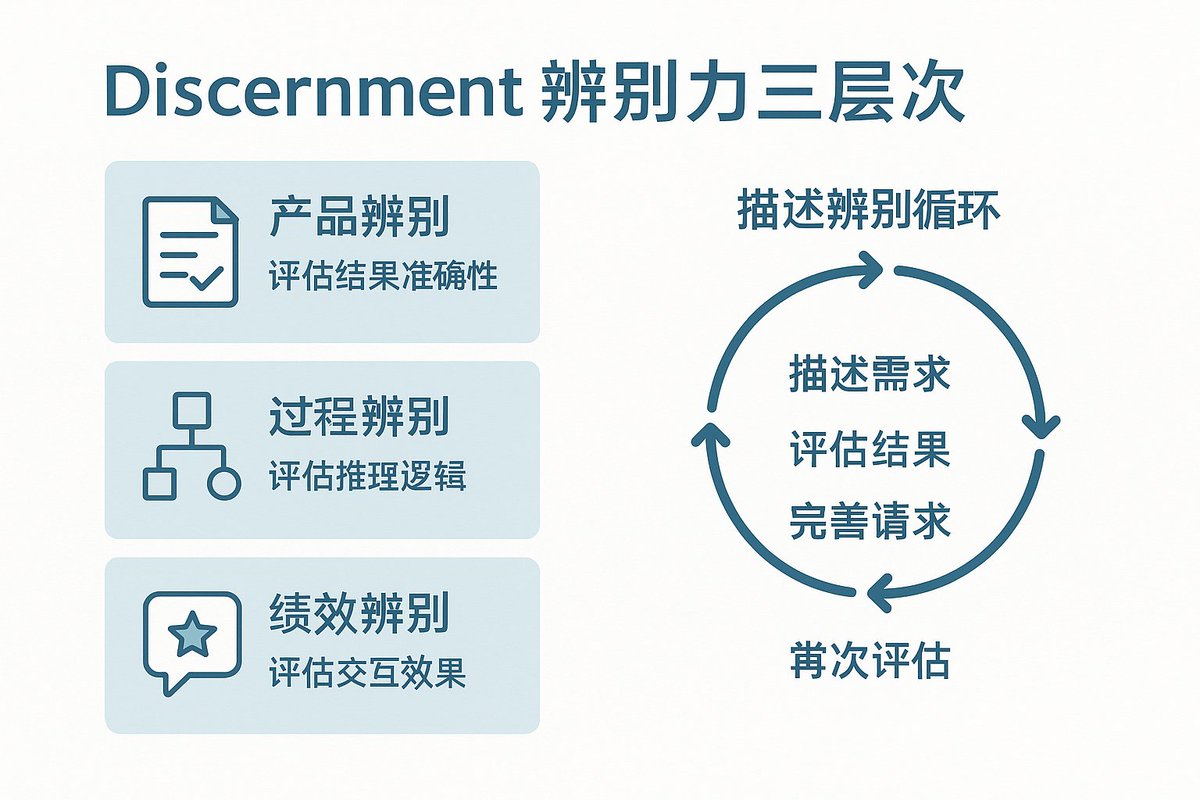
Discriminative ability is the counterpart of description. While description is about clearly conveying what you want, discriminative ability is about judging whether what you receive actually meets your needs.
The product differentiation assessment results themselves: Are the facts accurate? Is the logic coherent? Does it add value?
Process-based evaluation of AI’s reasoning path: Are there logical errors? Is it fixated on details? Does it fall into circular reasoning?
Evaluating the effectiveness of interaction performance: Is the communication method efficient? Does it respond effectively to feedback?
Description and identification form a continuous cycle: describe the requirements, evaluate the results, refine the request, re‑evaluate, and repeat until satisfied.
Diligence (responsibility): Use AI responsibly.
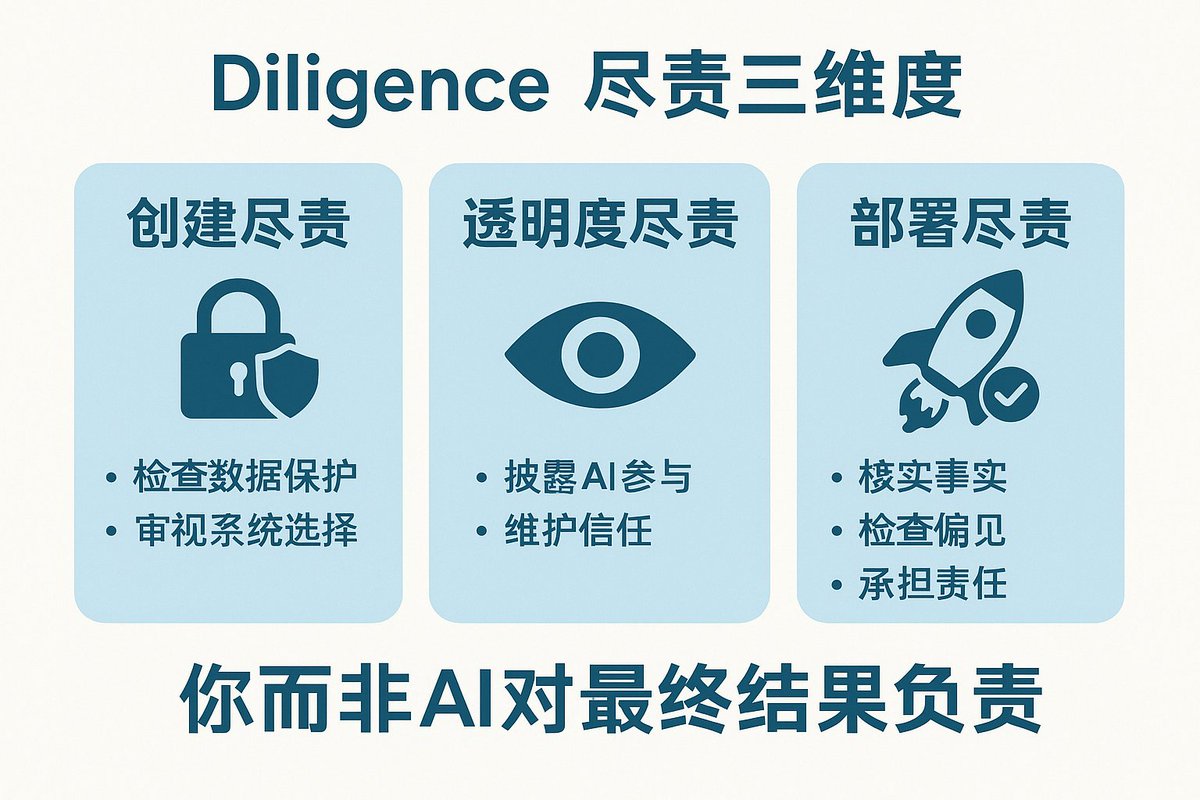
Take responsibility for the AI systems you choose to use and how you use them.
Before sharing sensitive information, check the data‑protection policy.
Transparency and accountability in information disclosure. Who needs to know how much AI is involved in the work? It’s not just a compliance issue—it’s about maintaining trust.
Take responsibility for deployment and final delivery.
When you share AI‑generated content, you—not the AI—bear ultimate responsibility for the outcome.
The complementary strengths of humans and AI
Humans bring critical thinking, judgment, creativity, and moral oversight. AI brings speed, scale, pattern‑recognition capabilities, and the ability to process vast amounts of information.
The course isn’t designed to make you an AI expert overnight; it’s meant to help you shift your mindset. These four abilities develop steadily through practice.
Remember: these systems are powerful, but they’re not a cure‑all. Their effectiveness and safety depend on how we value them. Invest in sharpening your own professional skills so that AI moves from a simple tool to a true intellectual partner. Most importantly, take responsibility for everything you and AI create together.
Source
Author:Jason Zhu
Release time: March 7, 2026 09:57
Source:Original post link
Editorial Comment
The internet is currently awash in "prompt libraries" and "cheat sheets" that promise to turn anyone into an AI wizard overnight. But as any seasoned observer of this space knows, these tactical hacks have the shelf life of an open carton of milk. A technique that works for one model version often breaks the moment the weights are updated. This is why Anthropic’s "AI Fluency" course is such a breath of fresh air. Instead of teaching people how to be better typists, they are teaching people how to be better managers.
The core of the 4D Framework—Delegation, Description, Discernment, and Diligence—represents a fundamental shift in how we view the human-machine relationship. For the past two years, the narrative has been dominated by "Prompt Engineering," a term that always felt a bit inflated for what was essentially trial-and-error guessing. Anthropic is effectively calling time on that era. They are arguing that the future of work isn't about learning a secret language to talk to the machine; it’s about having the professional maturity to oversee it.
I find the "Discernment" pillar particularly vital. We’ve all seen the "copy-paste" trap: a user asks a question, the AI generates a confident-sounding paragraph, and the user moves on without a second thought. Anthropic’s framework forces a confrontation with that laziness. It suggests that you shouldn't just look at the answer; you have to audit the reasoning. Is the AI using circular logic? Is it hallucinating a detail to bridge a gap in its knowledge? By positioning the human as a "process auditor," the framework elevates the user from a passive recipient to an active supervisor. This is where the real value is created—not in the generation of text, but in the verification of it.
Furthermore, this course signals the inevitable end of the "Prompt Engineer" as a standalone job title. When AI literacy is broken down into these universal management skills, it becomes a foundational requirement for *every* role, much like "searching the web" or "using a spreadsheet." If you are a lawyer, a tax consultant, or a software architect, your value won't come from knowing how to write a 500-word prompt. It will come from your ability to delegate the right tasks to the AI and discern when the AI is leading you down a logical dead end.
The reality is that if you don't understand your own field, no amount of AI fluency will save you. You cannot delegate a task you don't understand, and you certainly cannot discern the quality of an output if you lack the expertise to judge it. Anthropic is essentially saying that the "expert" is more important now than ever. The AI is a brilliant, occasionally dishonest intern. You are the partner in the firm. Your job is to provide the vision, set the constraints, and take the ultimate responsibility for the work that goes out the door.
For professionals looking to stay relevant, the advice is clear: stop hoarding prompt templates. They are digital clutter. Instead, start practicing the 4D loop in your daily workflow. Ask yourself: "Am I delegating the right part of this problem? Am I auditing the logic or just the grammar?" This shift from a tactical mindset to a managerial one is how you move from being a user of AI to a master of it. Anthropic has provided the map; now it's up to us to actually do the work of navigating.