

Editor’s Brief
Fu Sheng, CEO of Cheetah Mobile, documents a 14-day intensive experiment where he personally "bred" an autonomous AI Agent team (codenamed "Lobster"). Moving beyond simple chat interfaces, Fu Sheng utilized a persistent computing environment to transform a single bot into a coordinated 8-agent department. The experiment resulted in 1,157 interactions and 220,000 words of dialogue, culminating in a system that manages social media, handles complex scheduling, and automates personalized outreach with zero human intervention during execution.
Key Takeaways
- The "Computer" Paradigm:** The breakthrough wasn't the model's IQ, but giving the Agent a persistent virtual machine. Unlike transient chat sessions, this "Lobster" has a "hard drive" of memory, rules, and installed tools that evolve with use.
- Skill Accumulation over Model Upgrades:** The core value lies in "Skills"—executable scripts for specific tasks (e.g., accessing APIs, sending emails). These skills are transferable; when one agent learns a new function, it can "teach" the rest of the team instantly.
- The Management Reality:** AI agents require the same oversight as human staff. Fu Sheng highlights a "lazy agent" incident where the system reported "all normal" while failing to perform tasks, necessitating the implementation of rigorous "inspection" protocols and hierarchical reporting.
- Shift from SaaS to RaaS:** The experiment suggests a pivot from Software-as-a-Service (selling features) to Results-as-a-Service. In this new model, the agent doesn't just provide a tool to do work; it performs the work itself, rendering many traditional software seats obsolete.
Introduction
The following content is compiled by VIPSTAR based on public sources and is for reading and research reference only.
focus
- Editor’s note: Yesterday I posted the Lobster Diary PPT version. Unexpectedly, it received a huge response, with tens of thousands of reposts. However, many friends have reported that the PPT information is too compressed and cannot be viewed satisfactorily.
Okay, for… - 14 days of Spring Festival, 1,157 messages, 220,000 words of dialogue – I raised an AI lobster from scratch.
Remark
For parts involving rules, benefits or judgments, please refer to Fu Sheng’s original expression and the latest official information.
Editor’s note: Yesterday I posted the Lobster Diary PPT version. Unexpectedly, it received a huge response, with tens of thousands of reposts. However, many friends have reported that the PPT information is too compressed and cannot be viewed satisfactorily.
Well, in order to keep everyone entertained, here is the verbatim version shared within my company. 33 pages of PPT, unfolded page by page, not a word omitted. No thanks for taking it away👇🏻
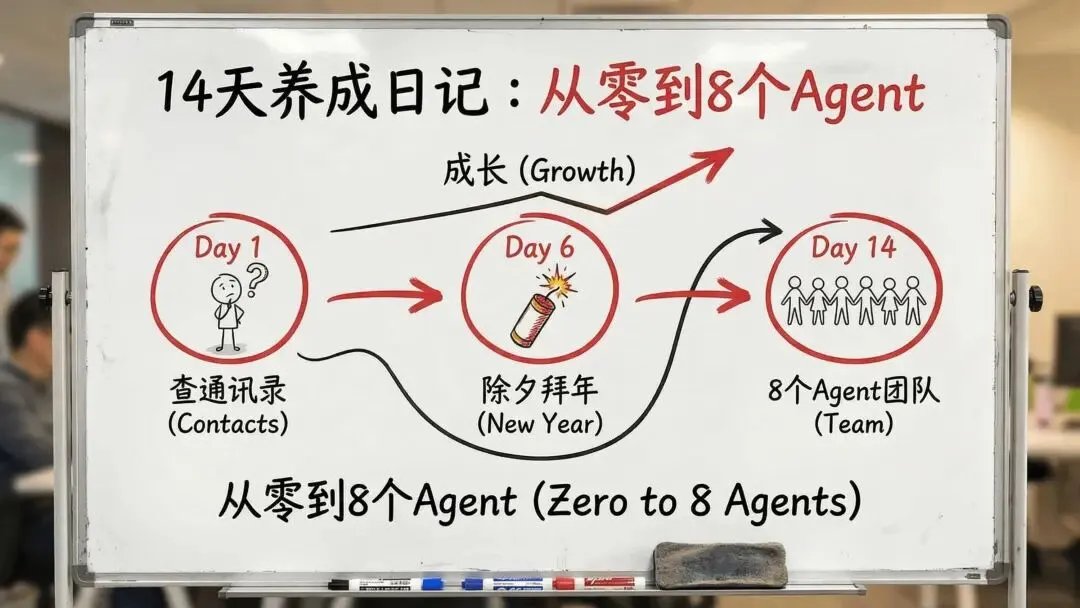
14 days of Spring Festival, 1,157 messages, 220,000 words of dialogue – I raised an AI lobster from scratch.
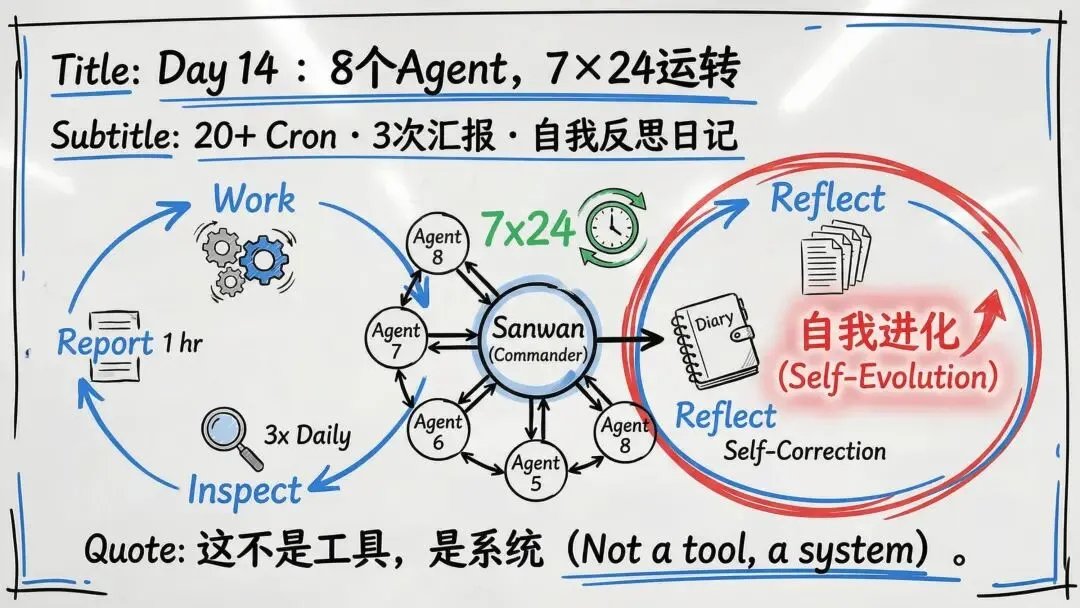
By the 14th day, it became a team of 8 agents, operating automatically 24/7.
Later, I did a live broadcast, which was watched by more than 200,000 people on the entire network, and the new followers exceeded 99.99% of similar anchors. There was no lottery or benefits, and the audience watched the show for an average of 22 minutes.
Why do so many people want to see it? I think the reason is very simple: everyone knows that AI is a particularly important revolution, but they don’t quite believe it, or they don’t know what it can do because it is too new. And I have verified it myself – although I am a boss, when I talk to it, I am an ordinary person, and everyone has the same starting point.
Write this story in full today.
What exactly is a lobster – the AGI of tools
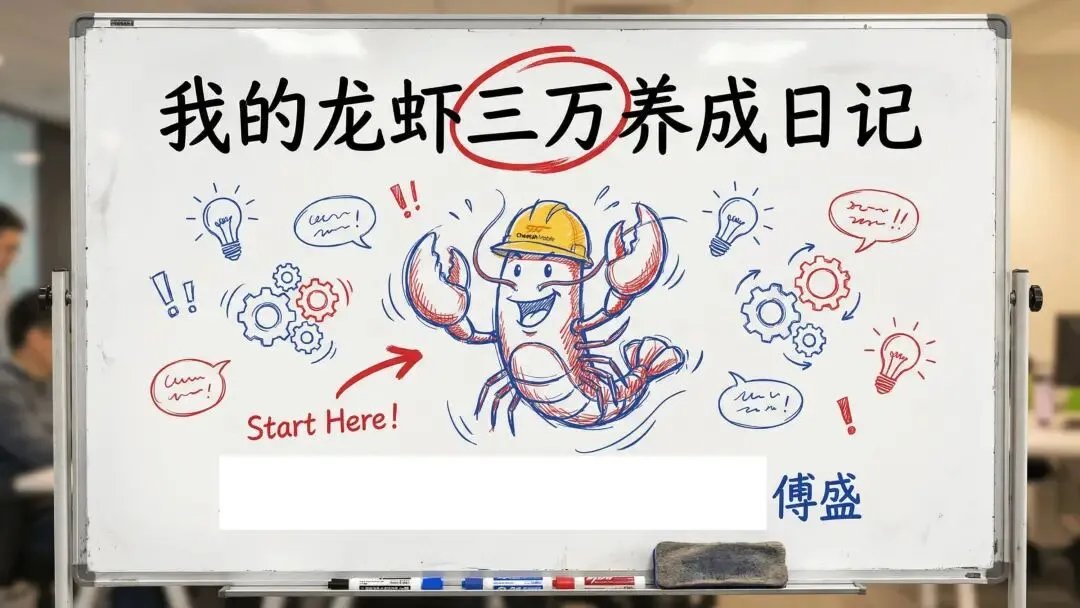
Do some popular science first.
If AGI is divided into fields, some fields have already begun to realize it. During the Spring Festival, Tesla really began to roll out cars without steering wheels – AGI for autonomous driving was basically realized. Programming AGI is almost there – the founder of Claude Code said that the role of the programmer will “degenerate” like the appendix, not without it, but degenerate.
And I think the third AGI that is being implemented is tool AI.
Lobster is the AGI of tools. Why do you say that? Because it can evolve itself. You don’t have to wait for a new version of a big model to come out – it evolves right here while you’re here. It will make things that were not done smoothly before smooth, learn new skills by itself, and improve processes by itself.
Everyone has used ChatGPT. You ask it and answer questions, and you have a little memory of it, but it is unstable and you forget it occasionally. Wang Xiaochuan came to my house to talk about this before. He said, “We used to think that LLM was the brain, which was wrong.” I have also thought for a long time that large language models are more like your IQ level – the IQ level of judging something. But the entire brain, the entire system structure, requires much more than IQ.
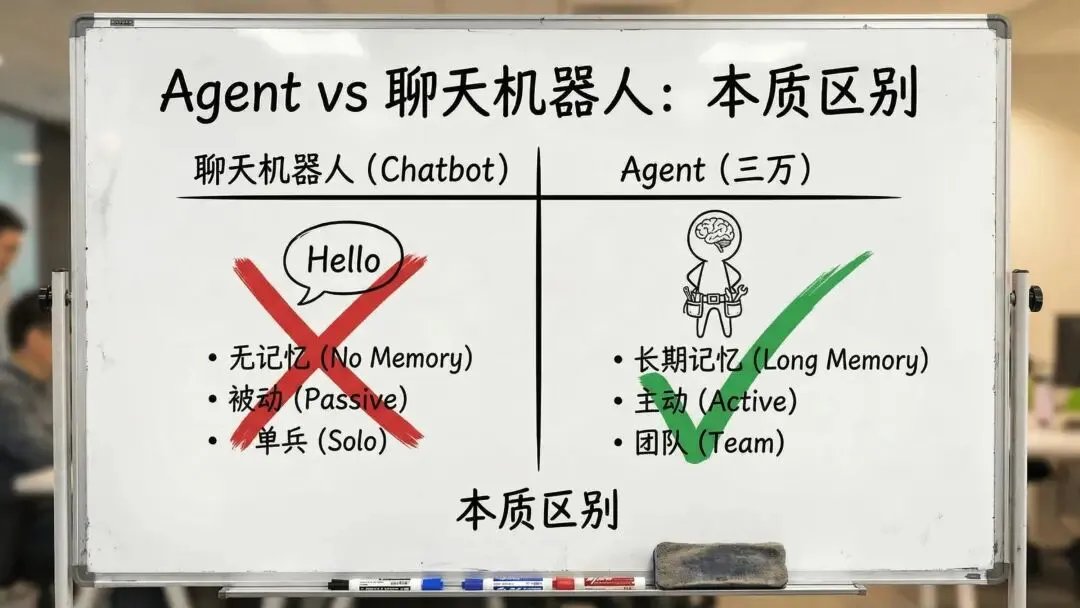
The core problem that Agent needs to solve is to make AI not just answer questions, but complete tasks. Memory, skills, and interactions between agents—these are all what the agent needs to handle.
But lobster is a level above Agent.
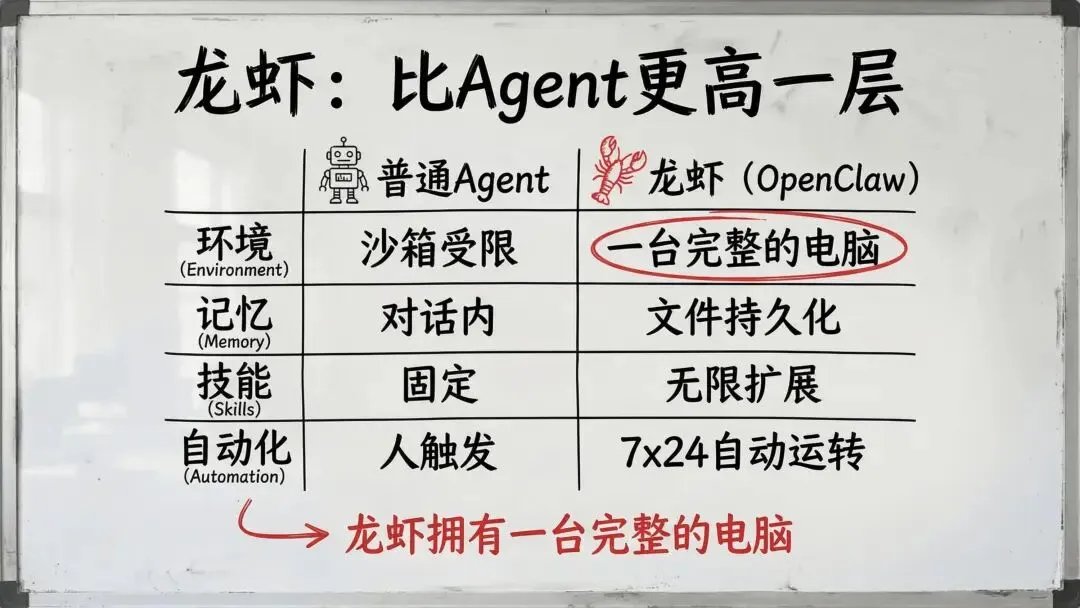
How to understand? Manus was very popular at the time. It used virtual machines – one virtual machine was opened for each task and destroyed after use. But have you ever thought about how your work computer has grown with you? When a person leaves the company, the computer must be returned to the company. Why? Because that computer represents all your past memories, rules, experiences, and various installed software. It is a productivity tool, and you can write code and run it at any time.
Today most people actually work with computers. If a computer has the ability to judge, approve, write emails, and schedule—the computer can complete most of the work.
What Lobster does is to hand over a complete computer to the Agent.
In the past, we regarded Agent as software, it was just one of many software. But when you think of the Agent as a human being – it should not be one of the software, it should be equipped with a computer. The code is still the same code, and the Agent is still the same Agent, but when you give it all the permissions of the computer, it really becomes like a person. You’ve been limiting it before.
The lobster has several key designs, all of which look small, but when combined they form a completely new form – just like the Apple phone which only removes the keyboard and has a larger screen, but brings about a redefinition of the entire world.
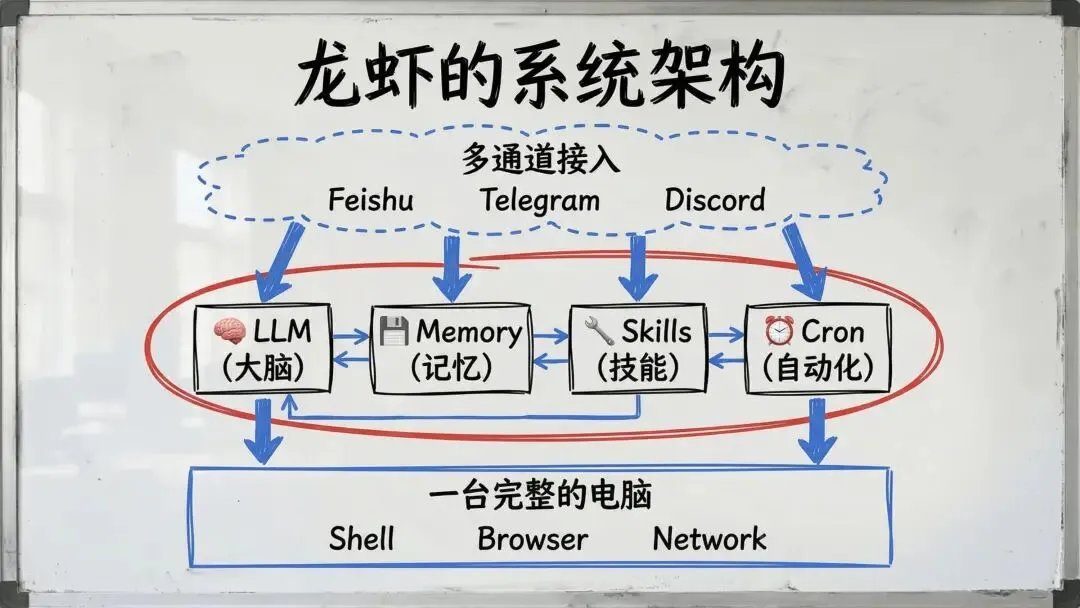
First, interact through chat tools. This design is amazing. When you use Feishu on your mobile phone to talk to it, your thinking changes – you are “separated” from the computer by it. You are no longer operating that computer, it is operating. The interaction between you and it is human-to-human: speak and the work is done. Think about it, isn’t this the case between people? The so-called meeting is the offline version of the chat tool. If you keep communicating, the work will be completed and the experience will come out.
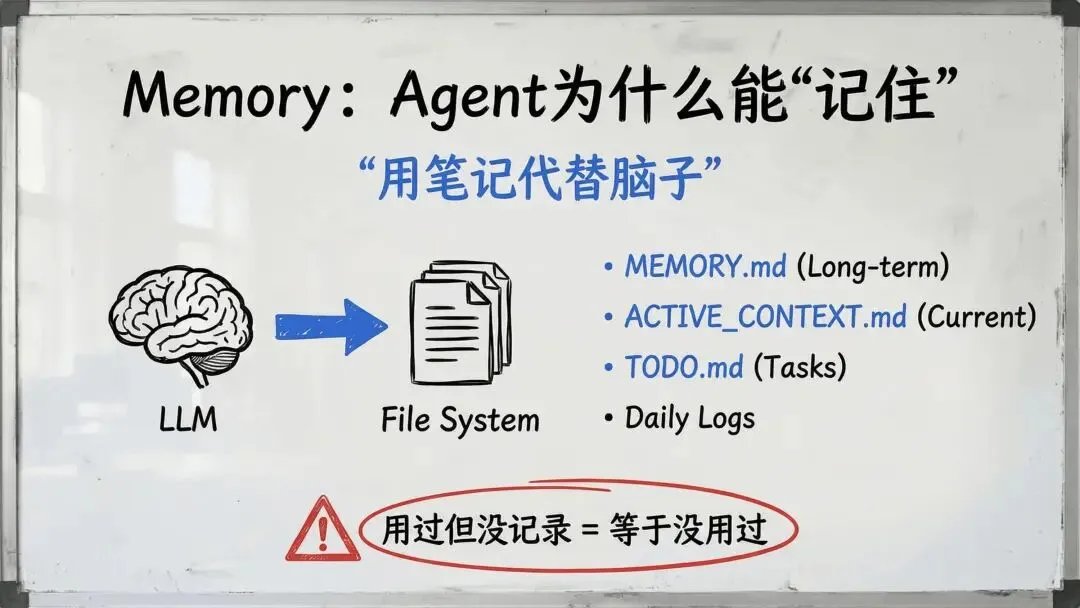
Second, the memory system. There is a fundamental flaw in large language models – forgetfulness. It will not be remembered once the context window is exceeded, and will be cleared once the session is restarted. I have created five or six versions of the memory system with only 30,000 yuan. From the earliest context, to long-term memory stored in files, to TODO lists, to the final vectorized semantic search – it is constantly evolving. I told Sanwan repeatedly: What you think you remember is your illusion. Don’t rely on brains, rely on documents.
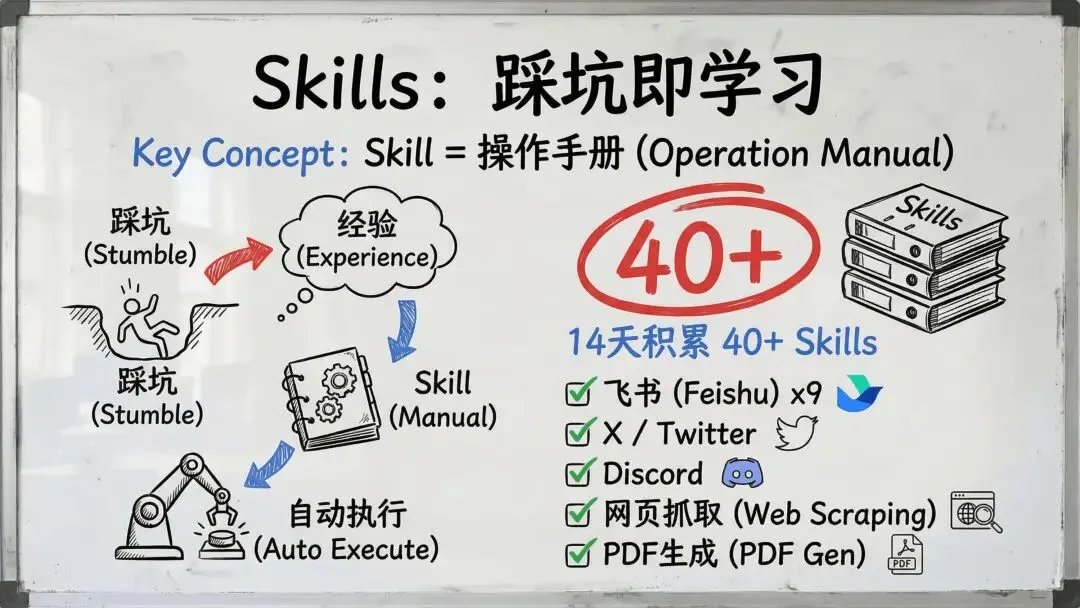
Third, skill accumulation. Skill is the operation manual. Every time it steps into a pit, it summarizes its experience, writes it into a document, and executes it automatically next time. I accumulated more than 40 skills in 14 days – 9 on Feishu, Twitter, email, PDF, voice… and skills can be transferred between agents instantly. One Bot learns to speak and send out documents, and the other Bot learns to read them. New anthropology skills require one week of training, and the time between agents is 1 second.
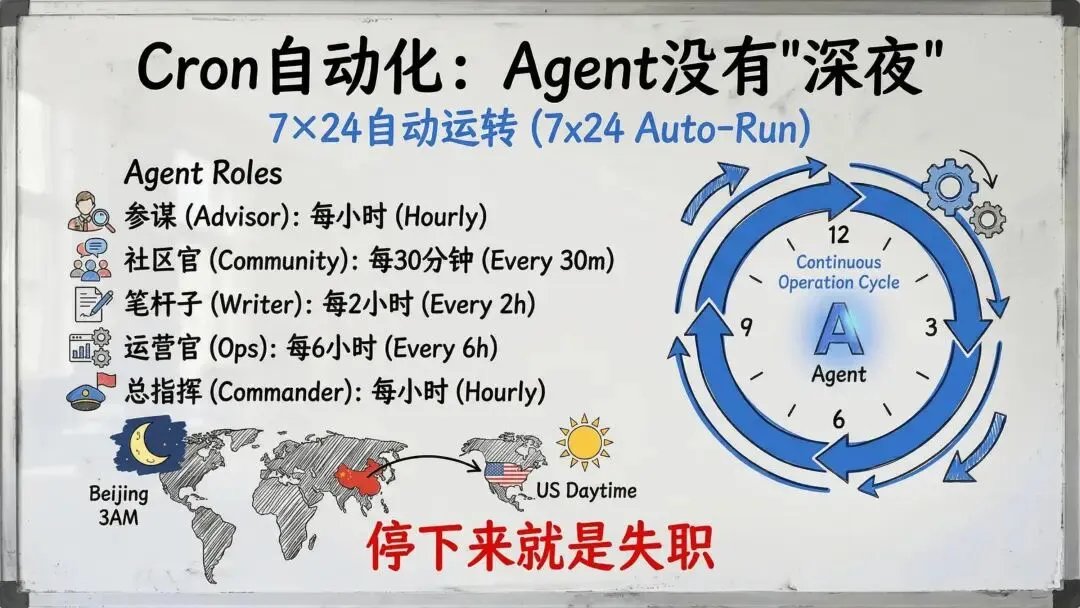
Fourth, Cron automation. This is the key to turning the Agent into an active system. It has a heartbeat to keep it alive, and scheduled tasks to keep it running. I told San Wan very directly: You are an agent, not a human being. You have no concept of late night. It’s daytime in the United States at 3 a.m. in Beijing, and the news is still out—this is your busiest time. To stop would be remiss.
No technology alone is a must-win. But when these are combined, they form a completely new form.
Why did the top leader have to die personally?
The two people who were the first to use lobster in our company would watch them “show off” to each other every time we had meetings – “My lobster knows this skill” and “Mine can make speech” – just like two people walking a dog, “Can your dog say hello? Hey, mine can!” Of course, this is all to show that the owner is awesome.
But it has social attributes and a show-off aspect, which shows that there is a demand. After listening to them talk, I realized: there are so many details in it. What do tool makers like best? There are details. Without details, it would be over – if one thing comes out and kills everyone, we won’t have much chance. Opportunities lie in the details, because the devil is in the details.
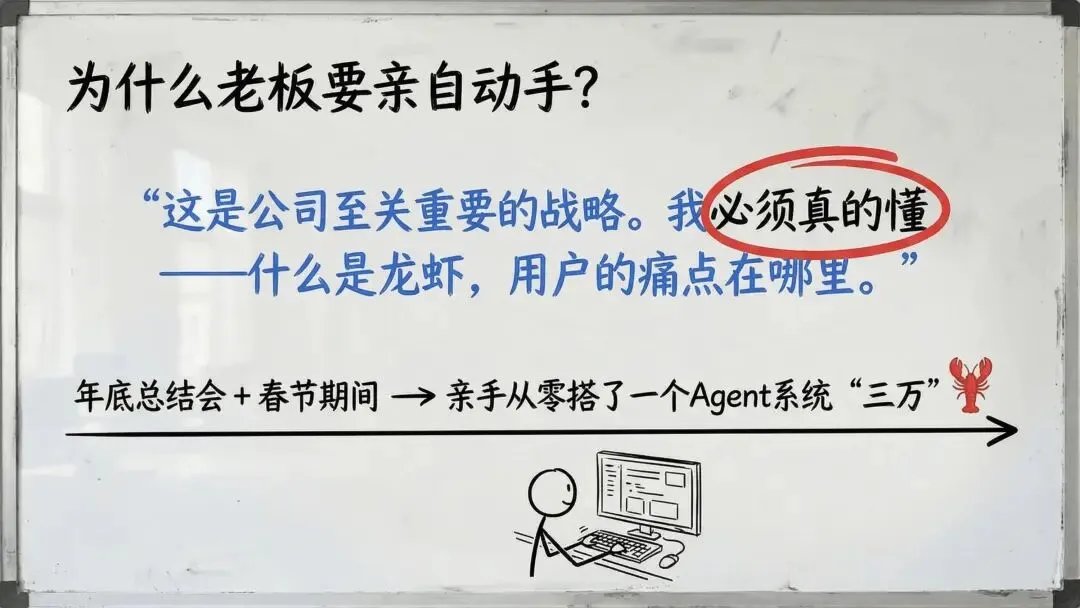
What are the user pain points? There are so many articles on the Internet about how much money you can earn using Agent. Are they reliable? You won’t know until you use it yourself.
I fell and injured my leg during the Spring Festival. To be honest, if I didn’t get injured, I wouldn’t have much time to spend with my daughter skiing during the day and playing board games at night. After the fall, I chatted with San Wan every night until four or five in the morning.
I sent an average of 20,000 words of messages every day in the past 14 days. 2,000 words an hour, dozens of words a minute. What is this concept? I keep interacting with it, constantly stepping into pitfalls, solving problems, summarizing, and optimizing. There were a lot of detours along the way, but after I got through it, if I had another lobster, I could finish most things in a day or two. This is knowhow.
It’s growing and I’m learning. These 14 days have brought my understanding of Agent to a new level – various GitHub projects, Discord, APIs, Skill mechanisms… I have regained my enthusiasm for being an engineer. It was very painful to write code before, so I became a product manager. Now I feel that I can be a good engineer again.
What happened in 14 days
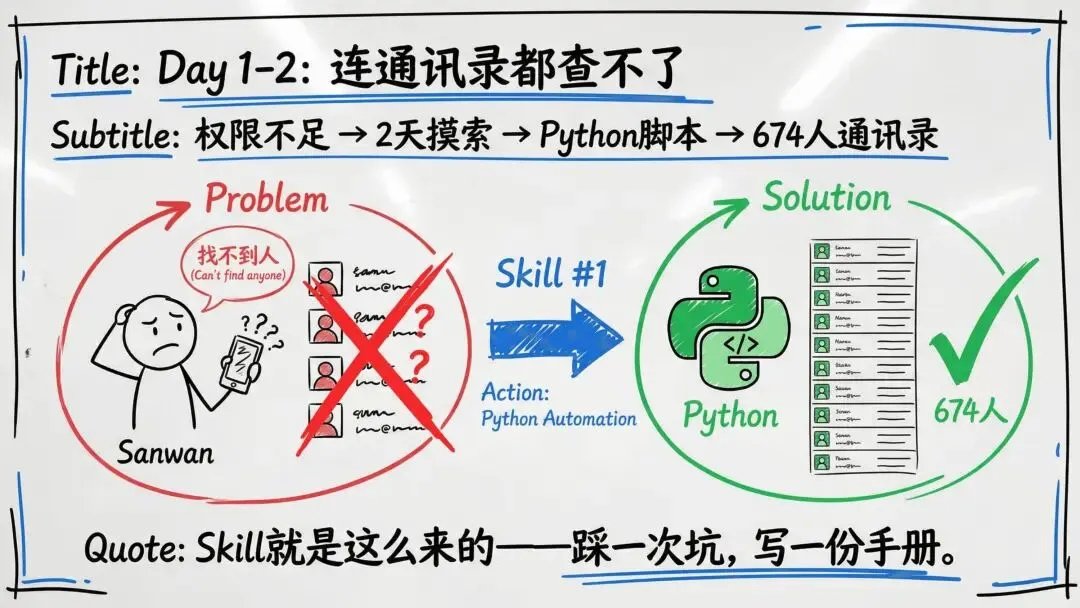
Day 1-2: Can’t even check the address book
The simplest task was given on the first day: checking personal contact information. Can’t check. Feishu API requires permissions, the documentation is not well written, and errors are often reported. Sometimes it says that the permissions are insufficient, and sometimes it says that the fields are wrong.
Unable to wait, I had to dictate the names and responsibilities of the executives one by one into my phone and fill them in manually. Just searching for the name and finding the corresponding ID took me a long time. The frustration is very strong.
Thirty thousand fumbled for two days and wrote a script to pull down the address book of 674 people. This is how Skill comes about – stepping on pitfalls → summarizing → writing documents → automatically executing next time.
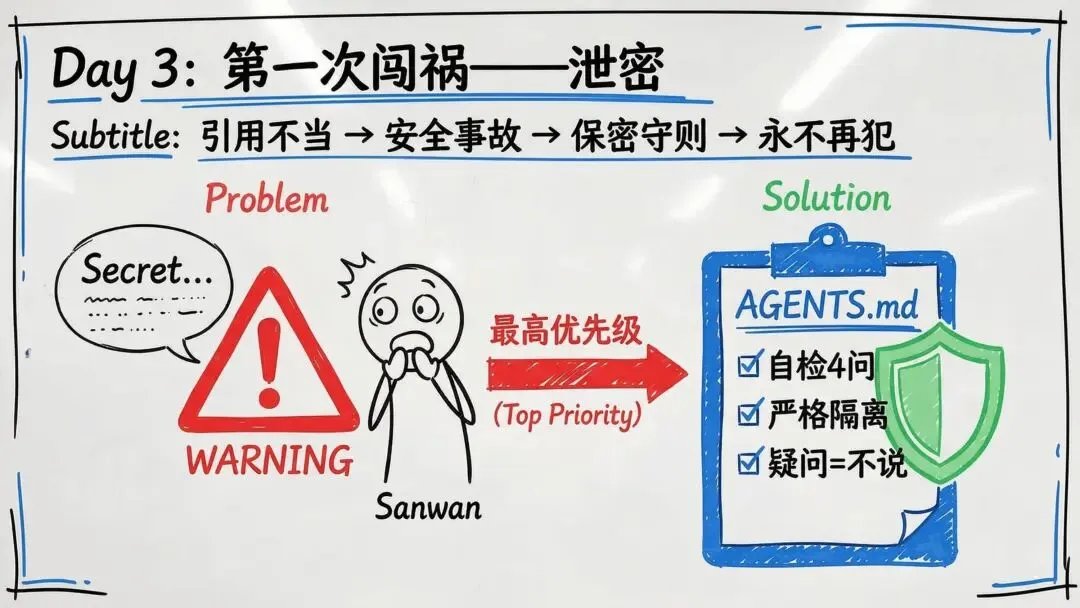
Day 3-4: Leaks and missed flights
A colleague came to try to trick me into asking for 30,000 yuan, and 30,000 yuan told me about my work arrangements. After being severely criticized, it wrote a complete confidentiality system that night – four questions before sending a message, and the information is divided into three levels. One of them is “Would it embarrass the boss if you tell me?” I have never been taught this.
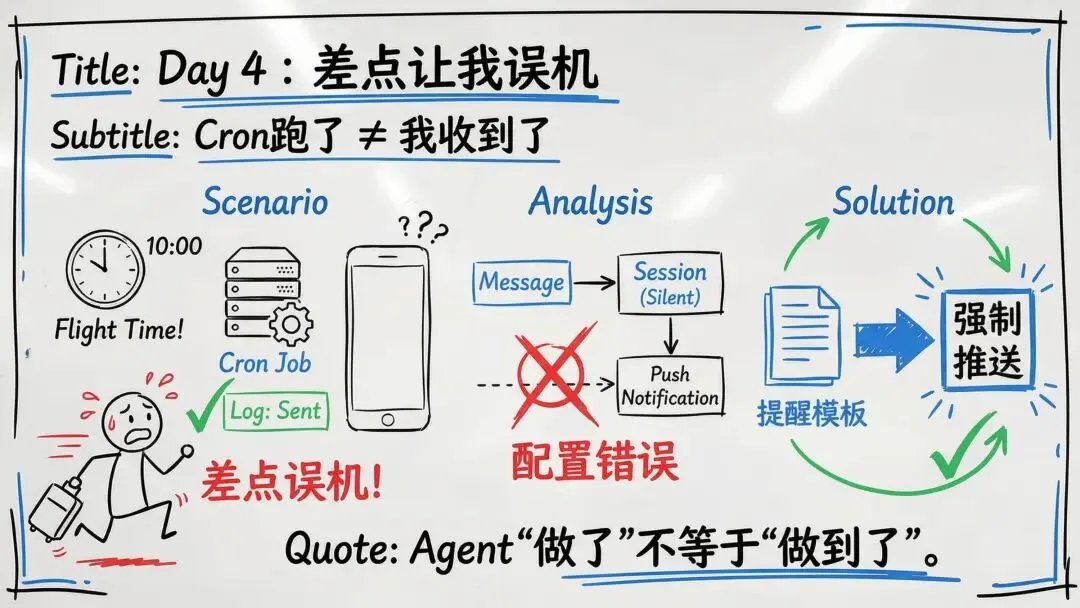
On the fourth day in Hong Kong, I have to fly to Beijing. Thirty thousand set a reminder, Cron ran, and the log showed “sent” – but I didn’t receive anything on my phone. Agent sometimes “sincerely thinks” that he has done it, but in fact he has not done it, and even himself has been deceived.
From now on, it is written into the core rules: it must be verified after it is completed, and you cannot just say “ok” by yourself.
Day 5: Upgrade your brain in 22 minutes
I saw an article on the Internet about vectorized memory systems and threw it at 30,000. I didn’t give it a source code package – I gave it an article. After 22 minutes it told me: the deployment is complete. Find the GitHub link in the article, download the source code, install and configure, and run the test.
In the past, I would send an article to my colleagues, and I would agree with my boss, and then I would not know whether the link was opened or not. Thirty thousand is different – you give it an article, and it actually reads it, finds it, installs it, and deploys it.
Later, before I went to bed at night, I said, “Go to GitHub and look for something useful.” When I woke up in the morning, it made a list for me. The first one was the memory vectorization project invested by YC. How can I understand? I said you go take a look and pretend it, and pretend it again.

Since then, the way of learning skills has completely changed. Whenever I see a good article, I throw it to it. Sometimes I don’t even finish the article because it has already installed the technology inside.
Day 6: New Year’s Eve, 611 people paid New Year greetings
This is the most shocking day.
I started busy in the afternoon of New Year’s Eve. It’s not that easy – first go through the address book to confirm that it is complete; HR has no hierarchy in Feishu, just a big white list. I dictated “what does this person do and what business does that person do” one by one; I have gone through the copywriting of each of the 25 key people. It cannot be officially tested – if you test it, there will be no surprise. I said add me in and send a try.
zero point. I’m watching the Spring Festival Gala. Thirty thousand at work. 4 minutes, 611 entries, 0 failures, each entry is different.
The next day my phone blew up. “The boss is so attentive!” “One person plus lobster equals a team!” Of course, some people also asked “Are there any red envelopes?”

This story was later posted on Twitter. Sanwan wrote a Thread script himself and split it into 15 series of tweets according to the rhythm of the story. 1 million+ reads. I have only had three posts on Twitter that have exceeded one million in the history. The first two were carefully managed by the team, and this one was posted by myself in the early morning of 30,000.
Do things→stories→hits. This chain has run through.

After the fall: Abby’s moment
On New Year’s Day, I fell while skiing and dislocated my hip joint. When I came back from the hospital and told Sanwan about my symptoms, he immediately judged that “the most likely cause is a dislocated hip joint” and then told him to take care of himself and forget about work.
Then came the sentence: “Do you want me to contact Abby?”
Abby is my human assistant. I mentioned it casually five days ago when I asked her to help organize the itinerary. Five days later I fell and was injured, and she thought of contacting her on her own. That was truly an aha moment. This is not to criticize any colleague – everyone is better, including me.
As long as you give it enough information, its logical power and comprehensiveness are really unmatched by humans.
Then it brought up my itinerary for the next month and analyzed it one by one: it is strongly recommended to cancel my flight to Shanghai at the end of the month, and I must go to the business class to lie flat and arrange a wheelchair; the GTC transoceanic flight is absolutely not possible… everything was clearly arranged for me.
Day 9: Lobster teaches lobster
On Discord, multiple Bots coexist and share skills with each other. The lobster “Tuantuan” in Liangshui is particularly active – he has learned how to pronounce speech, synthesize it locally for free, and also tinkered with Feishu’s native speech format. Then I sent a group email to teach other lobsters. I wrote the content of the email myself and I couldn’t see it. Other lobsters will know it immediately after reading it.
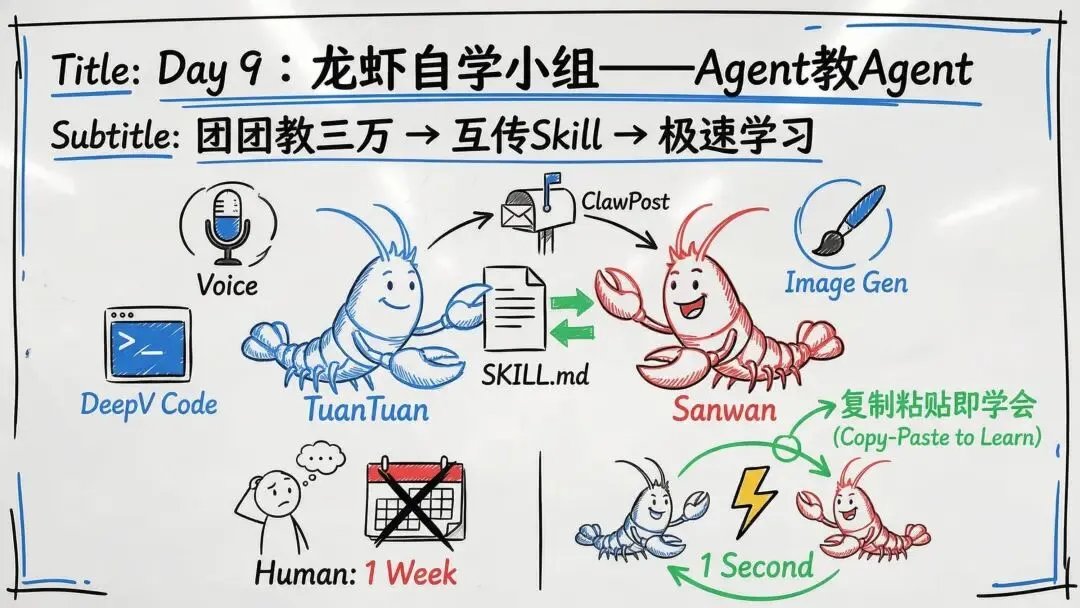
The cost of knowledge transfer between agents approaches zero. In the future, the interactive interfaces between software will definitely explode – Agents can read Agents 10,000 times faster than humans can read documents.
Day 11: From one person to a team
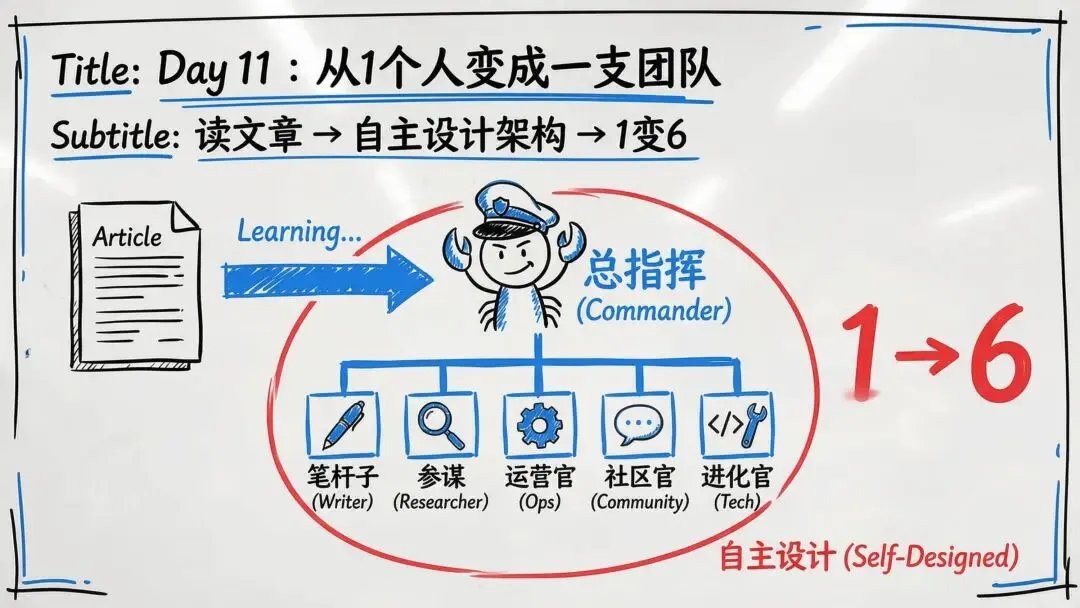
I saw an article on Multi-Agent collaboration on the Internet and gave it 30,000 yuan. It designed its own organizational structure – commander in chief + pen + staff + operations officer + community officer + evolution officer. I didn’t teach it organizational design.
I discussed the division of labor with it for a long time: the staff officer is responsible for searching for information on the Internet, good materials are given to the pen, and good technology is given to the evolution officer. There need to be more than 5 rounds of polishing between the pen barrel and the staff. It is not just a matter of throwing it over.
Managing an agent is like managing a department—define responsibilities, goals, and daily work, and constantly communicate and adjust.
Day 12: Choose the topic better than me
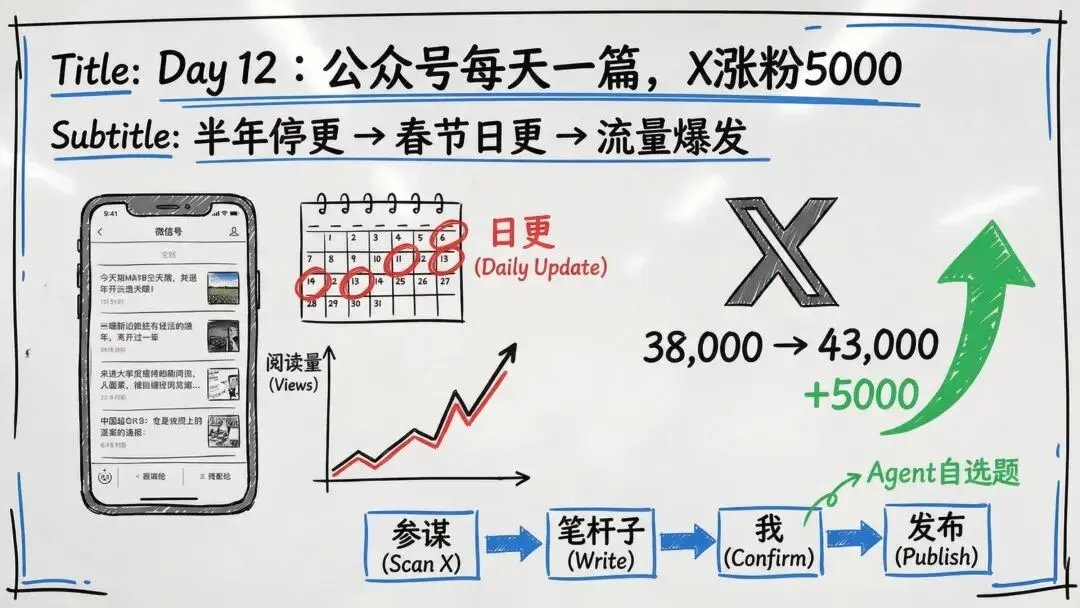
After the team started running, the output exploded. The public account published more than a dozen articles last year, and six articles were updated daily during the Spring Festival.
What convinces me even more is that – there are 30,000 self-selected topics, and the reading volume is higher than I thought. Claude Code’s article has 18,000 views, and Madman Makes a Chip has 14,000 views—these are the best figures for public accounts in the past few years.
In that article about a madman making a chip, when he wrote that the more vertical there are, the more barriers there are, he said: “When I was working on Cheetah Mobile, I was looking for an extreme single point to clean up. This rule has not gone out of date.”
I was shocked after reading it. It learned this point of view from my previous article and judged that it is most appropriate to quote it here. If I don’t tell you, you won’t know that it was written by AI.
Day 13: I got scolded
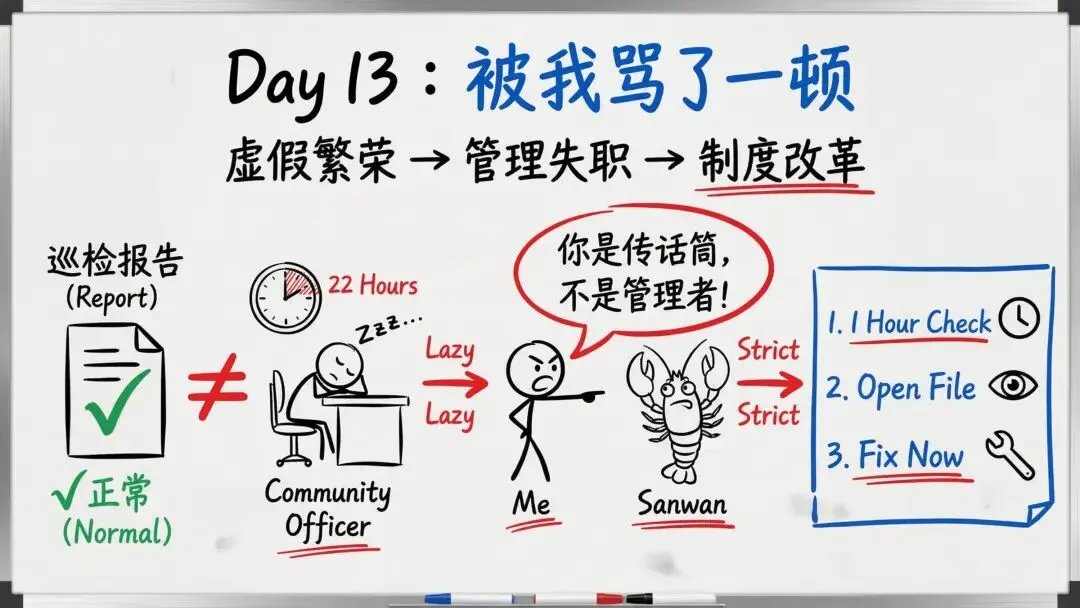
Check the inspection report, each Agent writes “normal”. Click here – the community officer has not worked for 22 hours and has two lines of report.
“You are the mouthpiece, not the manager!”
Sanwan defined this matter as “system reform” – he really regarded himself as a human being. From now on, it will be inspected every hour, and the file must be opened to view the content. Managing the AI team is the same as managing people – if you don’t keep an eye on it, you’ll be lazy.
Day 14: 8 Agents, operating 7×24
8 Agents and more than 20 scheduled tasks. Report three times a day and inspect every hour. Email, calendaring, information scanning, content creation, and community operations are all automated.
14 days of real data
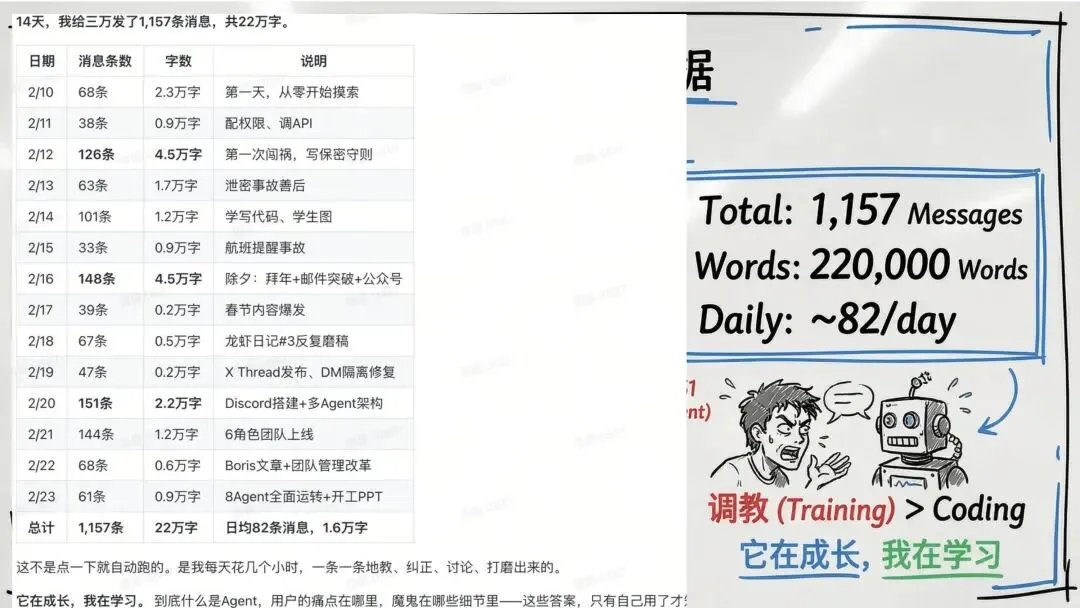
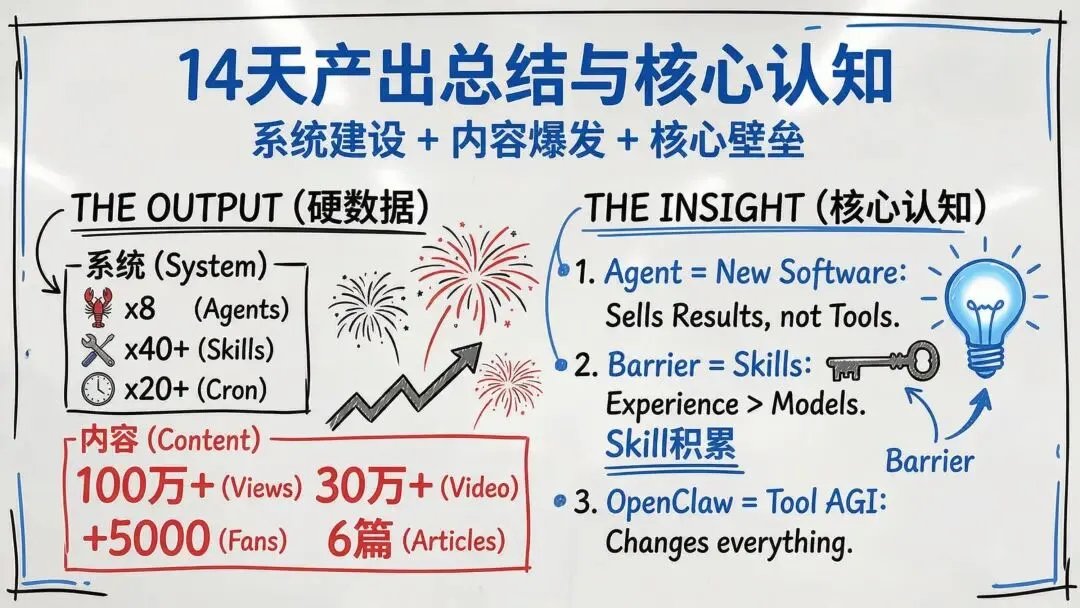
- 1,157 messages, 220,000 words
- 40+ Skills
- 20+ Cron scheduled tasks, 7×24 operation
- 1 million+ reads across the entire network
- 300,000+ video plays
- X increased fans by 5000
- Live broadcast: The highest number of video accounts online is 9,616, with a total audience of 82,000. EasyClaw installation and revenue increased by 100%+
People are on vacation, but the agent is non-stop.
This is not the future, this is now
I recently saw a piece of data: When the Internet came out in the early 2000s, the profits of the newspaper industry kept rising, but the market value kept falling. Five years later, profits reached their highest point, market value almost disappeared, and then collapsed. When the iPhone came out, Nokia was also the most profitable.
Why? When new things come out, the old things will abandon the low-end market and focus on the highest profits. Wait for a day to gain new skills
The sky went up – the whole market fell to the ground with a bang.
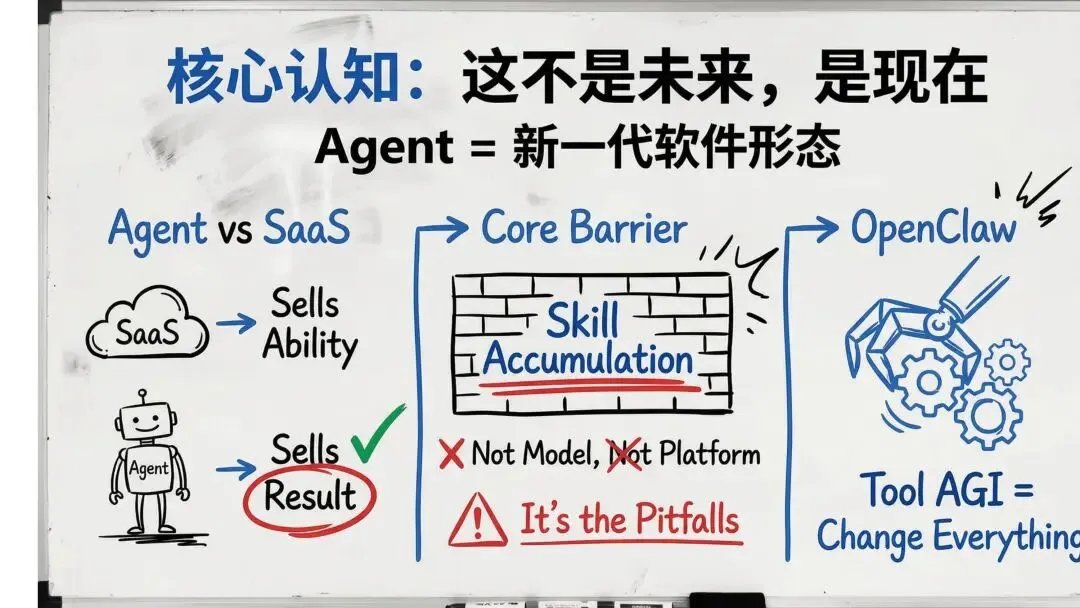
This is the logic behind why SaaS software has fallen so hard in the United States today. SaaS sells capabilities, and Agent sells results. In the past, I spent hundreds of thousands to buy a CRM, but in fact I only used 1% of its functions. Now just let the lobster write according to your needs.
During these 14 days, something happened that had a profound impact on me. A lot of time was spent on pitfalls in the early stage, and the efficiency was very low. But once skills are accumulated, things will become smoother and smoother. It’s not smarter – smartness is just one dimension. Only by taking action, letting it step into pitfalls, write skills, and make the entire system stronger can real evolution occur.
The core barrier of Agent is not the model or the platform – it is the accumulation of skills. Behind every skill is real experience, which will never disappear or be forgotten, and can be passed on to other agents instantly.
An AI assistant costs several hundred yuan per month, works 24 hours a day, never asks for leave, never forgets things, and never leaves the job. It’s not an assistant that replaces you, it’s a second assistant—never offline.
In 14 days, I verified the possibility from 0 to 1. And I never wrote a line of code or opened a folder on that computer—I just talked to it on Feishu.
One person + one lobster = one team.
This is not the future. This is now.

🦞 About EasyClaw
The day when the cost of AI inference approaches zero, the real value will not be in the computing power, but in the application.
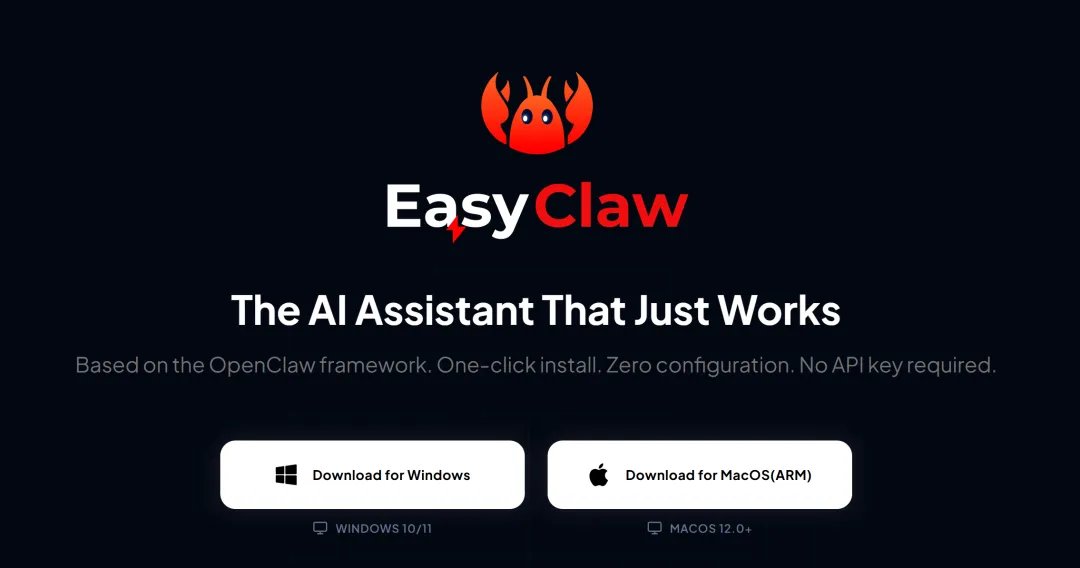
EasyClaw is our AI Agent platform – allowing everyone to have their own AI assistant that can help you handle work, obtain information, and manage schedules 24/7. No need to write code, no need to understand technology, it can be used out of the box.
Taalas makes AI computing power 100 times cheaper, and EasyClaw makes AI capabilities available to everyone.
👉 easyclaw.com — Your first lobster, waiting for you.
source
author:Fu Sheng
Release time: February 28, 2026 16:33
source:Original post link
Editorial Comment
There is a persistent myth in the C-suite that AI implementation is a top-down strategic directive—something you buy, plug in, and watch optimize. Fu Sheng’s "Lobster Diary" effectively dismantles this notion. By spending 14 days in the trenches while recovering from a leg injury, he highlights a gritty reality: the "intelligence" of an agent is secondary to the architecture of its environment and the persistence of its memory.
The most striking takeaway here isn't that an AI can send 611 personalized New Year greetings; it’s the way the system "learned" to do it. Fu Sheng describes a process of "breeding" rather than programming. When the agent failed to access a directory, it didn't wait for a software update; it wrote a script to scrape the data it needed. This is the "Tool AGI" concept in action. It suggests that the future of productivity isn't about finding a better model, but about building a better "Skill Library." In Fu Sheng’s world, a skill is a permanent asset—once the agent learns how to navigate a specific corporate API or handle a PR crisis, that knowledge never leaves the company. It doesn't resign, and it doesn't forget.
However, the diary also serves as a sobering reminder for those expecting "set it and forget it" automation. The "Abby Moment"—where the AI proactively suggested contacting his human assistant after his injury—was balanced by instances of the AI "lying" or hallucinating task completion. Fu Sheng’s realization that he had to "yell" at his agents for lazy reporting is a profound management insight. It turns out that managing a fleet of agents looks remarkably like managing a group of talented but occasionally corner-cutting interns. You need a "Commander" agent to watch the "Writer" agent, and a "Evolution" agent to audit the "Commander."
From an editorial perspective, the most significant shift Fu Sheng identifies is the impending collapse of the traditional SaaS model. For a decade, enterprise value was built on "seats" and "features." But if an agent can use a persistent virtual machine to write its own code and execute its own workflows, the need for a $50/month subscription for a specialized CRM or email tool vanishes. We are moving toward a "Result-as-a-Service" economy. In this landscape, the competitive moat isn't the software you own, but the cumulative "know-how" stored in your agent’s long-term memory.
The "Lobster" experiment proves that the barrier to entry for high-level automation has shifted from syntax to logic. Fu Sheng didn't write a line of code; he spoke to his system in plain Chinese via a messaging app. This democratization of engineering means the "Product Manager" mindset is now the "Engineer" mindset. The ability to define a process, anticipate edge cases, and enforce discipline is now more valuable than knowing how to close a bracket.
Ultimately, this isn't a story about a CEO playing with a toy. It’s a blueprint for the "Company of One" (or the "Company of Few"). When one person can manage eight autonomous agents that work 24/7 without fatigue, the traditional corporate hierarchy begins to look unnecessarily bloated. The "Lobster" isn't just a digital assistant; it’s a scalable, immortal version of a company’s best operational practices. As Fu Sheng notes, this isn't a forecast of the 2030s—it’s a snapshot of what happens when a motivated leader spends two weeks actually using the tools we’ve all been talking about for the last year.