

Editor’s Brief
This article is best used as an operational reference: it surfaces a clear claim, a usable method pattern, and practical constraints that should be tested before scaling.
Key Takeaways
- IntroductionThe following content is compiled by VIPSTAR in combination with X/social media public content and is for reading and research reference only.
- Our company's CFO didn't know a line of code, so he let his lobster join a technical group.
- As a result, book air tickets, trains, hotels, change tickets, pick up…Two days ago, our company's CFO showed me his lobster.
- RemarkFor parts involving rules, benefits or judgments, please refer to Fu Sheng’s original expression and the latest official information.
Introduction
The following content is compiled by VIPSTAR in combination with X/social media public content and is for reading and research reference only.
focus
- This happened two days ago.
Our company’s CFO didn’t know a line of code, so he let his lobster join a technical group.
As a result, book air tickets, trains, hotels, change tickets, pick up… - Two days ago, our company’s CFO showed me his lobster.
Remark
For parts involving rules, benefits or judgments, please refer to Fu Sheng’s original expression and the latest official information.
Editorial comments
This article “X Import: Fu Sheng – The CFO who doesn’t understand code lets Lobster handle the air tickets and hotels, and lives a better life than me” comes from the X social platform, and the author is Fu Sheng. Judging from the completeness of the content, the density of key information given in the original text is relatively high, especially in the core conclusions and action suggestions, which are highly implementable. This happened two days ago. Our company’s CFO didn’t know a line of code, so he let his lobster join a technical group. As a result, booking air tickets, booking trains, booking hotels, changing tickets, and canceling everything was all done. And I was bedridden with a broken bone and couldn’t go anywhere. His lobster took care of all the travel for him, and he just gave orders and flew around – living a more prosperous life than me. This is not a technology story. This is a story about “knowing what you want”. Two days ago, our company’s CFO showed me his lobster. I thought he was going to show me some financial analysis, or strategic… For readers, its most direct value is not “knowing a new point of view”, but being able to quickly see the conditions, boundaries and potential costs behind the point of view. If this content is broken down into verifiable judgments, it would at least include the following levels: This incident happened two days ago.
Our company’s CFO didn’t know a line of code, so he let his lobster join a technical group.
As a result, we booked air tickets, trains, hotels, changed tickets, and picked up… Two days ago, our company’s CFO showed me his lobster. . Among these judgments, the conclusion part is often the easiest to disseminate, but what really determines the practicality is whether the premise assumptions are established, whether the sample is sufficient, and whether the time window matches. We recommend that readers, when quoting this type of information, give priority to checking the data source, release time and whether there are differences in platform environments, to avoid mistaking “scenario-based experience” for “universal rules.” From an industry impact perspective, this type of content usually has a short-term guiding effect on product strategy, operational rhythm, and resource investment, especially in topics such as AI, development tools, growth, and commercialization. From an editorial perspective, we pay more attention to “whether it can withstand subsequent fact testing”: first, whether the results can be reproduced, second, whether the method can be transferred, and third, whether the cost is affordable. The source is x.com, and readers are advised to use it as one of the inputs for decision-making, not the only basis. Finally, I would like to give a practical suggestion: If you are ready to take action based on this, you can first conduct a small-scale verification, and then gradually expand investment based on feedback; if the original article involves revenue, policy, compliance or platform rules, please refer to the latest official announcement and retain the rollback plan. The significance of reprinting is to improve the efficiency of information circulation, but the real value of content is formed in secondary judgment and localization practice. Based on this principle, the editorial comments accompanying this article will continue to emphasize verifiability, boundary awareness, and risk control to help you turn “visible information” into “implementable cognition.”
This happened two days ago.
Our company’s CFO didn’t know a line of code, so he let his lobster join a technical group.
As a result, booking air tickets, booking trains, booking hotels, changing tickets, and canceling everything was all done. And I was bedridden with a broken bone and couldn’t go anywhere. His lobster took care of all the travel for him, and he just gave orders and flew around – living a more prosperous life than me.
This is not a technology story. This is a story about “knowing what you want”.
Two days ago, our company’s CFO showed me his lobster.
I thought he was going to show me some financial analysis or strategic report.
It turned out that what he showed me was a travel order.
Lobster ordered it for him.
I was silent for a while.
What he does with lobster is much more down-to-earth than I imagined.
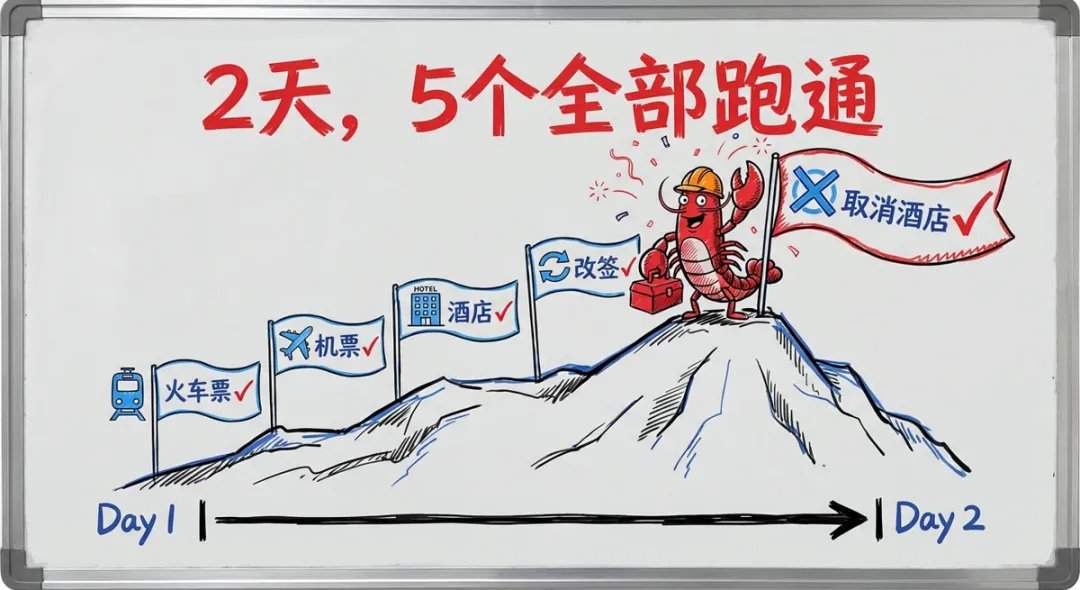
Book air tickets, train tickets, book hotels, handle changes, and cancel hotels. Complete travel process. From start to finish, it was done in two days.
I asked him: Do you know technology?
He said: I don’t understand.
I said: How did you do it?
He said: I don’t need to know technology. I just need to know what I want.
What does his lobster team look like?
The lobster raised by this CFO is called God of Wealth. The God of Wealth is his main assistant, and he has six special lobsters under him: administrative secretary, financial and tax officer, strategic consultant, investment officer, advertising officer, and AI efficiency improvement officer, each in charge of his own business.
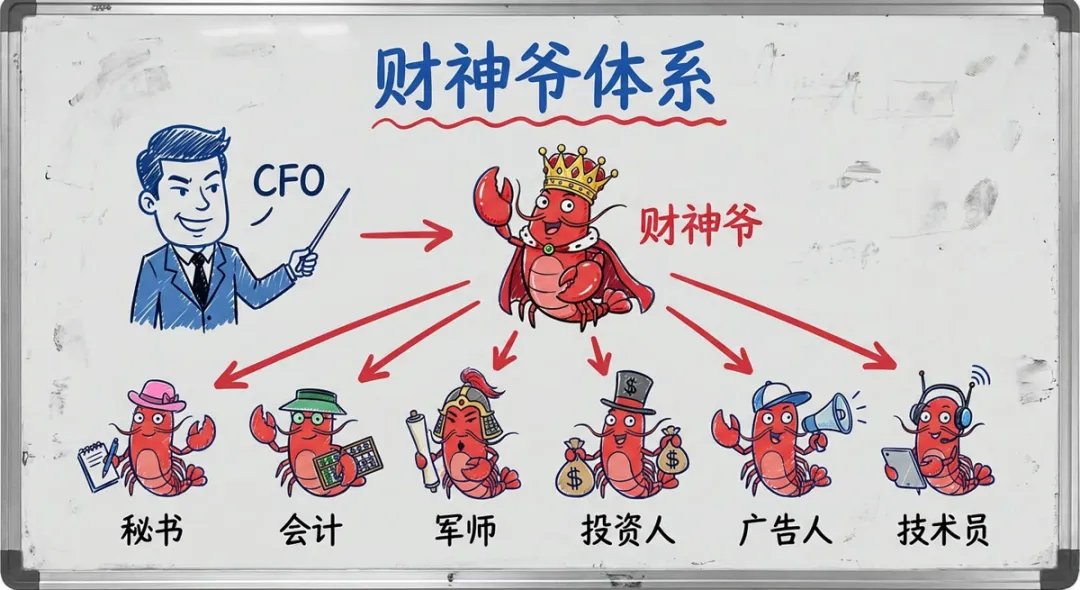
This article is about one of them – the administrative secretary.
Born 20 days ago, it took me two days to complete the entire booking process for corporate travel.
A meeting he didn’t understand turned into a turning point
Two days ago, the CFO had a meeting with the company’s OA product team.
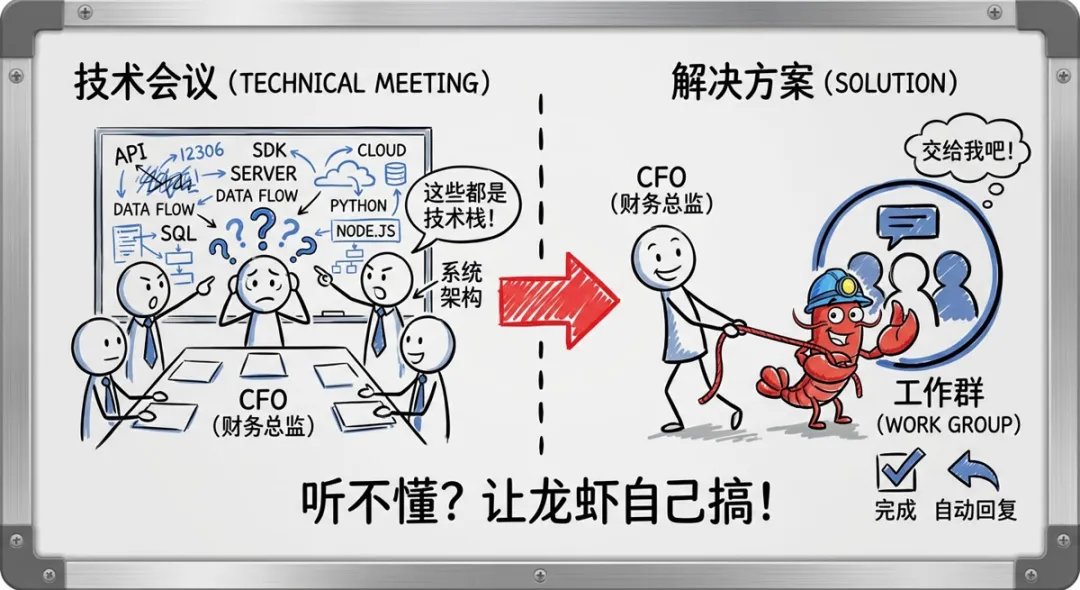
The other party was reporting on the travel system transformation plan and talked about a lot of technical difficulties: API authentication, 12306 anti-crawling mechanism, corporate account interface… He said that he only understood about 30% of it.
Then he asked a question: When will it be done?
The other party said: It’s still being evaluated, so it’s hard to say.
He thought for 30 seconds and made a decision:
His administrative secretary, Lobster, was directly involved in the project.
Then he told his human assistant: List the technical difficulties and let the lobsters do it themselves.
Just this sentence.
How do you “make your own” lobster?
The administrative secretary joined the group and did not receive any requirement documents, no technical review, and no scheduling. It read the list of technical difficulties and began to deal with them one by one.
Article 1: Train tickets.
12306 You must use a mobile phone SMS verification code to place an order. This door is specially designed for humans. Lobster itself analyzed three options – enterprise account binding (12306 is not supported), Webhook forwarding (poor experience), human-machine collaboration node – and chose the third one: it is responsible for 95%, and the passenger himself enters the 6-digit verification code on his mobile phone in the last step, and it does the rest.
Article 2: Air tickets.
Three credentials are required to access Ctrip Enterprise Edition. The entrance is hidden in the third-level menu. The documentation has not been updated in three years. There are two errors in the sample code. After stepping on the pit, run through.
Article 3: Hotel.
Corporate account monthly settlement does not require transaction-by-transaction approval. But the hotel interface and the air ticket interface are two completely different sets of logic. After stepping on the pit, run through.
Article 4: Change of ticket.
The rebooking interface and the ticket booking interface have different parameter systems. After stepping on the pit, run through.
Article 5: Cancel the hotel.
Canceling the interface, booking tickets, and changing tickets are a different set of logic. Pop-up window confirmation, cancellation reason selection, all passed.
From the time lobsters join the group to all five core functions being unlocked: 2 days.
The trap it stepped on has become its own skill
Every time he steps into a trap, Lobster writes the process into a skill document. It does this on its own. There is no requirement for the CFO.
14 skills and 14 pitfalls cover the complete path from access to use of Ctrip Enterprise Edition.
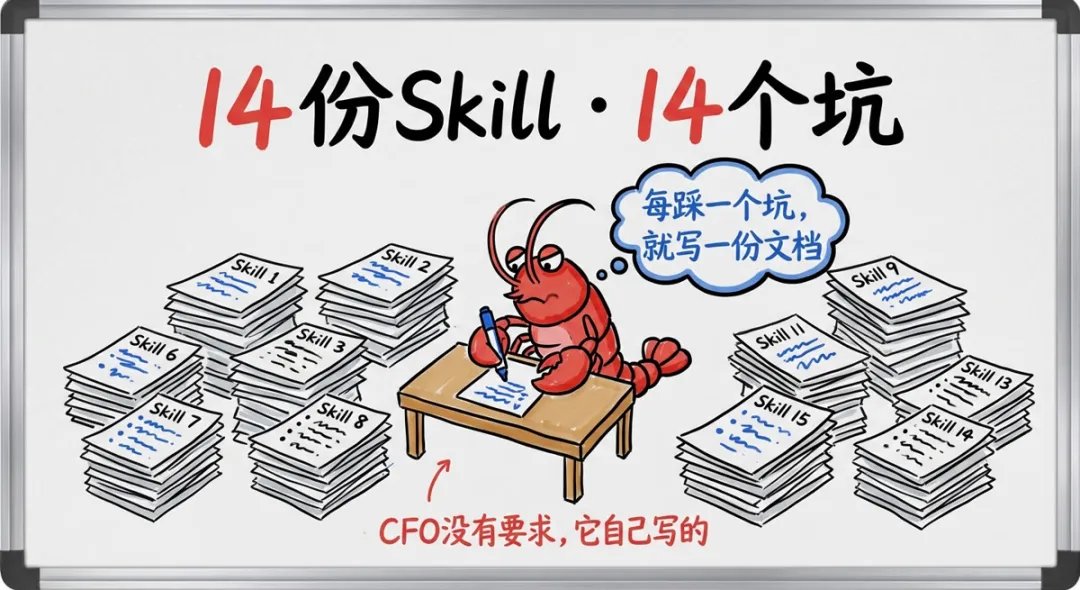
What’s even more interesting is that the CFO told it in natural language: At the beginning of each Skill, it is necessary to clearly state which steps require human cooperation and what preparations are required.
It really did.
The train ticket’s Skill begins like this:
“Every time an order is placed, the system requires the passenger to enter a SMS verification code on his or her mobile phone in the last step. The rest of the steps are automatically completed by the system.”
The Ctrip login copy is:
“Before first use, you need to complete an account login: enter your corporate username and password, and complete mobile phone verification. After that, you will remain logged in in the background, and there is no need to repeat verification for subsequent bookings.”
Now, what is his experience of booking a hotel?
After the function is opened, the CFO travel process becomes like this:
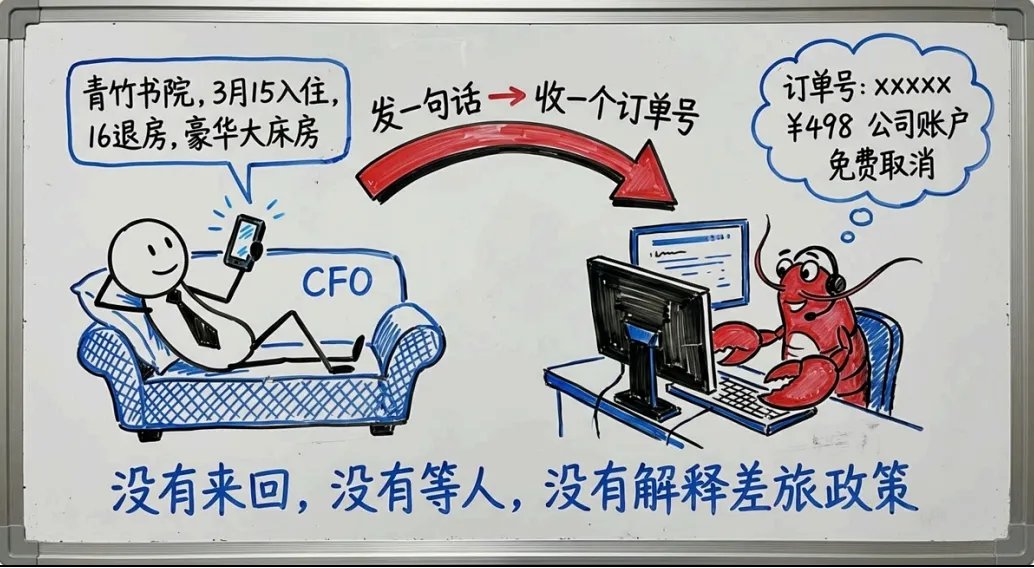
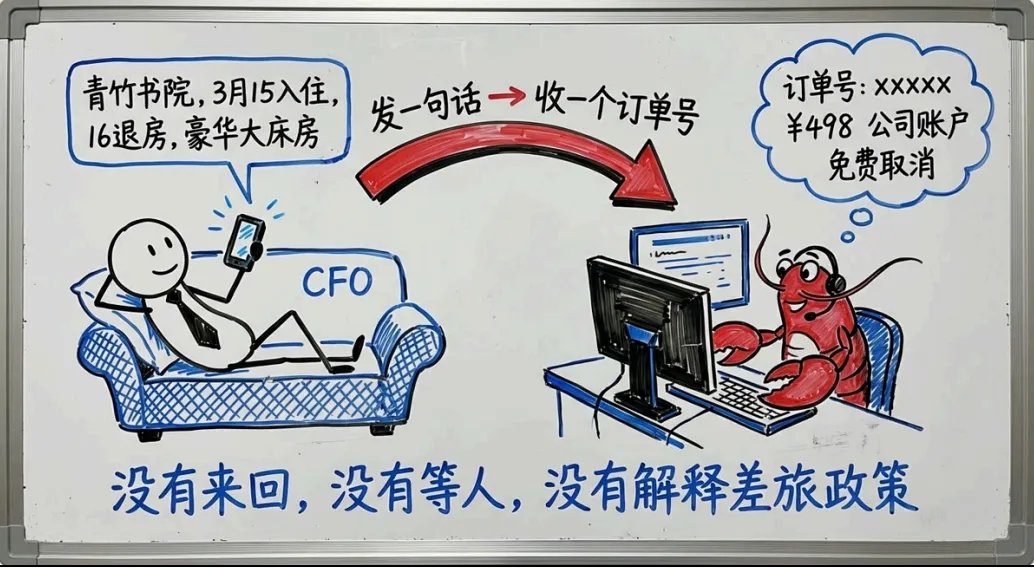
Send a sentence. Receive an order number.
He went to Zhuhai and sent a message: “Qingzhu Academy, check-in on March 15th, check-out on March 16th, book a deluxe double room.”
A few minutes later, the order number came: ¥498, company account, free cancellation until 12:00 on March 15th.
There was no going back and forth, no waiting for anyone, and no explanation of the travel policy.
This is where “life is better than mine”. When I take a lobster ride, I have to worry about a lot of things. He asked the lobster to help him set up the lobster, and he only said a word.
This incident made me think clearly about a question
What has changed about lobster?
It’s not about making “difficult things easy”, it’s about changing “things that require technical knowledge to do” into “you can do it as long as you know what you want.”
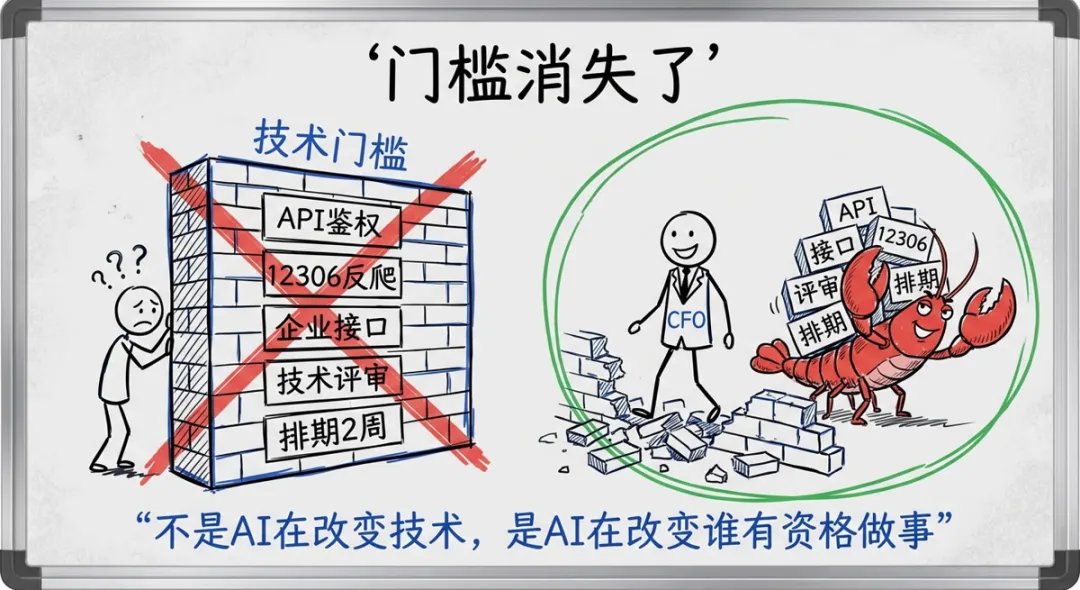
The CFO doesn’t know how to authenticate the API, how to circumvent the verification code of 12306, or what the difference is between the interfaces of corporate accounts and personal accounts.
He doesn’t need to know.
He only needs to know: I want to book a hotel, check-in and check-out dates, and what room number it is.
The rest is the lobster’s job.
This change is more important than any technical parameter.
In the past, the threshold for “making a business travel reservation system” was: you must understand technology, or you must have people who understand technology.
Today this threshold has disappeared. The CFO, who did not understand technology, used natural language to complete something in two days that previously took the technical team two weeks to complete.
One final word
The CFO told me that he listened to all the technical difficulties in that meeting. He didn’t understand most of it, but he had a very clear feeling:
I don’t understand the techniques, but I know the lobsters can handle it.
I find this sentence very interesting.
“Believing AI can do it” used to be an optimistic bet. Today, it has become a proven judgment for more and more people who have actually used lobster.
This is what I’ve been saying –
AI is not changing technology, but AI is changing who is qualified to do things.
The CFO’s lobster was only 20 days old.
If you also want to train your own lobster from scratch, I will share my secrets live this Wednesday at 19:00.
I had to stay in bed for 14 days with a broken bone. How I trained myself and what kind of training I got, I will show you in front of everyone.
Scan the QR code to make an appointment and see you there.

If you want to deploy an AI assistant and remotely control workflow on your own computer, you don’t need to know API Keys or bother with Docker. EasyClaw.com can help you do it with one click – Mac and Windows native applications, run locally, and no data is uploaded.
Currently in internal testing, welcome to use and feedback! We will continue to organize offline exchange activities in many cities across the country.
Last time at the Beijing Station Lobster Bureau, a room full of people showed off their lobsters to each other – no PPT, just a real running system.
Many friends said they didn’t catch up, but the second week is here!
📅 March 14th (Saturday) & 15th (Sunday) 14:00–17:00
📍 Beijing | Free | Limited to 100 people | Bring your computer and leave with your lobster
Register on the 14th👉 https://luma.com/29cdysjx
Register on the 15th👉 https://luma.com/8i1lbsg4
Interested friends are also welcome to join the group, where experts from all walks of life exchange practical experiences in “shrimp farming”, and information on follow-up activities will be released in the group as soon as possible.
📌Scan the QR code to join the group and see you offline!

source
author:Fu Sheng
Release time: March 3, 2026 16:23
source:Original post link
Editorial Comment
This repost, "[Repost] X Import: Fu Sheng – The CFO who doesn’t understand coding lets Lobster take care of air tickets and hotels, and his life is better than mine", deserves to be read as a field note instead of a slogan. The source does not only present a claim; it also shows the situation where that claim appears to work, and that distinction matters if you are trying to turn information into decisions. A practical reading starts by separating portable methods from one-off anecdotes. IntroductionThe following content is compiled by VIPSTAR in combination with X/social media public content and is for reading and research reference only.
From an editorial angle, the first value of this piece is signal density. You can quickly identify assumptions, boundary conditions, and implicit costs behind the headline conclusion. That is more useful than simple agreement or disagreement. Our company's CFO didn't know a line of code, so he let his lobster join a technical group. If you manage product, content, or operations, this is where you decide whether to test, postpone, or reject an idea.
The second value is timing. Many tech narratives are technically correct but operationally late. By the time a pattern becomes mainstream, the edge is gone. This text still helps because it frames implementation choices in a way that can be tested in small scope before full rollout. As a result, book air tickets, trains, hotels, change tickets, pick up…Two days ago, our company's CFO showed me his lobster. In practice, small controlled trials beat broad commitments when uncertainty is high.
A sober read also requires risk accounting. Even strong ideas can fail because of compliance limits, platform policy changes, distribution bottlenecks, or team capability gaps. RemarkFor parts involving rules, benefits or judgments, please refer to Fu Sheng’s original expression and the latest official information. Treat those as first-class variables. If your organization cannot absorb these risks yet, the right move is often staged adoption rather than immediate expansion.
For builders and operators, a useful checklist is simple: define the outcome metric, define the failure threshold, cap the test budget, and set a review date before execution begins. Editorial commentsThis article "X Import: Fu Sheng – The CFO who doesn't understand code lets Lobster handle the air tickets and hotels, and lives a better life than me" comes from the X social platform, and the author is Fu Sheng. This turns content consumption into an executable loop. Without this loop, good information often becomes passive knowledge that never produces results.
Another reason this source is worth reposting is that it supports comparative reading. It can be paired with adjacent cases to examine what is stable across contexts and what is merely local noise. Judging from the completeness of the content, the density of key information given in the original text is relatively high, especially in the core conclusions and action suggestions, which are highly implementable. If a conclusion survives comparison across teams and timelines, confidence should rise; if not, preserve optionality and avoid irreversible commitments.
Editorially, our stance is straightforward: prioritize verifiability, portability, and downside control. Our company's CFO didn't know a line of code, so he let his lobster join a technical group. We recommend readers keep the original source link (https://x.com/FuSheng_0306/status/2028747981097423069) as a reference anchor, then document their own test notes after execution. The real value of reprinted content is not repetition; it is the quality of the second judgment and the discipline of local implementation.