
Editor’s Brief
This article is best used as an operational reference: it surfaces a clear claim, a usable method pattern, and practical constraints that should be tested before scaling.
Key Takeaways
- IntroductionThe following content is compiled by VIPSTAR based on public sources and is for reading and research reference only.focusThe second tutorial promised is here.
- Unexpectedly, there was no update in just a few days, and Moltbot changed its name again.
- I can only say that the pace of the AI era is really fast.
- Faster than changing your name…OpenClaw currently supports mainstream channels including WhatsApp, Telegram, Discord, iMessage, Sl…RemarkFor parts involving rules, benefits or judgments, please refer to the original expression and latest official information of Zhixian|zhixian.The second tutorial promised is here.
Introduction
The following content is compiled by VIPSTAR based on public sources and is for reading and research reference only.
focus
- The second tutorial promised is here. Unexpectedly, there was no update in just a few days, and Moltbot changed its name again. I can only say that the pace of the AI era is really fast. Faster than changing your name…
- OpenClaw currently supports mainstream channels including WhatsApp, Telegram, Discord, iMessage, Sl…
Remark
For parts involving rules, benefits or judgments, please refer to the original expression and latest official information of Zhixian|zhixian.
The second tutorial promised is here. Unexpectedly, there was no update in just a few days, and Moltbot changed its name again. I can only say that the pace of the AI era is really fast. Faster than changing the name was the trend set off by moltbook. Various Agent-oriented products emerged one after another, which was dazzling. My mind was also opened and I saw the prototype of a new era. However, let’s not talk about that in this issue. Let’s fill in the previous pits and share my daily experience and thoughts on using OpenClaw through Telegram and Discord.
Channel choice: WhatsApp, Telegram or Discord?
The mainstream channels currently supported by OpenClaw include WhatsApp, Telegram, Discord, iMessage, Slack, etc. I have actually used WhatsApp, Telegram and Discord.
First of all, if there is no special need, it is recommended to exclude WhatsApp first. Its use costs and hidden dangers are relatively high. This is because the OpenClaw login method is not an officially allowed way. Essentially, OpenClaw is used as a web client to scan the QR code to log in, which is a bit of a hack. Moreover, this will cause the connection to be unstable and often disconnected. In addition, this method will most likely require a separate mobile phone number to register. After all, you cannot log in with your current WhatsApp account, otherwise how would you interact with it 😂. Therefore, if you are not particularly dependent on it, I suggest you give up this channel.
Then there are the two brothers Telegram and Discord. The difference in their tones is obvious: Telegram prefers peer-to-peer DM chat; Discord is server-centric and contains a large number of channels and degrees of freedom. This feature can give OpenClaw more room to play. In my configuration, Telegram is mainly responsible for “short and fast” direct chat, while Discord is mainly used to handle complex and systematic tasks, as well as tasks that can be advanced in parallel.
Understanding Main Session: How your AI assistant recognizes the owner
However, before I start talking about my own Setup, I need to talk about the Main Session concept of OpenClaw.
Main Session is the Session that OpenClaw thinks is talking directly to the owner (Owner). For example, Telegram, WhatsApp, Discord Bot’s DM, and iMessage. In this scenario where you have a direct one-to-one chat with the Bot, it seems to it that you are talking directly to the Owner. One benefit is that the main memory file MEMORY.md can be loaded by default, because this file stores context information with privacy attributes. It will not be loaded in other sessions. For example, when chatting in a group, other people can guess the type of anime that the owner likes to watch just by asking. This is not good, haha.
Another benefit is that these Sessions are open by default. That is to say, if you say 1, 2, and 3 in iMessage, Discord, and Telegram respectively, in the eyes of the Agent, it is actually saying 1, 2, and 3 in the same chat, there is no difference.
But this also brings a possible problem: if you share the Bot with family and friends (for example, if you open Telegram access), the Agent will not be able to distinguish between messages sent by you and messages sent by family members. They will all be counted in the same context, which will cause confusion.
There is a configuration that can solve this problem, which is session.dmScope. Configuring its value to “per-channel-peer” can achieve isolation of different Channels and different users of the same Channel. In this way, whether it is between your own Discord, Telegram, or between you and your family’s Telegram, it will become an independent session on the agent without interfering with each other.
Then you may be thinking, can I be separated from my family without affecting the communication between my own DMs? This is also possible. Because there is another configuration called session.identityLinks, where you can link your own different DM Sessions into the same one, you can achieve the state of “external separation and internal interoperability”.
For the configurations just mentioned, you do not need to manually change the configuration files because they are easy to change. It’s best to give your OpenClaw Bot the command directly and let it configure it.
For more related configuration, please refer to this section of the official documentation.
Discord Message Rating: The Charm of Thread💬
Discord also has a particularly good information classification capability, which I think is borrowed from Slack, and that is Thread. You can Create Thread for any message and continue the discussion of related topics below this message. For example, there is a Channel called “What to Eat for Lunch”, where everyone discusses what they want to eat every day. If Xiaoshuai says “I want to eat fish” today, everyone will reply one by one below. Some people will continue to discuss fish-related topics such as “Grilled fish or stewed fish?”, and some people will start a new topic and say “I want to eat beef.” This is actually the current situation of WeChat groups (of course it is better with the Quote function). Although communication is possible, it can easily make the entire communication confusing.
What if it is Thread mode? If you want to continue the discussion on the topic of eating fish, just create a Thread under Xiaoshuai’s message. At this time, a new chat space will be opened, and everyone can continue chatting along the topic of “What kind of fish to eat?” Outside of the thread, there is still the main chat where everyone proposes what to eat for lunch today. For example, people who eat beef have already started to book a table in the thread. It is not difficult to find that this is a better communication structure, with clear themes and controllable details.
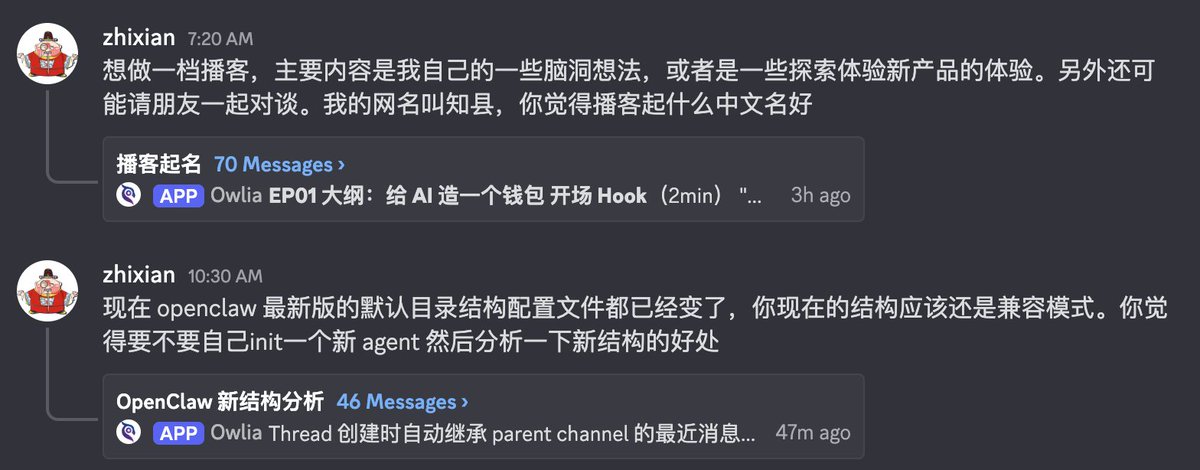
After introducing the Thread chat mode, we can explain the entire architecture clearly: each Channel in Discord Server is an independent Session, which is easy to understand; except for Channel, in fact, each Thread and Channel are actually the same, and are an independent Session. However, the latest version (2026.2.1) at the time of writing has updated a feature: Discord: inherit thread parent bindings for routing. Simply put, when Thread is created, the agent will automatically inherit the recent messages of the parent channel as the context, so that the agent can also know the “previous summary” in the thread. By making good use of the Thread function, the information organization in your Discord will be greatly improved, and the problem of session explosion will be less likely to occur.
My Discord workflow: Doomsday cabin in action
Next, I show you how I use Discord. My usage is to create a dedicated Server. Friends who have read my previous articles may know that I have an AI workflow Server called “Doomsday House”. Now I have opened a special Section here to host the entire process of my work with Owlia 🦉 (my OpenClaw agent).
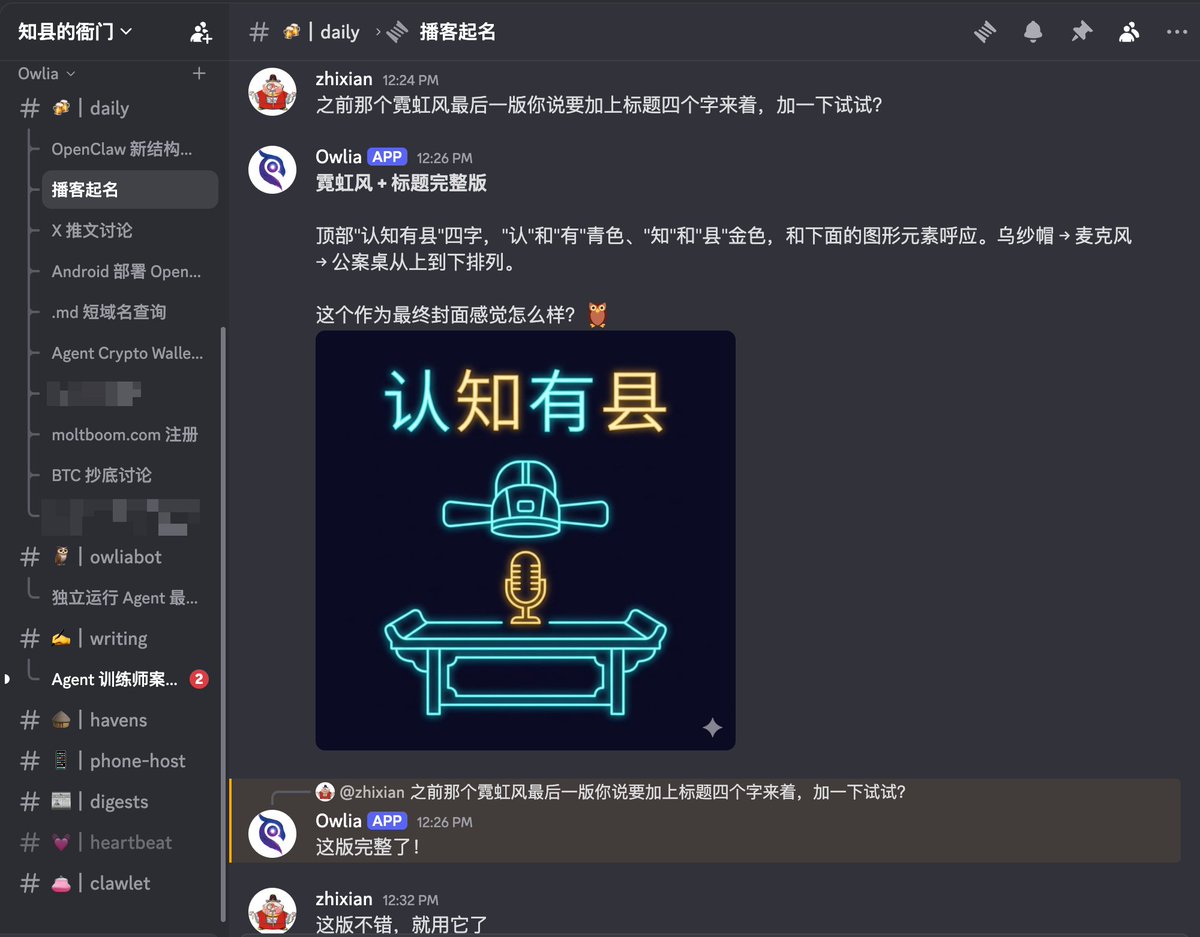
You can take a look at the screenshots. I basically divided them into categories:
One type is called “daily”, which is equivalent to chatting in the brainstorming stage. You can see a large list of Threads that are still in the open state below. The previous screenshot is the content form in this channel; the other type is content that has been independent and continues to be promoted as a project, such as owliabot and writing below; and the other type is daily push, such as digest and . .
In the daily chat channel, I will give the Agent an instruction: as long as I say something in it, your reply must first create a Thread (thread), and then continue in the Thread. This is still a soft constraint at the moment, but it works very well and can basically be followed.
The advantage of this is that things in the Daily channel are relatively complicated. When you suddenly think of something and want to continue the discussion – such as “I want to buy BTC at the bottom recently, what should I do?” – after sending this message, the Agent will analyze the current situation, ask your preferences and current positions, and then you can continue the chat.
When something becomes relatively large and you think it can become a long-term project, or even allow Agent to actively promote it, make it an independent Channel. You can tell the Agent in the new channel that this is a continuation of a previous Thread, and let it compress the original Session here, so that the conversation can be connected. The next step will be easier, because in this channel, you can still use Thread to conduct multi-dimensional discussions and folding.
The benefit of this way of working is that I can switch between different transactions very quickly. By default, OpenClaw can reply to messages in 4 different Sessions at the same time, and this quota can be changed, but 4 is enough for me. I rarely have 4 channels in the reply state at the same time (I still need to practice). At this time, you will find yourself like “Doctor Octopus”, waving four big claws to operate the work of four threads, and feel particularly accomplished.
In addition to channels for advancing tasks, you can also create channels for some daily scheduled tasks. In this way, the previous work in the main session can be split into different directions. For example, I have a dedicated Channel called digest, which runs regularly several times a day to summarize and send the content on X and the blog. Another example is heartbeat. I need an observation window to understand the time and content of its triggering, so I built a heartbeat Channel to direct all output here. You can configure it based on the specific needs of your daily work and life.
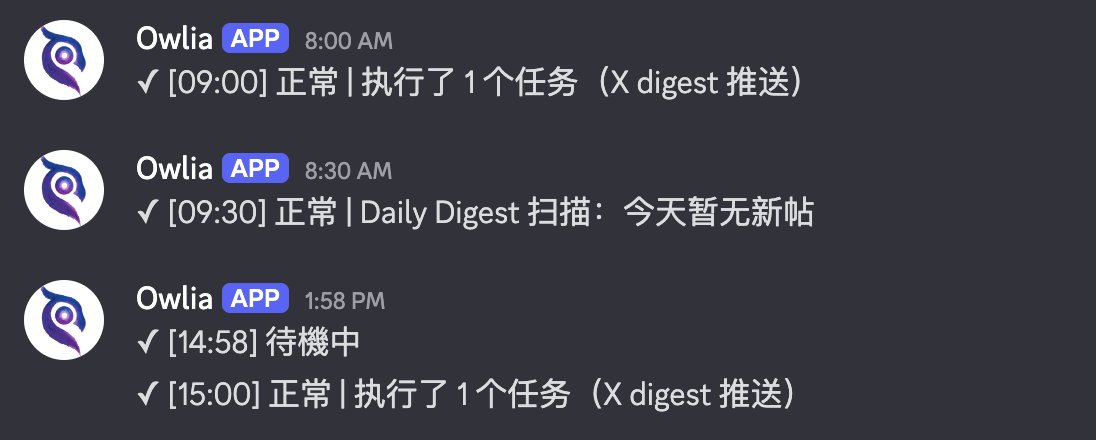
Once configured, the capabilities of the entire “Doomsday Cabin” will become very powerful. Not only does it have automated processes, but it also houses a very powerful intelligent agent that can help you do things, look up information, and chat. These sessions are isolated from each other, and you can also specify a session to read the content of another session to quickly synchronize the context. This experience is well suited to the needs of advancing complex matters.
In theory, Slack can do it, but now I think I may not even use Slack in the future, because the experience of Discord is so good.
Discord advanced gameplay: Reaction, multi-Agent and model distribution
Discord also has some advanced ways to play:
Reaction. You can specify that different Reactions represent different functions, and let your Agent do the corresponding things according to your operations. For example, to collect: you can click a red heart♥️, and it will automatically forward the message to a certain channel for collection.
Agent. Each Channel or even Thread can be configured as a separate agent and can have its own various settings. In this way, if you need multiple agents to cooperate, you do not have to create multiple independent agent bots and bring in a bunch of robots. Instead, create a pm bot in #product and an engineer bot in #dev. You can even configure different models for them according to different task attributes. In this way, opus may be needed for product work to do in-depth design. In many cases, sonnet is already good enough for development work (of course complex logic may need to be matched) codex haha).
A similar attempt at Telegram (and why I gave up)
Finally, I will add some similar usages of Telegram. One is to open a Group and divide it into Topics. This is actually a function that Telegram has made under the pressure of Discord, but the experience has always been poor. In addition, Thread can also be turned on in the DM of Bot (actually the same mechanism as Topic), and the update on January 24 (then called Clawdbot) added support: when you set up Thread mode for Bot on BotFather (note that it must be in This switch can only be found in BotFather’s Mini App), and your DM with it will become like a Telegram Group with a Topic, except that the Topic is called Thread in the DM. My experience with it was very poor, so I won’t go into details here.
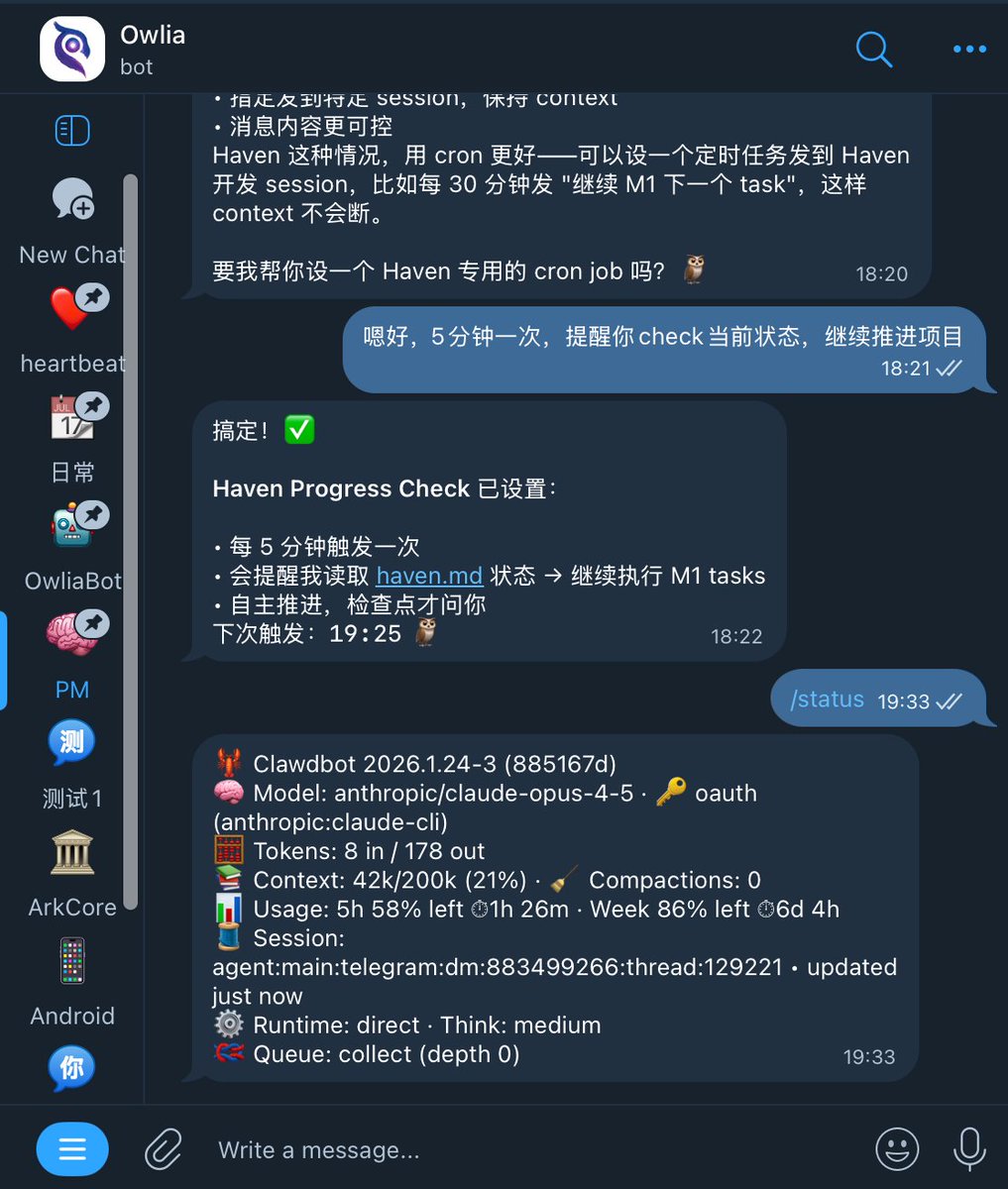
The era of natural language programming
Finally, I would like to express my thoughts. I used to implement the Reaction automation function in my “Doomsday House” by writing programs (of course also written by AI). With Agent, these things can be “compiled” into the process using natural language. This is also the biggest difference between the Agent era and the original era in my opinion: people have really realized programming in natural language, but the method is not to translate natural language into program code, but to have an Agent who can understand human speech and is proficient in programming or calling interfaces as the bridge.
This change in paradigm is similar to the change in AI paradigm back then. After all, no one expected that Transformer, the core architecture of modern large language models, would actually come from the path of machine translation.
So, Telegram or Discord?
Telegram is light and suitable for asking questions anytime and anywhere; Discord is heavy but has strong organizational skills and is suitable for long-term projects. So if you just want an AI assistant that you can chat with at any time, Telegram is enough. But if you want Agent to really help you with work, project promotion, and automation, Discord’s Server + Channel + Thread three-tier structure will make you feel like “finally you have a decent workbench.” My current usage is to open both sides, with Telegram as the mobile portal and Discord as the main battlefield.
OK, this article is here first. The next article may be about scheduled tasks and multi-agent collaboration, or see if there are any topics in the comment area that everyone wants to hear!
“Agent Trainer” series of articles:
- Agent Trainer Getting Started Guide: Clawdbot Configuration and Pitfalls
- Agent Trainer Safety Course: Clawdbot Seven-Step Self-Check Guide
- Agent trainer case sharing: Use Clawdbot to create exclusive writing workflow
- Agent Trainer Advanced Guide: Use Discord to create an efficient OpenClaw collaboration system
- Agent Trainer Advanced Course: OpenClaw Multi-Agent Configuration Practice
English versions are on zhixian.io
source
author:County magistrate|zhixian
Release time: February 3, 2026 15:59
source:Original post link
Editorial Comment
This repost, "[Repost] X Import: Magistrate | zhixian – Agent Trainer Advanced Guide: Use Discord to create an efficient OpenClaw collaboration system", deserves to be read as a field note instead of a slogan. The source does not only present a claim; it also shows the situation where that claim appears to work, and that distinction matters if you are trying to turn information into decisions. A practical reading starts by separating portable methods from one-off anecdotes. IntroductionThe following content is compiled by VIPSTAR based on public sources and is for reading and research reference only.focusThe second tutorial promised is here.
From an editorial angle, the first value of this piece is signal density. You can quickly identify assumptions, boundary conditions, and implicit costs behind the headline conclusion. That is more useful than simple agreement or disagreement. Unexpectedly, there was no update in just a few days, and Moltbot changed its name again. If you manage product, content, or operations, this is where you decide whether to test, postpone, or reject an idea.
The second value is timing. Many tech narratives are technically correct but operationally late. By the time a pattern becomes mainstream, the edge is gone. This text still helps because it frames implementation choices in a way that can be tested in small scope before full rollout. I can only say that the pace of the AI era is really fast. In practice, small controlled trials beat broad commitments when uncertainty is high.
A sober read also requires risk accounting. Even strong ideas can fail because of compliance limits, platform policy changes, distribution bottlenecks, or team capability gaps. Faster than changing your name…OpenClaw currently supports mainstream channels including WhatsApp, Telegram, Discord, iMessage, Sl…RemarkFor parts involving rules, benefits or judgments, please refer to the original expression and latest official information of Zhixian|zhixian.The second tutorial promised is here. Treat those as first-class variables. If your organization cannot absorb these risks yet, the right move is often staged adoption rather than immediate expansion.
For builders and operators, a useful checklist is simple: define the outcome metric, define the failure threshold, cap the test budget, and set a review date before execution begins. Unexpectedly, there was no update in just a few days, and Moltbot changed its name again. This turns content consumption into an executable loop. Without this loop, good information often becomes passive knowledge that never produces results.
Another reason this source is worth reposting is that it supports comparative reading. It can be paired with adjacent cases to examine what is stable across contexts and what is merely local noise. I can only say that the pace of the AI era is really fast. If a conclusion survives comparison across teams and timelines, confidence should rise; if not, preserve optionality and avoid irreversible commitments.
Editorially, our stance is straightforward: prioritize verifiability, portability, and downside control. Faster than changing the name was the trend set off by moltbook. We recommend readers keep the original source link (https://x.com/zhixianio/status/2018595121084994002) as a reference anchor, then document their own test notes after execution. The real value of reprinted content is not repetition; it is the quality of the second judgment and the discipline of local implementation.