

Editor’s Brief
Xiaomi has successfully ported the "OpenClaw" agent logic to the mobile environment with the introduction of "miclaw." By integrating this agent directly into the smartphone and the Mi Home (Mijia) ecosystem via the Model Context Protocol (MCP), Xiaomi has moved AI beyond the screen. This allows the agent to perceive environmental data and control physical hardware—such as air conditioners, curtains, and security cameras—through natural language commands rather than rigid automation scripts.
Key Takeaways
- Mobile Adaptation of OpenClaw:** Xiaomi miclaw simplifies the high technical barrier of desktop agents, allowing users to orchestrate complex IoT tasks using conversational English/Chinese.
- Deep IoT Integration:** The agent utilizes the Model Context Protocol (MCP) to access real-time data from over a billion Xiaomi ecosystem devices, turning sensors into the AI’s "eyes" and appliances into its "hands."
- Dynamic Skill Creation:** Users can create and edit "Skills" (e.g., a "Morning DJ" or "Leaving Home" mode) on the fly, which the agent stores and executes based on specific triggers or environmental changes.
- System-Level Control:** Beyond home hardware, miclaw can interact with system apps like Notes, Calendar, and Recorder to automate workflows like generating meeting minutes and scheduling follow-ups.
Introduction
Xiaomi’s Xiaomi Miclaw brings the previously PC‑only OpenClaw to mobile devices, becoming China’s first “lobster‑style” intelligent agent for smartphones. It is deeply integrated with the Mi Home ecosystem, allowing users to invoke Skills and the MCP protocol through natural‑language interaction. This gives the AI real‑world perception and intervention capabilities, marking a pivotal step as agents move from virtual information processing to physical‑world coordination.
Key Takeaways
- Xiaomi Miclaw lowers the technical barrier of OpenClaw, letting users orchestrate complex Mi Home device workflows with simple spoken commands.
- Leveraging the MCP protocol and Mi Home authorization, the agent can fetch real‑time environmental data—such as temperature and humidity—and autonomously control hardware like air conditioners and humidifiers.
- Unlike rigid automation scripts, Miclaw supports dynamic editing of scheduled tasks and can pair with Xiaomi wearables to deliver more human‑centric proactive services.
Notes
Compared with humanoid robots, the fusion of smart home and mobile phone is the “fast lane” for agents to reach reality. With its vast IoT ecosystem, Xiaomi has led the way in taking AI off the screen. Although still in beta, this “Jarvis‑style” interaction demonstrates the potential for general artificial intelligence to close the loop in everyday life scenarios.
Editorial Comment
Recently in the AI community, Agents like OpenClaw (Crayfish)—which can operate computers like a human and execute complex tasks—have certainly been trending for a while. But frankly, for most average users, the barrier to entry is too high, making them
Device. When your smartwatch tells
When OpenClaw first went viral, I realized that this kind of scheduled‑task and companion product would be perfect for mobile phones.
I also mentioned in a recent article that the Agent’s contact with the real world should happen soon.
It isn’t limited to the still‑distant humanoid robots; today’s electric vehicles provide a better channel.
I just didn’t expect that day would arrive so quickly.
Xiaomi has released Xiaomi miclaw, which you can
Mi Home devices and your phone can almost gather all of your information, automatically handling tasks in any scenario—Xiaomi’s version of “Jarvis.”
I’ve spent the last few days studying three fairly complex cases, so let me give you a preview of what the future of Agent‑controlled real‑world interactions might look like.
Case 1: Smart Morning Butler
Many people use a “lobster” (a playful nickname for a smart speaker) to get their morning briefing, but that information is only visible when you open your computer or phone. It can help you get work done, but it doesn’t really improve your daily life or set the right mood.
I’ve always wanted my Xiao Ai speaker to wake me up in the morning, and while doing so, play a radio‑DJ‑style rundown of the news and music that matters to me. With the new Xiaomi Miclaw, that’s finally possible.
All you have to do is say a phrase, and every morning Xiao Ai will announce:
- The day’s weather
- Yesterday’s tech news
- The home’s temperature and humidity
- Adjust the humidifier if needed
- Play a song that matches the current season and weather
Let’s see how it’s set up.
Xiaomi Miclaw can retrieve the status of all your Mi Home devices. Just grant it access in the settings. I’ve authorized it to read my temperature‑humidity sensor.
Besides broadcasting the data, if the temperature or humidity goes beyond normal ranges, it will automatically turn on the humidifier or air conditioner.
Figure 2
Then it also supports search tools like OpenClaw and MCP. It even has that functionality built‑in, so it immediately knows my current location. I asked it to look up the current weather and yesterday’s tech news, and it organized the results for me.
It can not only report the status of your Mi Home devices at home, but also control them. Xiao Ai has now become a radio DJ and an alarm clock.
At first I didn’t add any music playback, but later I found that editing is still possible—just tell the system which scheduled task to edit.
Any scheduled tasks you’ve already added will appear on the “Scheduled Tasks” page in the upper‑left corner, and they’ll run automatically when the time comes.
This is what Only Xiaomi Can Do.
If you have smart curtains, you can have them open automatically when the weather is announced, letting sunlight in and naturally waking you up.
If you have a smart coffee machine, you can have it brew coffee automatically when you get out of bed, so you can sip hot coffee
It might be integrated with Xiaomi Auto.
You say “Getting ready to go out,” the garage door opens automatically, the car starts preheating in advance, seat heating turns on, and the navigation automatically plans the route—this is just too cool.
In the past, a temperature and humidity sensor just told you the temperature; now, it is an AI sensor for perceiving the environment.
The more devices there are, the smarter the AI becomes; the smarter the AI, the more valuable the devices become.
Case 2: Smart Away Mode
Since we were kids, we’ve been taught to check if the appliances are turned off every time before leaving the house.
Bedroom lights, TV, air humidifier, air conditioner socket, monitor light bar.
But checking and turning them off one by one is a real hassle.
Of course, Mi Home can set up automations now, but it’s quite tedious—I’d rather do it myself than set it up manually.
Plus, I’m not used to being watched by cameras every day; I only want to start monitoring when I’m not at home.
“`html
to interact.
Then I didn’t see anything like “Skills” in the settings, and I wondered how this would be implemented.
But with a skeptical attitude, I said to Xiaomi miclaw:
"Create a Skill called ‘Leaving Home,’
I’ve learned that too.
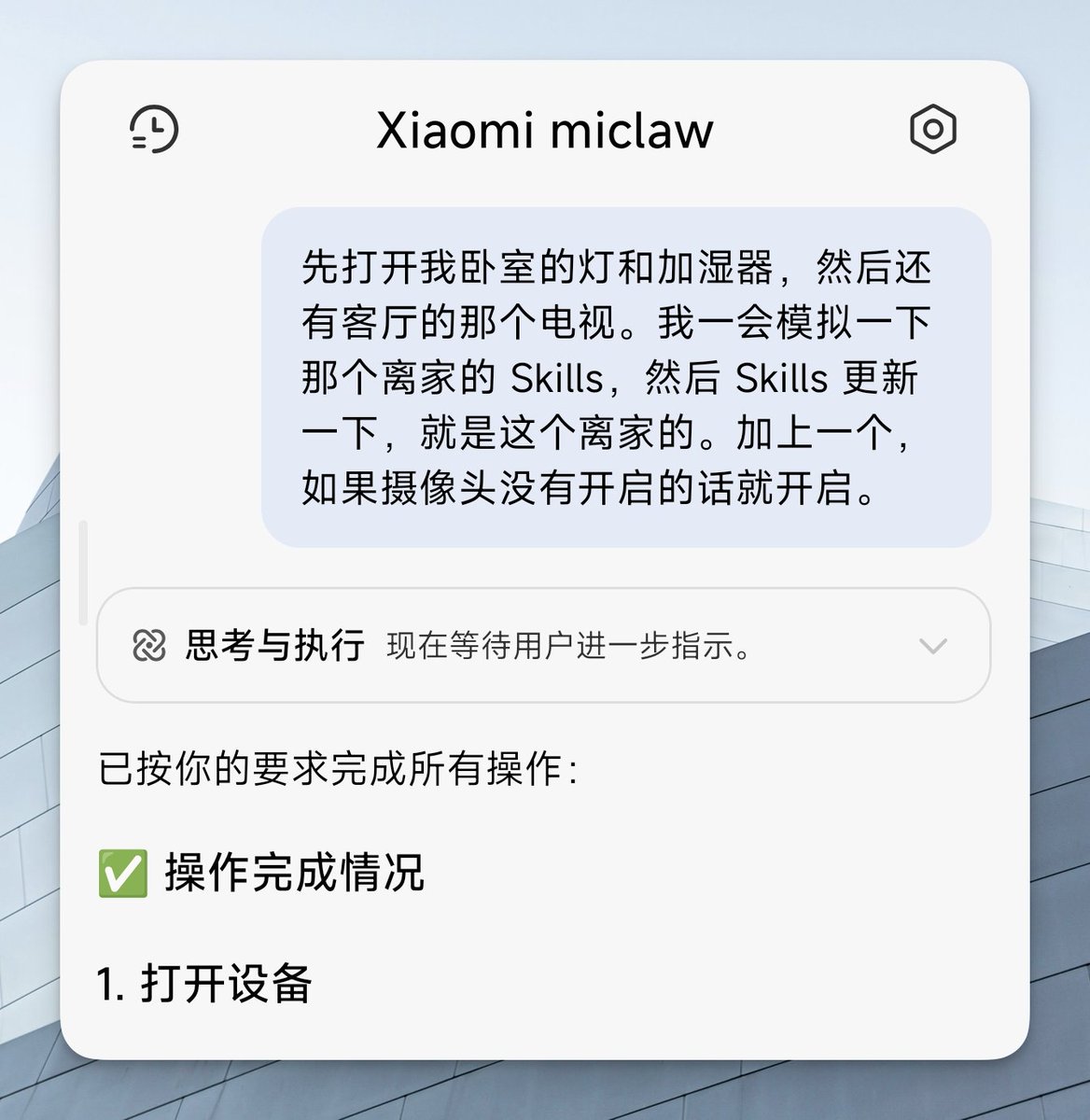
Note: This isn’t a simple command like “turn off all devices.”
Xiaomi miclaw is making intelligent decisions: checking device status and only turning off devices that are currently on, avoiding redundant operations.
The most impressive part of this Skills system is:
You can create any automation scenario using natural language.
If you have a smart door lock, you can add “check door lock status, and automatically lock if it’s unlocked.”
If you have a robot vacuum, you can have it start cleaning automatically after you leave and finish just before you get home.
If you have pets, you can have the smart feeder dispense food at scheduled times after you leave, and use the camera to check on your pets in real-time.
Furthermore, these Skills don’t require coding or complex visual configurations; you just need to tell the AI what you want in a single sentence, and it can create it for you.
This hardware is no longer just smart home devices, but the nerve endings of AI.
Xiaomi’s 1 billion devices are becoming the tentacles for AI to interact with the physical world.
Case Study
3: Smart Meeting Assistant
Xiaomi Miclaw can also control most of your phone’s system apps, such as Notes, Calendar, and more.
AI‑powered recording devices and software have become a huge category of AI products.
I decided to test whether Xiaomi Miclaw could handle a similar use case.
I asked Xiaomi Miclaw to create a “Recording Meeting Assistant” skill for me. The workflow is straightforward:
- Before the meeting starts, say “Test recording skills.”
- Xiaomi Miclaw automatically begins recording (silently in the background, without opening a recording interface).
- I conduct the meeting normally.I actually ran a test once. The recording captured the following:
“I’m going to test the recording skills, and then… We have five tasks to tackle today. By 9 p.m. tonight we need to finish the smart meeting‑assistant test. Tomorrow morning we’ll complete the smart information‑collection test, and in the afternoon we’ll organize all the case materials. The day after tomorrow…”
The meeting minutes produced by Xiaomi’s miclaw include an overview (meeting topic, participants, key conclusions, and critical decisions) as well as a detailed transcript.
It also accurately added calendar entries for the times I mentioned, which
ot;结束”,AI 自动完成录音、转录、整理、添加日程。
你的时间完全解放出来,专注在真正重要的事情上。
这个任务手机变成了 AI 的眼睛和手。系统级整合让 AI 真正融入你的生活。
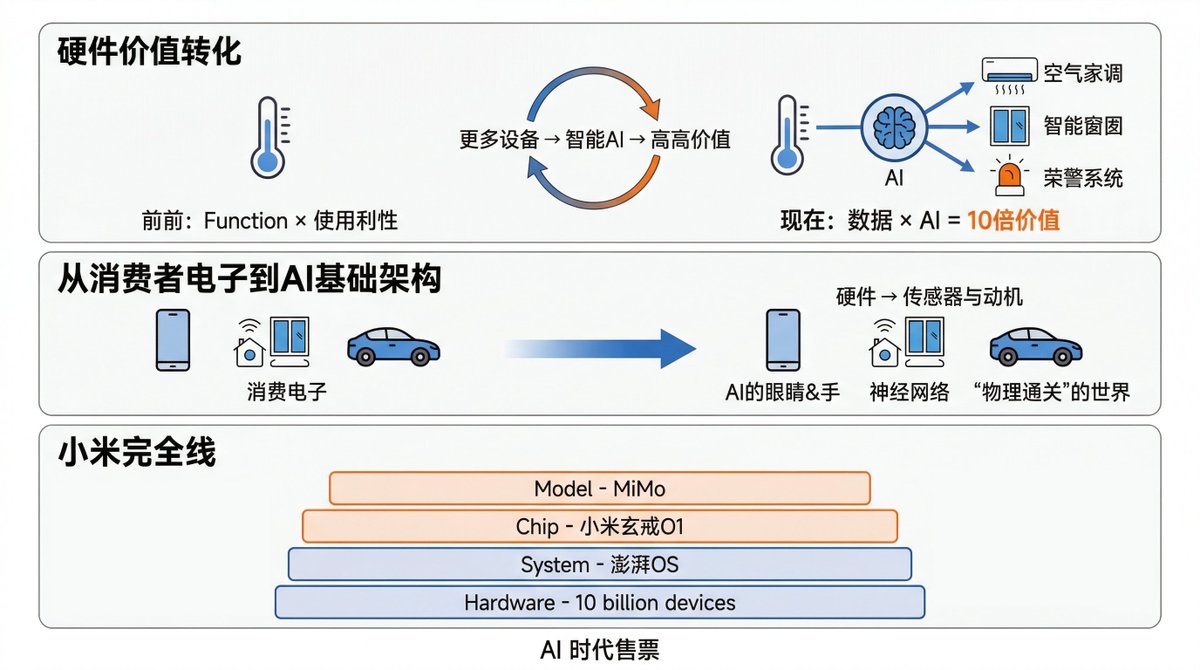
以前硬件的价值是功能乘以易用性,温湿度计的价值就是能测温湿度、显示清晰。
现在硬件的价值是数据乘以 AI 的利用能力。
同一个温湿度计,在 AI 手里价值放大了 10 倍:
根据温湿度调整空调、判断是否开窗、预测你的作息习惯、甚至判断火灾风险。
设备越多,AI 越聪明;AI 越聪明,设备越有价值。这是正向循环,也是小米的护城河。
小米以前是卖手机、卖家电的公司。
但现在这些硬件的角色变了。
手机变成了 AI 的"眼睛和手",能看、能听、能操作。
米家设备变成了 AI 的"神经末梢",分布在你家里的每个角落,感知环境、执行指令。
未来小米汽车会是 AI 进入物理世界的载体,能移动、能运输、能到达任何地方。
卖硬件的逻辑变成了搭建 AI 基础设施的逻辑。
小米在转型。不只是补齐线上 AI 的短板(模型、算法、软件),更重要的是在线下 AI 建立优势。
因为 AI 要接触物理世界,必须通过硬件。而硬件恰好是小米的强项。
OpenAI、Anthropic 做不了这件事,他们没有硬件。
这可能是小米在 AI 时代最大的机会。
小米自研了 MiMo 模型。
加上硬件和系统,小米现在掌握了完整的技术栈:模型、芯片、系统、硬件。
因为 AI 时代,如果你只有硬件,别人的 AI 会把你的硬件变成"被控制的对象"。
你失去了用户关系,变成了管道。
如果你只有模型,没有硬件,你的 AI 只能活在屏幕里,接触不到物理世界。
只有模型 + 硬件 + 系统都有,才能建立完整的护城河。
正文配图 10 Xiaomi miclaw 毕竟目前还在小规模封闭内测阶段,所以会有些产品不稳定,功能不完善的问题。
目前暂不推荐普通用户用主力机申请内测。这是探索性产品,适合尝
鲜,不适合作为主力工具。
我测试过程中也遇到过一些小Bug,不过反馈之后小米很快都解决了。
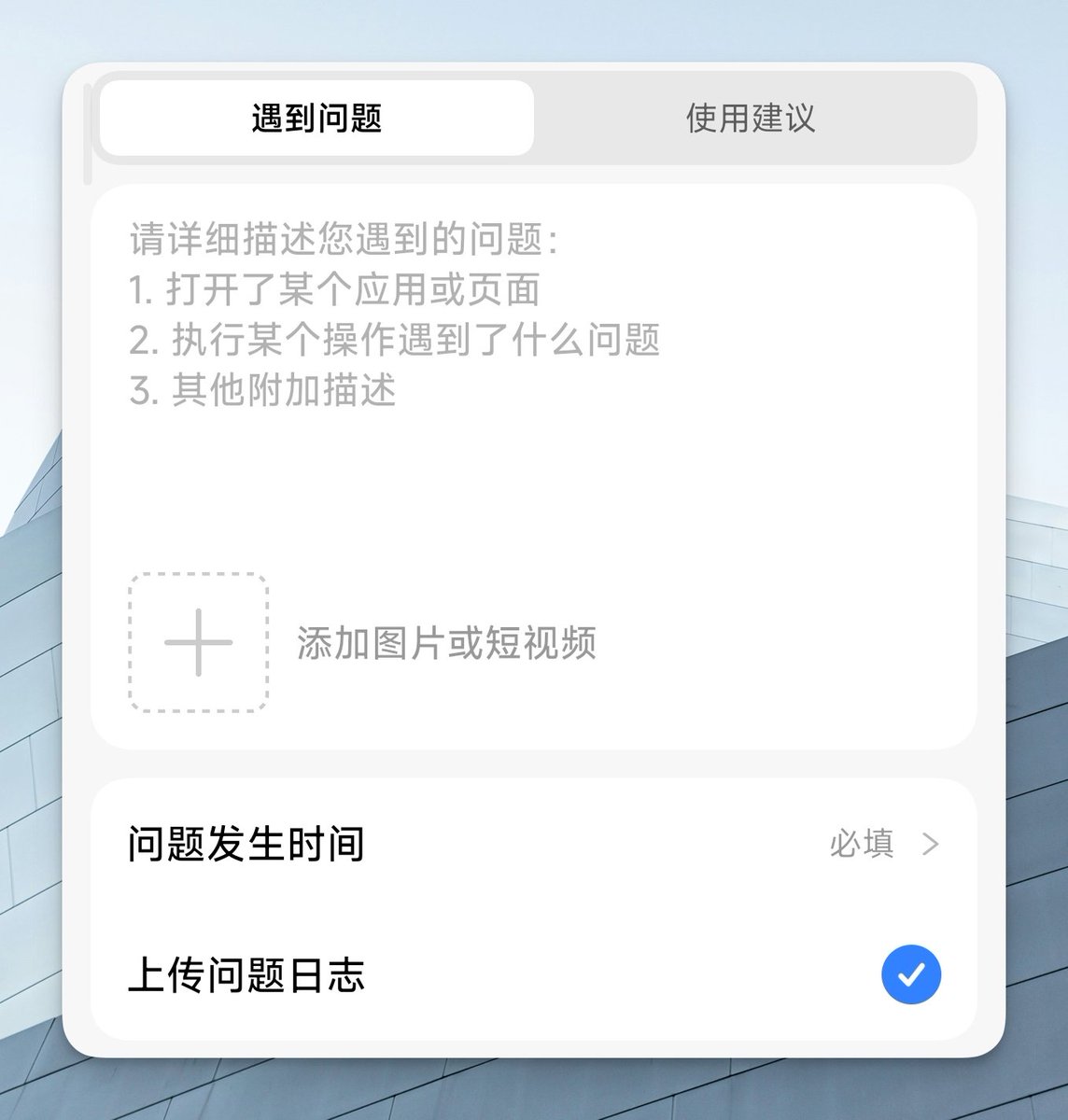
如果你也在使用中遇到问题,可以点击 Ximi miclaw 设置里面的问题反馈,将问题描述清楚、添加图片/视频,再勾选日志提交就行。
正文配图 11 这就是今天的内容,如果觉得有帮助的话可以帮我点个赞或者转发给对 Xiaomi miclaw 感兴趣的朋友。
Source
Author: Guizang (guizang.ai)
Published: March 9, 2026 18:21
Source: Original post link
Editorial Comment
For the past year, the tech industry has been obsessed with "Agents"—AI entities that can actually *do* things rather than just talk. We’ve seen impressive demos of agents navigating desktop interfaces or writing code, but for the average person, these have mostly remained geeky curiosities tethered to a PC. Xiaomi’s introduction of "miclaw" (a mobile evolution of the OpenClaw framework) changes the conversation because it moves the agent from the digital workspace into the living room.
The real kicker here isn't just that an AI can now turn off your lights. We’ve had "smart" homes for a decade. The breakthrough is the shift from rigid, "if-this-then-that" automation to intent-based interaction. Anyone who has tried to set up a complex smart home routine knows the frustration of menu-diving through apps to link a motion sensor to a lamp. With miclaw, you simply tell the phone, "When I wake up, give me a news briefing and make sure the house feels comfortable." The agent then looks at the thermometer, checks the humidity, pulls the morning headlines, and decides—on its own—whether to start the humidifier or open the curtains.
This is where Xiaomi’s "Only Xiaomi Can Do" advantage becomes obvious. While companies like OpenAI or Anthropic have the most powerful brains, they lack the nervous system. They don't have a proprietary fleet of millions of sensors, air purifiers, and rice cookers. Xiaomi does. By using the Model Context Protocol (MCP), they’ve essentially given their AI a map of the user’s physical reality. When the agent "hallucinates" in a chat window, it’s a minor annoyance; if an agent has the power to control your home, the stakes are much higher. This deep integration suggests Xiaomi is betting that the future of AI isn't a standalone app, but a system-level layer that manages your physical environment.
I’m particularly interested in the "Skills" aspect mentioned in the early tests. The ability for a user to say, "Create a 'Leaving Home' skill that checks my door lock and turns on the security cameras," and have the AI write that logic into its own memory, is a massive leap. It effectively turns every user into a programmer without them ever seeing a line of code. It also hints at a "post-app" future. If I can tell my agent to record a meeting, summarize it, and put the action items in my calendar, I no longer need to open three different apps. The smartphone becomes a unified interface for my life, not just a grid of icons.
However, we need to be realistic. This is still in closed beta, and for good reason. Entrusting an AI with physical hardware carries inherent risks. What happens if the agent misinterprets a command and cranks the heater to 90 degrees while you’re asleep? Or more importantly, what happens to the massive amount of personal data required to make this "Jarvis-like" experience work? Xiaomi is collecting everything from your sleep patterns to your indoor humidity levels to fuel this agent.
For now, miclaw is a glimpse into a very near future where the "smart home" finally earns its name. It’s no longer about remote-controlling your house from your phone; it’s about the house—and the phone—understanding what you need before you even ask. If Xiaomi can navigate the privacy minefield and ensure the reliability of these physical actions, they might just have the first "killer app" of the agentic AI era.